Gardening tips
Fertiliser for flowers: how to choose
The word “flowers” covers a rose in the garden, a petunia in a hanging basket and an African violet on the windowsill, and you cannot feed them all with one product. We look at the criteria for choosing a fertiliser so that your flowers bloom abundantly and for a long time.
Three questions before you buy
Before you take a particular pack off the shelf, answer three questions for yourself:
- Where do the flowers grow? In open ground, in hanging baskets and balcony boxes, or indoors. This determines the form of fertiliser: granules, a powder for a solution or a liquid concentrate.
- What exactly is flowering? Annuals, perennials, roses, bulbs or acid-lovers such as hydrangeas — each group has its own rhythm and its own soil requirements.
- What season is it? In spring flowers need growth, at the height of summer — buds, in autumn — preparation for winter.
The answers to these questions rule out most bad purchases before you even start comparing labels.
The formula: why flowers need less nitrogen
Nitrogen is responsible for leaves and stems, phosphorus for roots and bud formation, potassium for the number of flowers, the brightness of the petals and the length of flowering. A flowering plant that gets too much nitrogen builds lush foliage but flowers sparsely. That is why fertilisers for flowers usually contain at least as much phosphorus and potassium as nitrogen.
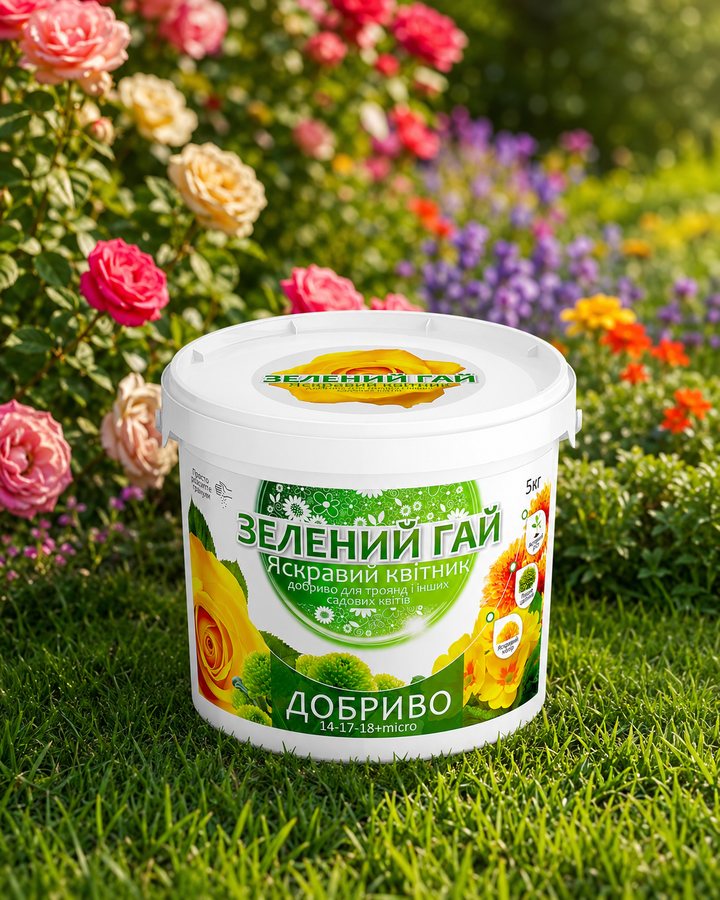
Compare three formulas from our range: “Bright Flowerbed” — NPK 14-17-18, “Universal” — 16-16-16, “Emerald Lawn” — 27-4-10. The first is made for flowering, the second is a balanced base for the whole garden, the third is for grass. On a flowerbed, lawn fertiliser gives exactly what flowers do not need: leaves instead of buds.
The second thing to look at is micronutrients. Iron and magnesium are responsible for leaf colour, boron is needed for normal flowering and fruit set. It is good when they are already in the formula rather than bought separately.
Garden flowers: granules as the base
For flowers in open ground, granules serve as the base. They dissolve gradually, with every watering and rain, and feed the plant for several weeks. Granular “Bright Flowerbed” is designed for roses and garden flowers: spread it over moist soil at 25 g per 1 m² or per bush, up to 60 g under large mature bushes, lightly work it in and water. If you have just one flowerbed, a 500 g pack is more convenient than a bucket.
After that, the routine depends on what grows in the bed:
- Annuals — marigolds, zinnias, salvias, asters — live for one season and flower continuously, so they are fed more often and little by little, with a solution.
- Perennials — peonies, phlox, daylilies — have clear stages of development, and a few applications of granules per season plus an autumn feed are enough for them.
- Bulbs need feeding most right after flowering, while the bulb is forming next year’s flower.
A step-by-step schedule for a mixed flowerbed is in the article on feeding flowers in a flowerbed.
Roses and acid-lovers: separate rules
Roses are the most demanding of garden flowers. Repeat-flowering varieties bloom in several flushes, and after each one the bush needs to recover. They are fed more often than other perennials, and at the end of summer nitrogen is stopped completely. A detailed calendar is in the article on feeding roses.
Hydrangeas, azaleas and rhododendrons flower well only on acidic soil. An ordinary flower fertiliser will not give them the result they need: here you need a formula that acidifies the soil, such as “Exquisite Hydrangea”. This is a case where the general label “for flowers” is misleading.
Flowers in hanging baskets and on the balcony
A hanging basket or balcony box holds only a few litres of soil, yet a petunia, surfinia or calibrachoa has to flower there all summer. The nutrient reserve in such a volume does not last long, and daily watering washes it out through the drainage holes. That is why balcony flowers are fed regularly and often — and with a solution rather than granules: in a small volume granules easily create an excessive concentration of salts near the roots.
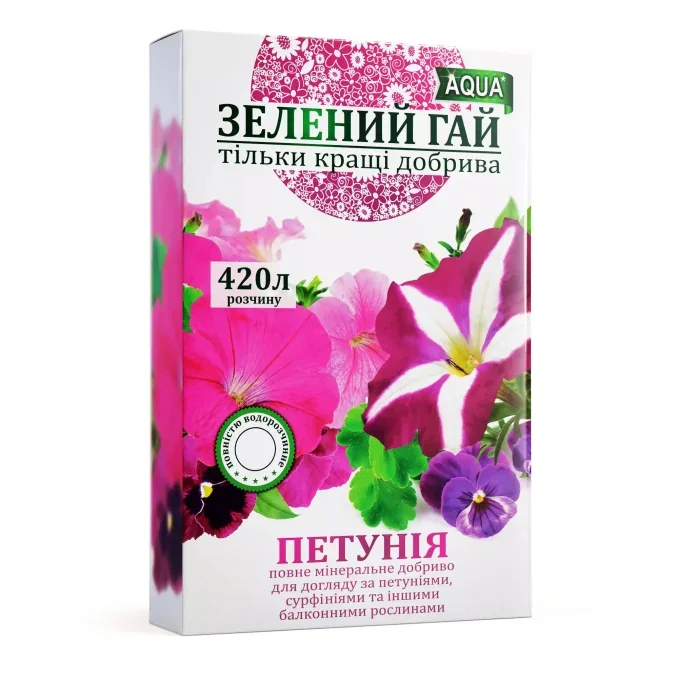
For petunias and other trailing flowers there is water-soluble “Aqua Petunia” and liquid “Mister Tsvit Petunia”. When to start, how often to feed and what to do about yellow leaves is covered in the article on feeding petunias.
Flowering houseplants
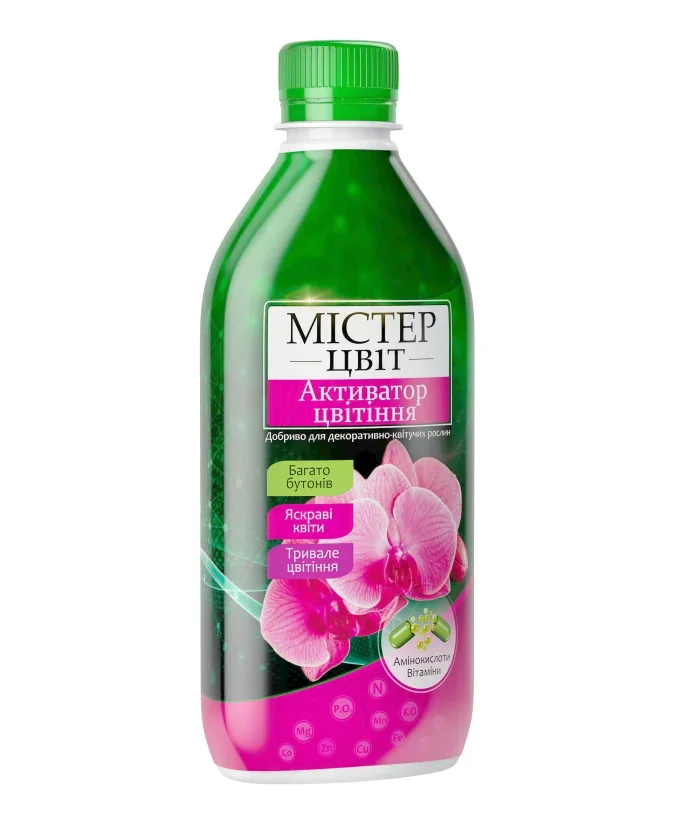
On a windowsill a plant lives in an even smaller volume of soil and grows more slowly than in the garden. Here liquid concentrates are the most convenient: the dose is measured with the cap, so it is harder to overfeed the plant. African violets, orchids and cacti need different formulas, which is why the “Mister Tsvit” range is divided by plant type. For plants that grow but do not flower there is “Mister Tsvit Bloom Activator” — but first check the light and the rest period, because without them no fertiliser will help. How to match a bottle to your plant is explained in the article on fertilisers for houseplants.
Granules, powder or liquid
| Form | How it works | Where it fits |
|---|---|---|
| Granules | Gradually, over several weeks | Flowerbeds, roses, perennials in open ground |
| “Aqua” water-soluble powder | Quickly, through the root and leaves | Annuals, hanging baskets, balcony boxes, quick correction |
| “Mister Tsvit” liquid concentrate | Quickly, precise dose with the cap | Indoor flowers, small pots |
The forms do not exclude each other. A typical garden routine: granules as the base in spring, a solution for annuals and roses at the peak of flowering, an autumn granular fertiliser at the end of the season. More on the differences in the article granular or water-soluble fertilisers.
What fertiliser will not do
- It will not replace the sun. Most flowering plants need direct light for at least half the day.
- It will not prolong flowering without care. If you do not remove spent flowers, the plant will switch to setting seed.
- It will not work in dry soil. Without water, nutrients are not absorbed.
- A double dose will not give double flowering. Excess salts damage the roots rather than speed up the buds.
Frequently asked questions
Can you feed both garden and indoor flowers with one fertiliser?
The formula — partly yes, the form — no. Flowerbed granules are not meant for pots on a windowsill, and a 300 ml bottle will not be enough for a flowerbed. So people usually keep granules for the garden and a liquid fertiliser for the home.
When should you start feeding flowers in spring?
When the soil has thawed and warmed up and the plants have started growing. Annual seedlings are first fed two to three weeks after planting out, once they have established.
Is a universal fertiliser suitable for flowers?
As a spring base — yes. But during budding and flowering a formula with more phosphorus and potassium works better for flowers.