Gardening tips
Fertilisers for houseplants: what to feed with and how
A houseplant lives in a few litres of soil, and in a year or two it eats up everything that was in it. We look at how to feed a windowsill correctly and why a ficus and a cactus need opposite formulas.
Why houseplants need feeding
In the garden roots can go deep and wide, and rain and humus replenish reserves. In a pot there is none of that: the soil is limited, and each watering washes part of the nutrients out through the drainage. Shop-bought potting soil lasts roughly a month and a half to two months — after that the plant lives on what you give it.
Hunger on a windowsill looks mundane: the plants do not die, but everything looks dull. New leaves are smaller than the old ones, internodes stretch, the stem goes bare at the bottom, the overall tone of the green turns greyer. The soil in the pot is the same as two or three years ago.
When and how often
- The main season is from March to September, when there is enough light and the plant is actively growing.
- In winter most houseplants grow slowly and take up less; feeding is done less often or stopped. The exception is plants that flower or grow under supplementary lighting precisely in winter.
- After repotting do not feed for two or three weeks: fresh soil already contains nutrients, and damaged roots are sensitive to salts.
- A sick or wilting plant, or a plant with waterlogged soil, should not be fed: feeding is a load, not medicine. First sort out the watering and the light.
The exact dose and frequency for each bottle of “Mister Tsvit” are printed on the label; the concentrate is measured with the cap.
Three rules that matter more than the dose
- Only onto moist soil. First a normal watering, then the solution — or the solution instead of one of the waterings, but not onto dried-out soil. Otherwise the concentrate burns the fine roots.
- Do not make up for missed feedings with a double dose. Excess salts in a pot are much harder to correct than a deficiency. Signs and rescue are described in the article on overfeeding.
- Garden granules are not for pots. In a closed volume salts accumulate near the roots. Liquid concentrates are meant for the windowsill.
Which formula to choose
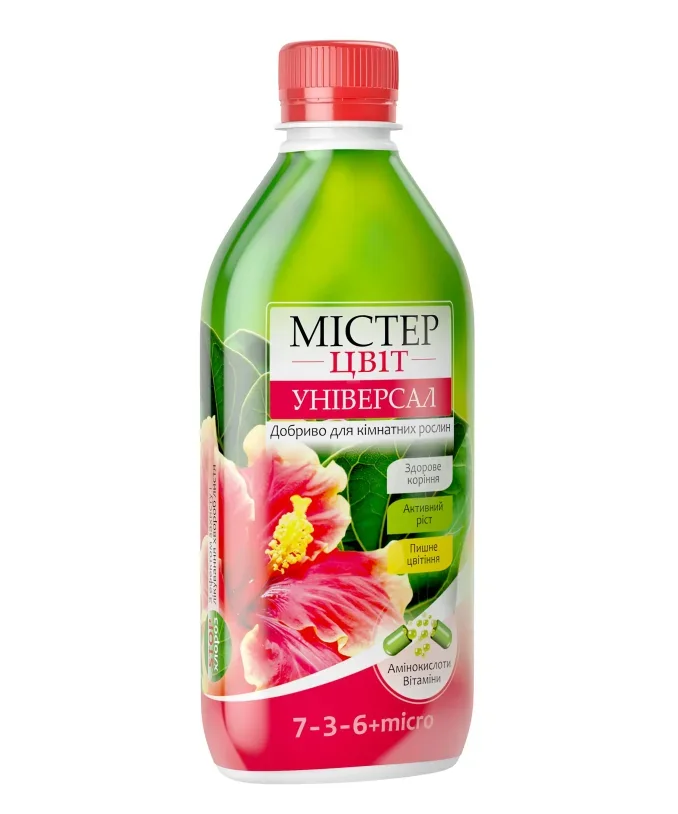
One bottle for the whole windowsill is a reasonable solution if the plants are mostly foliage plants. “Mister Tsvit Universal” 7-3-6 is a formula for growth and greenery, with twice as much nitrogen as phosphorus. But there are groups of plants for which a universal formula is not suitable or suits them poorly.
| Plants | Bottle | NPK | Logic of the formula |
|---|---|---|---|
| Most houseplants | Universal | 7-3-6 | Growth and greenery |
| Ficus, ornamental foliage plants | Ficus | 9-3-4 | The highest nitrogen in the range — for foliage |
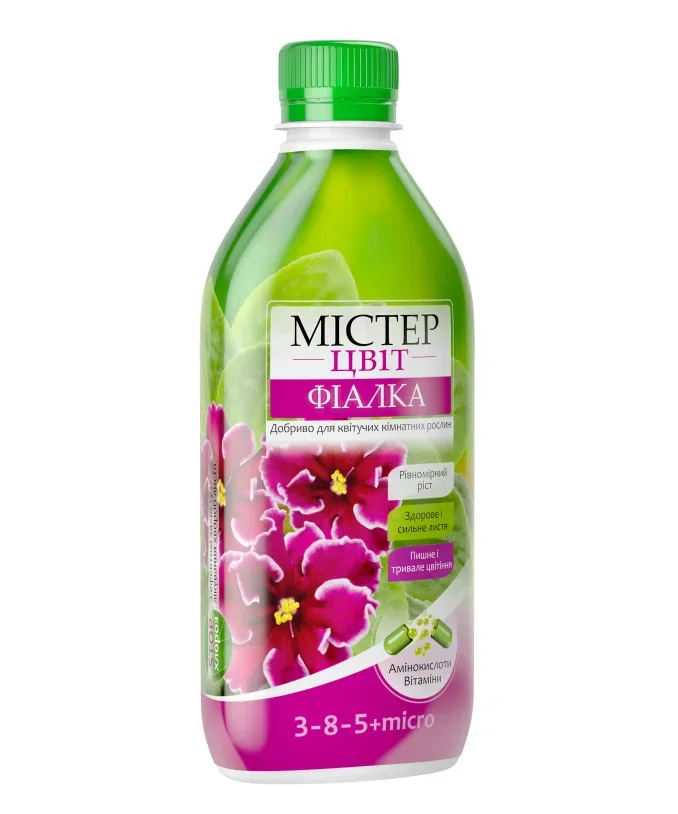
| African violets (saintpaulias), flowering houseplants | Violet | 3-8-5 | Phosphorus dominates — for buds |
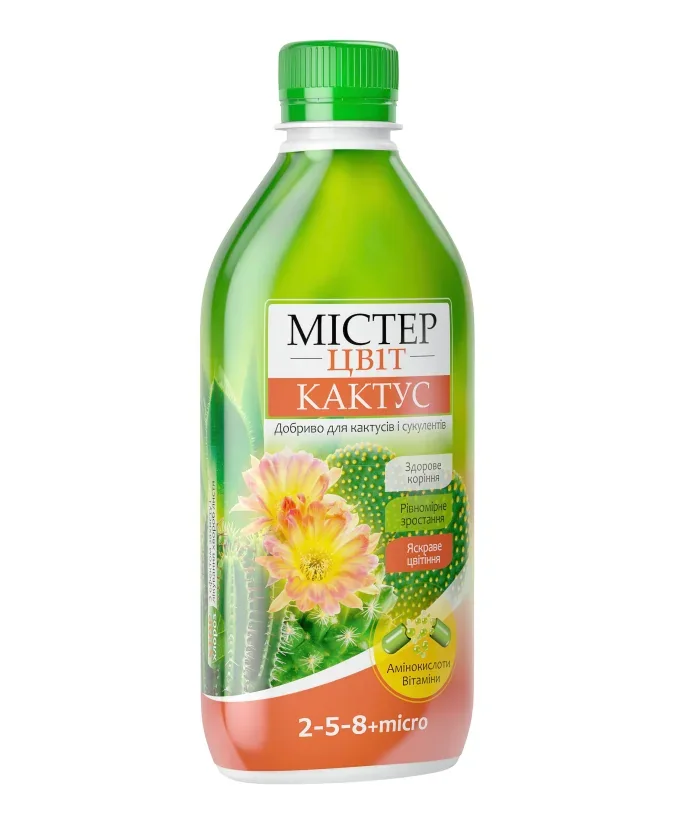
| Cacti and succulents | Cactus | 2-5-8 | Minimum nitrogen, maximum potassium — dense tissue |
| Palms | Palm | 6-6-4 | Even nitrogen and phosphorus for slow growth in a large tub |
| Lemon, mandarin, other citrus | Citrus | 8-4-4 | Evergreen: the leaves work all year round |
| Orchids (phalaenopsis) | Orchid | 1,5-4-2,5 | Little nitrogen — for roots and flower spikes |
| Hydrangeas in pots | Hydrangea | 5-3-5 | For acid-lovers |
Separately, the range includes “Bloom Activator” — for plants that grow but do not flower, “Rooting Agent” — for cuttings and freshly repotted plants, and “Anti-Chlorosis” — for when leaves turn yellow while the veins stay green (more in the article why leaves turn yellow).
Cacti and African violets: two opposite mistakes
Cacti: why a universal formula will not do
The most common mistake on a windowsill is feeding a cactus the same thing as a ficus. Nitrogen makes a cactus grow fast, and the tissue comes out loose and watery. It cracks, and rot gets into the cracks. That is why the formula for cacti and succulents is the opposite — “Mister Tsvit Cactus” 2-5-8, where potassium is highest. They are fed only during the season of active growth, and not in winter, during the dry cool rest period.
African violets and flowering plants: when there is greenery but no flowers
A saintpaulia that builds up its rosette and does not flower is often getting too much nitrogen — for example, from a universal fertiliser. Switching to a phosphorus-dominant formula (3-8-5) works together with light: an African violet needs a bright, diffused daylight period. Without light no bottle will start flowering.
Orchids: separate rules
An orchid grows not in soil but in bark, which contains almost no nutrients. So everything a phalaenopsis gets, it gets from watering. The rules:
- The solution is prepared in advance and never poured onto dry bark. It is convenient to immerse the pot in the ready solution for 15–20 minutes and let it drain.
- Do not let the solution stand in the heart of the rosette or in the leaf axils.
- Feed when the plant is putting out a new root or leaf; if it stands still, do not feed.
- After repotting, the first watering is after 3–5 days, and it is clean water, not fertiliser.
The detailed scheme is in the article how to feed an orchid. And if the bark has already broken down and the orchid needs repotting, take a look at Orchid Lovemix orchid substrate — healthy roots start with it.
Palms and citrus: large tubs
Palms grow slowly and sit in the same tub for years, so they are especially sensitive to salt build-up. Feed them evenly and moderately, without “shock” doses. Every few months it is useful to flush the tub with a large amount of clean water to wash out excess salts, and to remove the salt crust from the soil surface and replace it with fresh substrate. Brown leaf tips on a palm are more often linked to dry air and hard water than to a lack of nutrients. Citrus, by contrast, keep their leaves all year and actively use nitrogen during the season; but if it is specifically the young leaves that yellow with green veins, it is chlorosis, and a regular formula will not fix it.
In short
- Feed from March to September; in winter less often or not at all.
- Only onto moist soil, dose from the label, without “a bit more to be sure”.
- Dilute a whole watering can at once and go over all pots with the same formula with it — it is faster than mixing for each one separately.
- Do not feed for two or three weeks after repotting.
- Foliage plants — nitrogen, flowering plants — phosphorus, cacti — potassium, orchids — minimum nitrogen.