Gardening tips
Feeding flowers in a flowerbed
Annuals go from seedling to abundant flowering in a few months, while perennials live in one place for years. They are fed differently — we look at how to put together a plan for a mixed flowerbed.
What flowers need from feeding
A flowering plant spends its energy on three things: leaves, roots and buds. Nitrogen is responsible for green mass, phosphorus for roots and flower formation, potassium for the number of buds, the brightness of the petals and the length of flowering. When there is too much nitrogen, the flowerbed becomes lush and green but flowers poorly. That is why formulas for flowers are chosen with no less phosphorus and potassium than nitrogen. How to read these numbers on the package is explained in the article about NPK.
The second thing is rhythm. An annual lives one season and flowers continuously, so it needs to be fed often and a little at a time. A perennial has clear phases: regrowth, flowering, preparation for winter. It is fed less often, but on time.
Soil first: preparing the flowerbed
Fertiliser gives a plant nutrients but does not make the soil loose. On heavy clay that crusts over, or on poor sand, flowers suffer from a lack of air or water regardless of feeding. That is why, before laying out a new flowerbed, the soil is dug over, weed rhizomes are picked out and well-rotted compost is added: it improves the structure and helps the ground hold moisture.
In an already planted flowerbed the best way to improve the soil is mulch. A thin layer of compost, shredded bark or dried grass clippings between the plants retains moisture, holds back weeds and gradually enriches the top layer with organic matter. The granules are then scattered under the mulch or lightly worked into the soil before it is renewed.
Annuals: from planting out to autumn
Marigolds, zinnias, salvias, ageratum, verbenas, asters, cosmos — annuals grow fast and flower until the frosts if they are not starved.
- Before planting out seedlings, scatter granules over the flowerbed and work them into the top layer of soil. This way the nutrients will be evenly distributed over the whole area even before roots appear.
- Two to three weeks after planting out, when the plants have established and started growing, begin regular solution feeds.
- Throughout flowering, feed roughly once every two to three weeks. Annuals do not overwinter, so the July cut-off for nitrogen, mandatory for shrubs and trees, does not apply to them — but from the end of summer there should be less nitrogen.
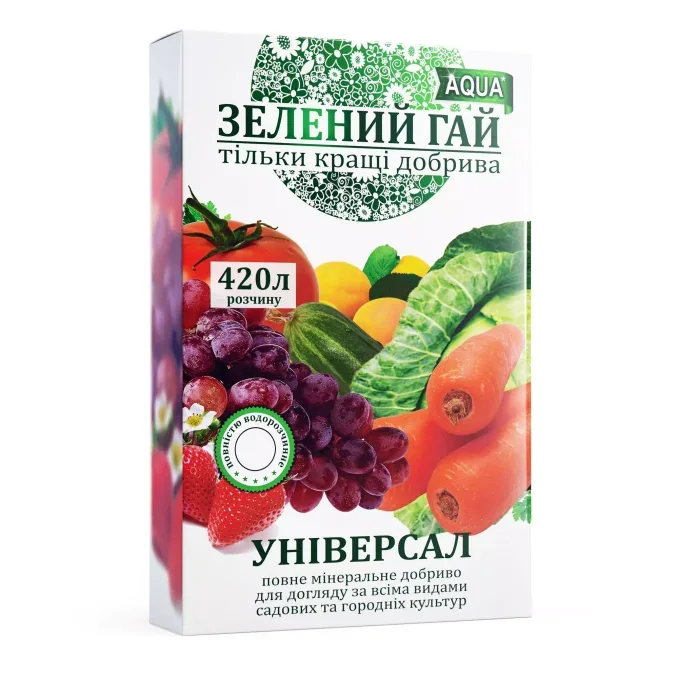
Water-soluble “Aqua Universal” is convenient for regular feeds: the powder is dissolved in water according to the dosage on the package and poured at the root. A solution acts faster than granules, so it suits annuals that grow and flower at the same time. Flowers in hanging pots and balcony boxes live by their own rules — see the article on feeding petunias.
Perennials: three moments per season
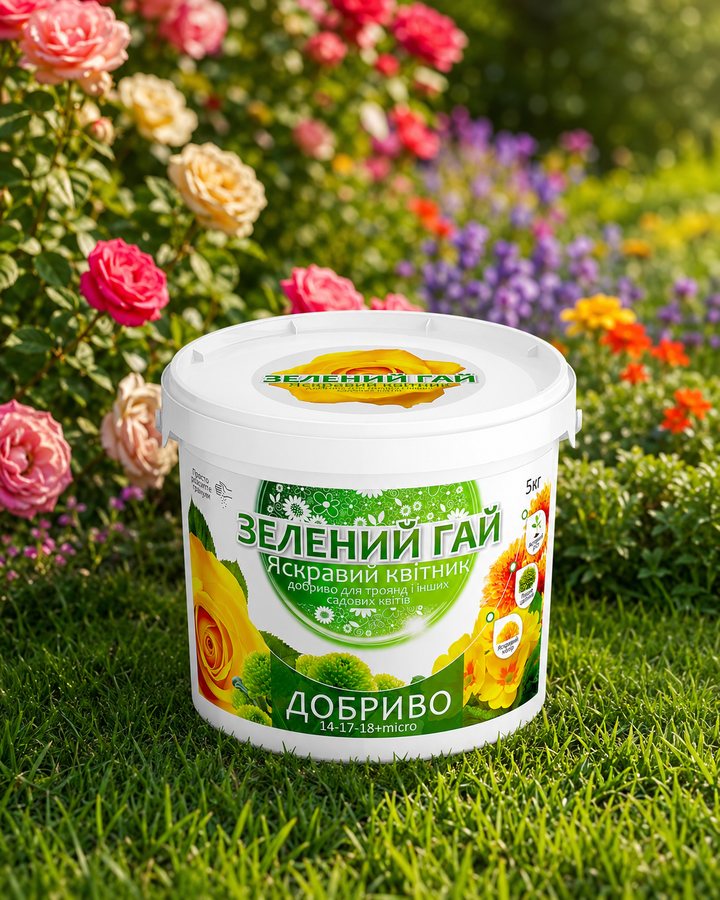
Peonies, phlox, daylilies, echinacea, rudbeckia, bellflowers, geums, salvia — perennials come back every year and therefore take part of the nutrients out of the soil every year. Their base is provided by granular “Bright Flowerbed” with NPK 14-17-18: it has more phosphorus and potassium than nitrogen, so it works for buds and colour, not just for leaves.
| When | What is happening | What to do |
|---|---|---|
| Early spring, regrowth | Growth of leaves and stems | First application of granules, 25 g per 1 m² or per plant |
| Budding | Flower formation | Second application of granules, topped up with a solution if needed |
| After flowering, until mid-July | Recovery, next year's buds | Third application for plants that finished flowering early |
| August — first half of October | Preparation for winter | Autumn low-nitrogen formula |
For large mature plants — peonies, old clumps of daylilies — the rate can be increased to 60 g. The granules are scattered over moist soil around the plant, not onto the rosette or the leaves, lightly worked in and watered.
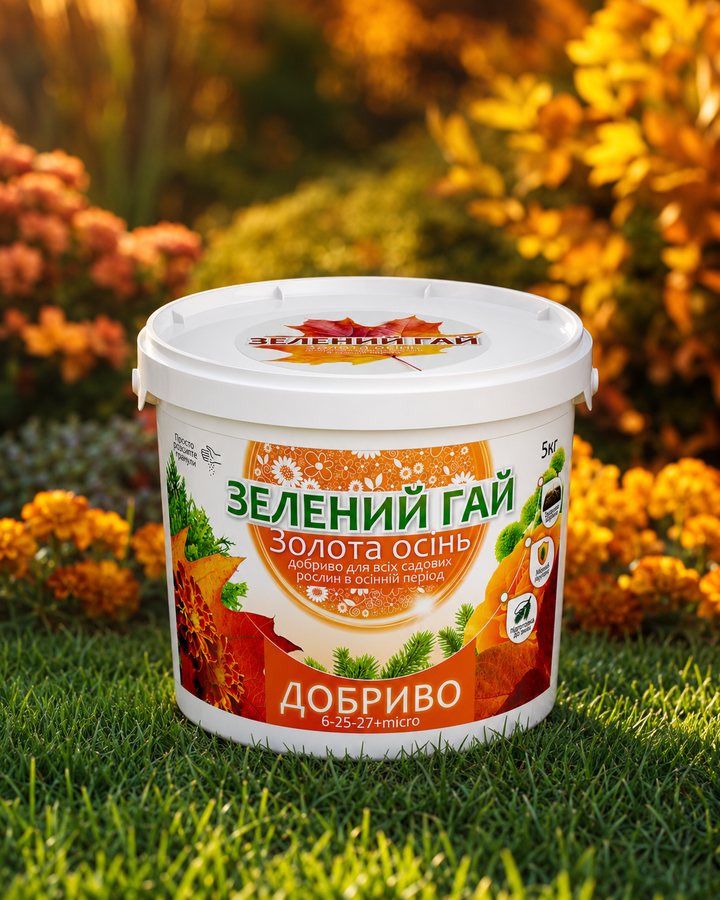
In autumn, from August to the first half of October, perennials are given an autumn feed of “Golden Autumn” with NPK 6-25-27. Phosphorus and potassium help rhizomes and tubers store nutrients and overwinter better.
Bulbs in the flowerbed
Tulips, daffodils, hyacinths and lilies are fed on their own rhythm. The first feed is as soon as the shoots appear, the second in the bud phase. The most important is the third — right after flowering: while the leaves are green, the bulb recovers and sets next year's flower. That is why the leaves are not cut after flowering until they turn yellow by themselves.
Why the flowerbed is green but has few flowers
- Excess nitrogen. Fresh manure, lawn fertiliser that ended up on the flowerbed, or frequent nitrogen feeds give lush foliage instead of buds. Nasturtiums, marigolds and cosmos are especially sensitive.
- Shade. Most flowering annuals need sun for at least half the day.
- Spent flowers are not removed. The plant switches to setting seed and winds down flowering. Regularly picking off faded flower heads prolongs it better than any fertiliser.
- Overcrowding. Perennials that have not been divided for years flower smaller. Divide the clump — and the fertiliser will start working.
Frequently asked questions
Can I feed a flowerbed with one fertiliser for everything?
Yes, for a mixed flowerbed this is normal practice. Granules for flowers as the base plus a solution for annuals at the height of the season cover the needs of most plants. Roses, which are fed more intensively and for longer, and acid-lovers — hydrangeas, rhododendrons, heathers — need a separate scheme: they need formulas that acidify the soil.
How many granules does a flowerbed need?
Measure the area: 25 g for every square metre per application.
The leaves of annuals turn pale in midsummer. What is it?
Most often it is ordinary hunger: over several weeks of abundant flowering the plants have taken the nutrients from the soil, and rain and watering have washed out the rest. If the old lower leaves turn pale, nitrogen is lacking, and the next feed with a solution will quickly bring the colour back. If young leaves turn yellow while the veins stay green, it looks like iron deficiency, and what helps here is not a bigger dose but the right soil reaction.
Can granules be applied in hot weather?
Better in the evening, on moist soil, and always with watering afterwards. On dry ground the granules do not dissolve and do not work.