Gardening tips
How to feed hydrangea
Hydrangeas need four feedings a year: three for growth and flowering until mid-July and one in autumn. Below are the calendar, the rate in grams and the mistakes that keep a bush from blooming.
What a hydrangea needs from feeding
The hydrangea is a plant with large leaves, abundant flowering and shallow fibrous roots. It quickly takes everything there is from the soil and just as quickly shows a deficiency: it pales, its flower heads get smaller, it yellows between the veins. So feeding is not a luxury for it but part of normal care.
The second feature is acidic soil. Hydrangea absorbs iron and other micronutrients well only in a slightly acidic environment, around pH 5–6. On alkaline soil or with constant watering with hard tap water the leaves turn yellow even if there is enough fertiliser. How to check acidity and acidify a plot we covered separately — in the article on acidic soil and pH.
Finally, hydrangeas vary, and this affects the rate:
- Bigleaf — the most demanding: the thinnest leaves, the shallowest roots, sets its flower buds on last year's shoots.
- Panicle and smooth — hardier, bloom on current-year shoots and are fed at the normal rate.
Feeding calendar
The scheme is simple: three feedings for growth and flowering from April to mid-July, then a pause and one in autumn.
| When | What for | With what |
|---|---|---|
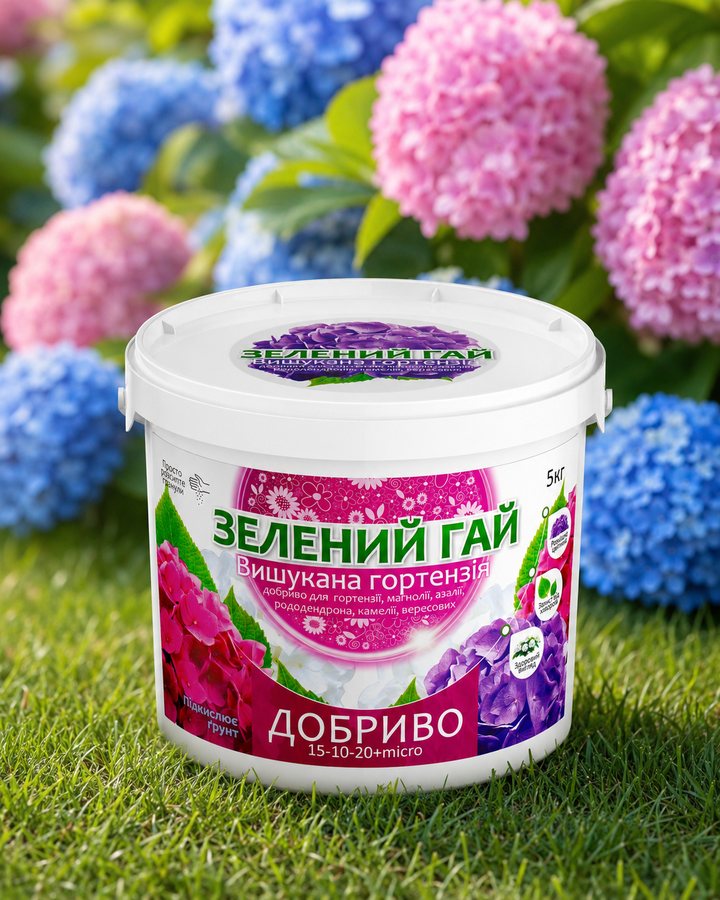
| April, when the soil has warmed to +10 °C | Start of growth, new leaves | Exquisite Hydrangea 15-10-20 |
| End of May | Shoot growth, setting of flower heads | Exquisite Hydrangea |
| First half of July | Supporting flowering | Exquisite Hydrangea |
| Second half of July | Pause: nitrogen now does harm | — |
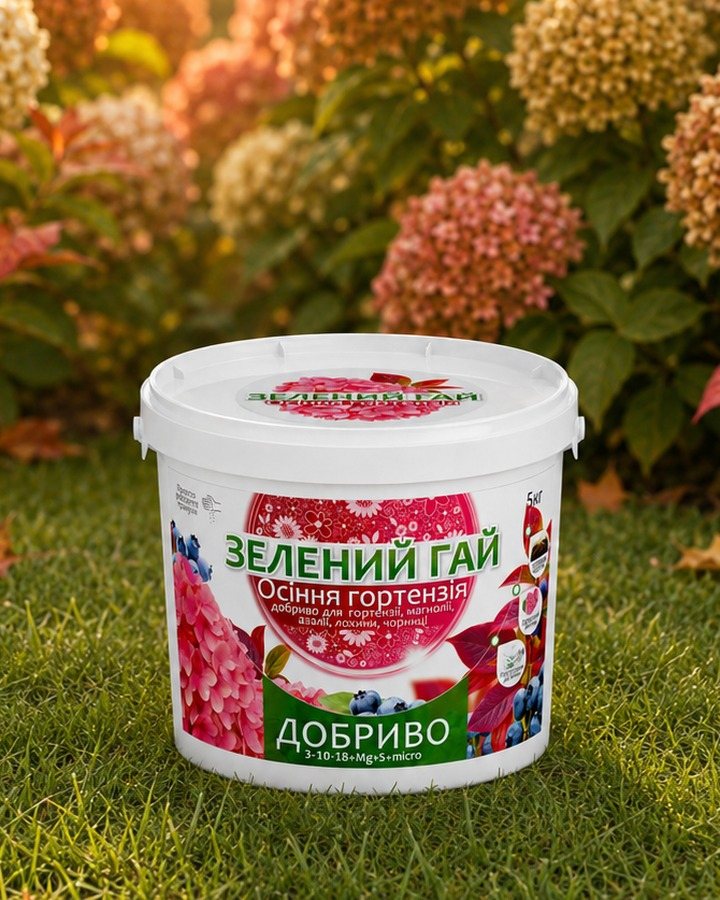
| August — first half of October, once | Maturing of shoots, setting of next year's buds | Autumn Hydrangea 3-10-18 |
At least three weeks must pass between spring–summer feedings. After mid-July hydrangeas are no longer given fertiliser with nitrogen: nitrogen drives late growth that does not have time to mature before the frosts. For bigleaf hydrangea this is especially painful — frost-damaged shoots mean there will be no flowers next summer.
How much fertiliser to give
For spring–summer feedings we recommend the granular “Exquisite Hydrangea” (NPK 15-10-20 with micronutrients). It supports the acidic reaction of the soil, and the increased potassium works for the density and colour of the flower heads.
| Plant | Rate per feed |
|---|---|
| Regular bush or 1 m² of planting | 25 g — 1 scoop |
| Large spreading shrub | up to 37 g — 1.5 scoops |
| Bigleaf hydrangea | 12 g — 0.5 scoop |
For bigleaf hydrangea, half the rate, but the number of feeds stays the same: three times per season. It is the dose you reduce, not the schedule. Panicle and smooth hydrangeas get a full scoop.
500 g bags come without a scoop. As a guide: a tablespoon holds about 17 g of granules, so one and a half tablespoons is roughly one scoop, and two thirds of a tablespoon is the rate for bigleaf hydrangea.
How to apply the granules correctly
- Water the shrub the day before or in the morning — granules go only onto moist soil.
- Scatter the fertiliser evenly over the area under the crown, keeping 10–15 cm away from the stems. The feeder roots of hydrangea spread wide, not just under the shrub itself.
- Gently mix the granules into the top layer of soil. Do not dig deep — the roots are shallow.
- Water and mulch: pine bark, acid peat or conifer litter also help keep the soil acidic.
Make sure no granules stay on wet leaves: a burn may appear where they touch.
Autumn feeding
Between August and the first half of October, while the soil is still warm, hydrangeas get the last feed of the season — “Autumn Hydrangea” (NPK 3-10-18). It contains little nitrogen, so it does not push new growth but helps the shoots ripen and set flower buds for next year. It is applied once.
- mature shrub — 25 g (1 scoop);
- young seedling — 12 g (0.5 scoop);
- bigleaf hydrangea — 12 g (0.5 scoop).
The granules are scattered along the edge of the crown’s footprint, not right against the stem, lightly mixed into the soil and watered in.
Hydrangea in a pot — separate rules
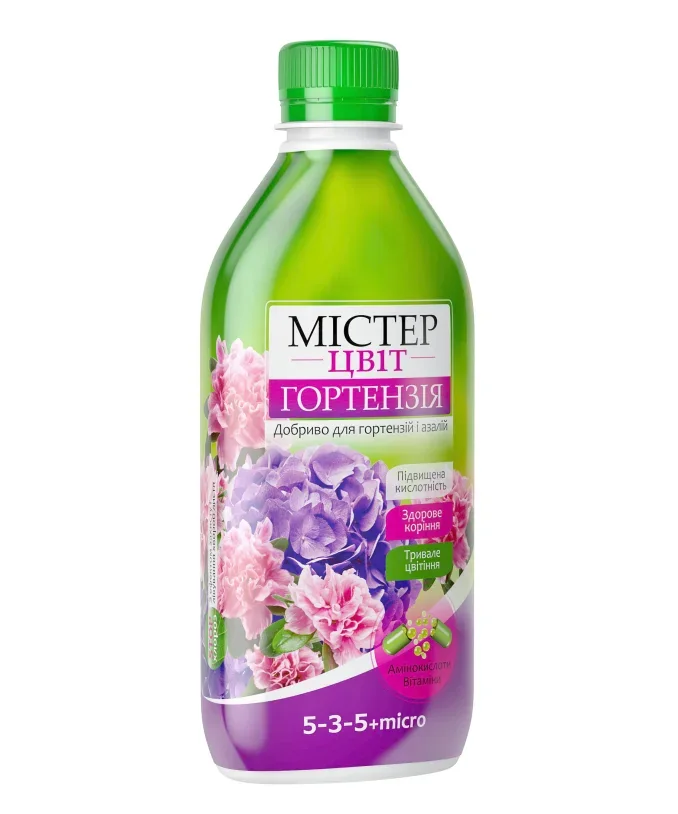
Granular fertilisers for open ground are not used in containers. In a pot the salts are not washed down deeper, and the concentration near the roots rises many times over — it is easy to burn the plant this way. For indoor, balcony and young hydrangeas in containers, use the liquid “Mister Tsvit Hydrangea” or the water-soluble “Aqua Hydrangea”: measure the dose according to the label and give it with watering. In autumn, container hydrangeas are not fed with autumn granular fertiliser either.
Typical mistakes
Exceeded the rate
Signs — leaf edges drying out, wilting despite moist soil. Remove the top layer of soil together with the granules, flush the shrub generously with clean water 2–3 times a few hours apart, shade it for 3–5 days and do not feed until new growth appears. The plant usually recovers. More details — in the article on overfeeding.
Fed with nitrogen in September
The shrub puts out young shoots, they go into winter green and get frost-damaged. In bigleaf hydrangea the flower buds die along with them.
Hard water
Constant watering with limy water gradually makes the soil alkaline, and chlorosis appears — yellow leaves with green veins. Water with rainwater or water that has been left to stand; this often helps more than extra feeding.
Ash and fresh manure
Ash makes soil alkaline — for hydrangea that is the opposite of what it needs. Fresh manure gives excess nitrogen and a risk of root burn.
Frequently asked questions
Why doesn’t my hydrangea bloom even though I feed it?
In bigleaf hydrangea the most common cause is last year’s shoots that were frost-damaged or cut off in spring: the buds were on exactly those. In panicle and smooth hydrangeas — deep shade. Fertiliser fixes none of these causes.
Will feeding turn my hydrangea blue?
No. The colour of bigleaf hydrangea is determined by soil acidity and available aluminium. How to control it — in the article how to change hydrangea colour.
How to feed a hydrangea in its planting year?
If the planting hole was filled with acid peat and rotted pine bark, for the first weeks the shrub lives on the hole’s reserves. Start feeding when new growth appears, not right after planting: the roots must establish first. In autumn a young plant gets “Autumn Hydrangea” at half the rate — 12 g.
My hydrangea wilts during the day although it is fed. What is it missing?
Most often — water, not fertiliser. The large leaves evaporate a lot of moisture, and in the heat the shrub droops them even on moist soil, recovering towards evening. If the leaves do not lift in the evening either, check watering, mulch and whether the shrub stands in scorching midday sun. Feeding on dry soil in this state will only do harm.
Is this fertiliser suitable for azaleas and rhododendrons?
Yes, “Exquisite Hydrangea” is designed for hydrangeas, azaleas and rhododendrons — all of them are acid-lovers with similar needs.