Gardening tips
Feeding petunias in hanging baskets
A petunia in a hanging basket flowers all summer on one condition only: it is fed regularly. We explain why nutrients run out quickly in a small volume of soil, how to feed and what to do about yellow leaves.
Why petunias in hanging baskets are fed so often
Trailing petunia, surfinia or calibrachoa produce a mass of shoots and hundreds of flowers over a summer. All this work happens in a few litres of soil. The nutrient reserve in a peat mix does not last long, and every heavy watering washes part of the nutrients into the saucer. In hot weather hanging baskets are watered daily, so the washing out is daily too.
So balcony plants are that rare case where feeding is done not a few times a season but regularly, roughly once every week to week and a half from the start of flowering to the end of August. The most convenient way is not to set up a separate procedure but simply to make one of the ordinary waterings with fertiliser solution.
Surfinia and calibrachoa
Surfinias and calibrachoa are even greedier than ordinary petunia: they grow faster and form longer trails. Calibrachoa is, in addition, particularly sensitive to an alkaline substrate reaction and hard water — it is the first to show chlorosis. The rule for both is the same: regular feeding, soft water, no pauses at the height of the season.
When to start
- After planting into the basket, give the plant a week to settle in — the first week without feeding.
- After that — regularly until the end of summer.
- After the summer trim — without fail: it is the most useful moment of the season.
- In September–October feeding is gradually stopped. Petunia is an annual; it does not need to be “prepared for winter”.
What to feed with
Only liquid or water-soluble fertilisers are suitable for hanging baskets and balcony boxes. Granules cannot be distributed evenly in a small container, and salts build up near the roots faster than in open ground. How fertiliser forms differ is explained in the article granular or water-soluble fertilisers.
We recommend two options — choose the more convenient one:
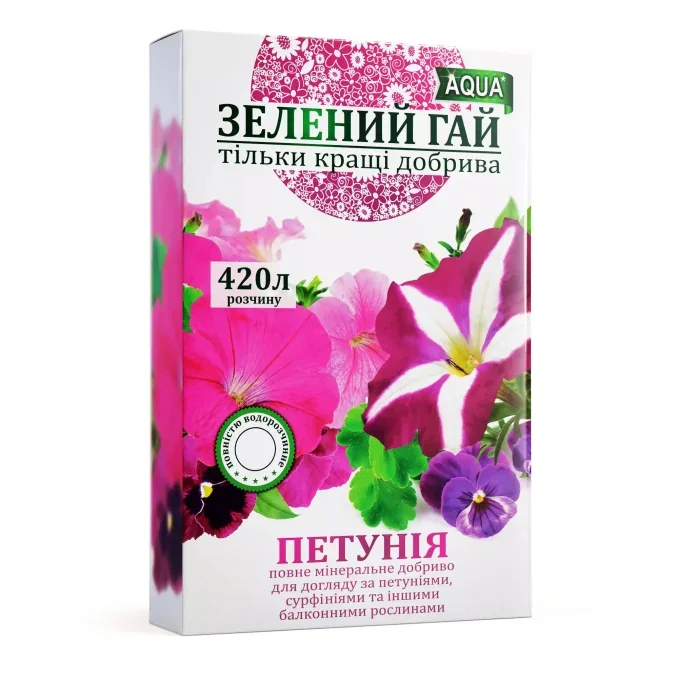
- “Aqua Petunia” — a powder for petunias, surfinias and calibrachoa. It is dissolved in water in the proportion given on the pack and poured at the root or sprayed on the leaves. Convenient when there are many hanging baskets.
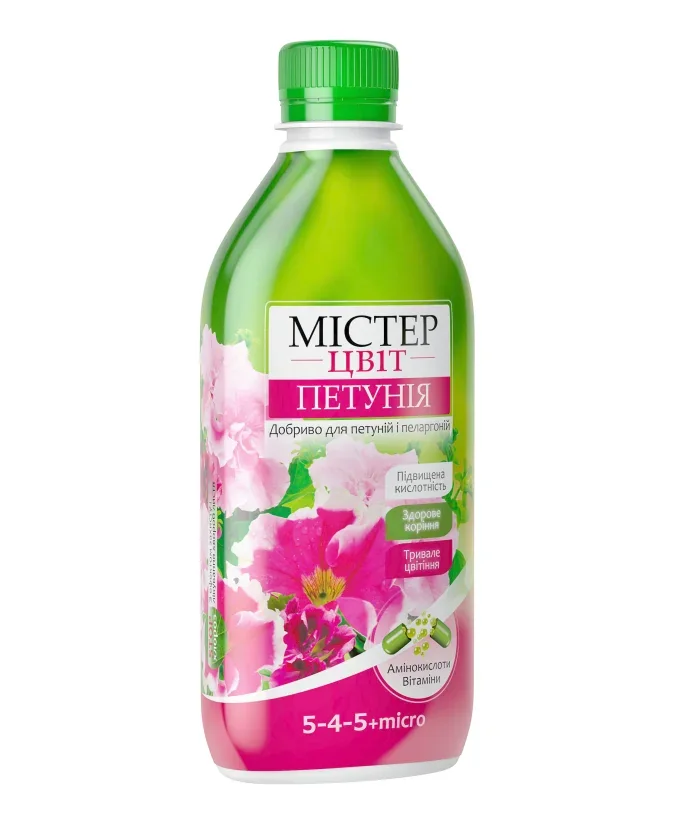
- “Mister Tsvit Petunia” — a liquid concentrate: the dose is measured with the cap according to the label. Convenient for a few hanging baskets on a balcony. The solution has an acid reaction, and this is no accident — more on that below.
Petunias in a flowerbed, in open ground, can also be fed with granules for flowers — there they work as ordinary planned nutrition.
How to feed correctly
- Water with the solution only on moist soil. If the basket has dried out, water it with clean water first.
- Feed in the morning or evening, not in the midday heat.
- Spray on the leaves early in the morning or in the evening: drops on the petals in the sun leave spots.
- Do not exceed the dose “for speed”. In a small volume overfeeding happens quickly: the leaf edges dry, the plant wilts on wet soil. What to do in that case is in the article on overfeeding.
Chlorosis in petunias: yellow leaves with green veins
The most characteristic problem of balcony petunias is young leaves turning yellow while the veins stay green, like a drawn grid. This is chlorosis, and in petunias it is almost always linked to iron.
The cause is rarely that there is no iron in the soil. Petunia absorbs it only in a slightly acid environment, and watering with hard tap water gradually makes the substrate alkaline. There is enough iron in the pot, but the plant cannot take it. Therefore:
- water with settled, rain or filtered water;
- use a fertiliser with an acid reaction, such as “Mister Tsvit Petunia” — it counteracts alkalisation;
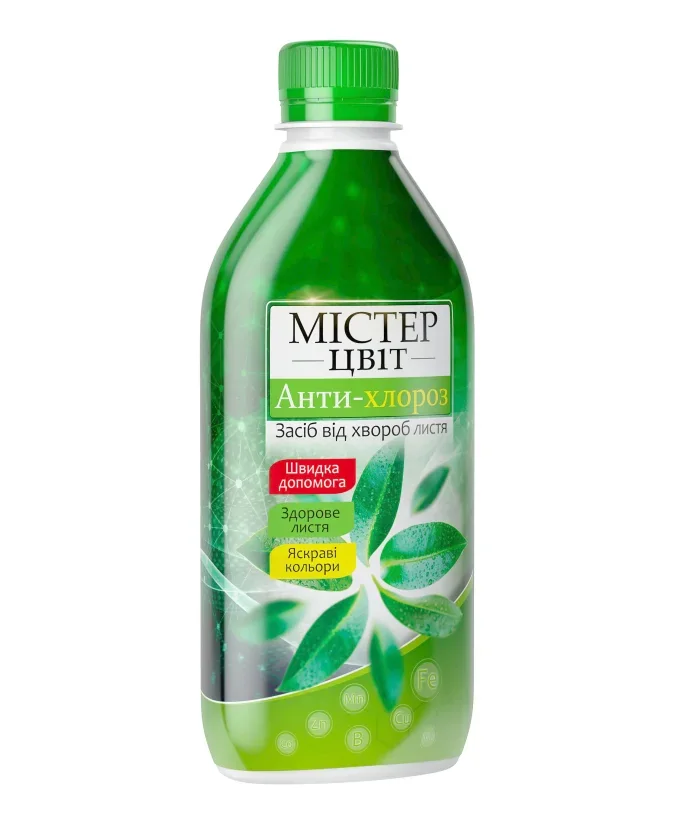
- with pronounced chlorosis, the targeted “Mister Tsvit Anti-Chlorosis” with iron, manganese, zinc, copper and boron will help.
Other causes of yellow leaves and how to tell them apart are in the article on chlorosis.
Trimming and pinching: without them fertiliser does not work
By midsummer petunia often gets leggy: the trails lengthen, go bare at the bottom, and flowers gather only at the ends. Fertiliser will not pull stretched stems back. The order of actions is: first shorten the shoots by about a third, then feed. Then the nutrients go into new side shoots, and in a few weeks the bush flowers densely again.
Two more habits that give more flowers: regularly remove spent flowers together with the developing seed pod so that the plant does not waste energy on seed, and pinch young shoots at the start of the season for bushiness.
What fertiliser will not do
- Grey mould in a damp August — brown spots and grey fuzz — is a fungus. Feeding does harm here, because it adds soft green growth.
- Thrips and whitefly — silvery streaks, a sticky coating, tiny white flies — need an insecticide.
- A basket without drainage, in which water stands after every rain, cannot be fixed by any fertiliser: the roots suffocate and rot.
Frequently asked questions
What soil should I use for hanging baskets?
A light, loose, slightly acid substrate for flowers with good drainage at the bottom. Heavy garden soil in a basket compacts, dries slowly and lets little air through to the roots. The smaller the basket, the more important regular feeding is: one petunia plant should ideally have several litres of soil.
Can petunias be watered with the solution at every watering?
Only with a very weak solution and only if the pack says so directly. It is simpler and safer to keep to a rhythm of once every week to week and a half, and to water with clean water between feeds.
Why does petunia set buds that then drop?
Common causes are the soil drying out in hot weather, a lack of nutrients at the height of flowering, and pests. Check the watering and the underside of the leaves.
Are these fertilisers suitable for pelargonium and other balcony flowers?
“Mister Tsvit Petunia” is designed for pelargonium as well. Other balcony annuals have similar needs — a small volume of soil, frequent watering, long flowering — so they live by the same feeding rhythm.