Gardening tips
Why houseplants do not flower
The plant is healthy, large, green — and not a single bud. Most often the reason is not the fertiliser but the conditions. We go through eight reasons one by one and explain when feeding really triggers flowering.
First — honestly about fertiliser
When a plant does not flower, the first impulse is to buy “something for flowering”. But nutrition is only one of eight places on the list of causes, and far from the first. Flowering is an expensive project for a plant, and it launches it only when conditions allow: enough light, the right temperature, mature age, roots filling the pot. Fertiliser helps when all of this is already in place. If light or a cool overwintering is lacking, no bottle will replace them.
Go through the list below one by one — most often the cause is found in the first three points.
Reasons 1–3: light, pot, age
1. Too little light
Reason number one in a flat. The human eye judges light levels poorly: a room seems bright, but for a plant two metres from the window it is twilight there. A north window, the depth of the room, shade from a neighbouring building or tree — and the plant lives and grows but has no energy for flowering. Signs: stretched internodes, small new leaves, the plant leaning towards the glass. The solution is closer to the window, a brighter window or a grow light.
2. Pot too big
Many plants flower only when the roots have filled the whole volume. In a roomy pot they spend years building roots and leaves, “postponing” flowering. Peace lily, anthurium, clivia, hippeastrum and African violet behave this way. Repot into a pot only slightly larger than the previous one.
3. The plant is still young
Seedlings and young cuttings often do not flower for several years — this is a normal stage of development, not a problem. This applies especially to plants grown from a seed or a stone: citrus, cacti, palms. Find out at what age your species usually starts flowering: sometimes the “problem” is solved simply by patience, while feeding a young plant “for flowering” only distracts it from building roots and leaves, of which there are not yet enough for flowering.
Reasons 4–5: overwintering and day length
4. No cool rest period
Some plants set buds only after a period of coolness and reduced watering. Classic examples are desert cacti, which flower after a dry cool overwintering, and the Christmas cactus, which needs coolness and infrequent watering in autumn. A plant that has stood all winter next to a radiator with watering and feeding does not receive that signal. How to arrange overwintering for cacti is in the article on feeding cacti.
5. Wrong night length
Kalanchoe, Christmas cactus and poinsettia are short-day plants: they set buds when the nights are long. If in autumn the light stays on in the room for a long time in the evening, the plant “does not notice” autumn and does not flower. For a few weeks before budding they need real dark nights.
Reason 6: excess nitrogen
This is the reason that fertiliser really is connected to — but the other way round. A plant that regularly gets a high-nitrogen formula receives the signal “resources are plentiful, grow”. It builds luxurious foliage, bushes out, takes up half the windowsill, and it has no need to flower: green mass is cheaper and safer for it.
The typical picture: a second season of lush foliage and not a single bud; or buds set and drop without opening; or a single short flowering. A peace lily puts out a spathe and it turns black; an anthurium produces one flower stalk in six months.
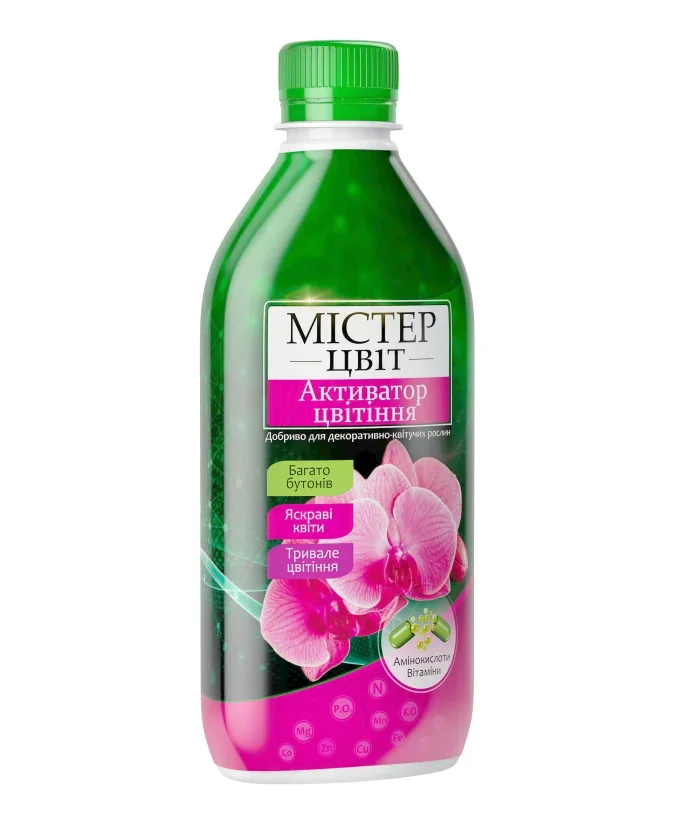
It is for exactly this situation that there is “Mister Tsvit Bloom Activator”. This is a fertiliser for ornamental flowering plants; no NPK figures are printed on the bottle, the label lists the elements — nitrogen, phosphorus, potassium, magnesium, manganese, iron, zinc, copper, cobalt — and separately amino acids and vitamins. It is used not as a permanent feed but as a course for a specific phase:
- start before buds appear and continue through their formation and flowering;
- for the duration of the course, remove the high-nitrogen universal fertiliser — otherwise you are pressing two opposite pedals at once;
- after flowering, return to the regular formula for your plant species;
- dose and schedule are on the label; water onto moist soil.
For African violets and similar flowering houseplants there is a separate phosphorus-dominant formula — “Mister Tsvit Violet” 3-8-5; how to work with it is explained in the article on feeding African violets.
Reasons 7–8: stress and pruning
7. Moving and fluctuations
A plant that has set buds reacts badly to a change of conditions. A Christmas cactus turned to the light with its other side, a gardenia moved to another room, a draught from a window vent, a temperature swing, drying out — and the buds drop. During budding the plant is not moved or turned, and it is watered evenly.
8. The flower buds were pruned off
Some plants flower on last year's shoots or at the tips of branches. Late pruning, for example of a pelargonium or an indoor hydrangea, removes exactly the places where flowers were to appear. Prune after flowering, not before it. The same applies to excessive “pinching for bushiness”: each pinch pushes flowering back by several weeks, because the plant first grows new shoots and only then sets buds on them.
And if an orchid does not flower
Orchids have their own flowering logic: the difference between day and night temperatures, the state of the roots, the substrate. For them we have covered the reasons separately in the article why an orchid does not flower.
How to look for the cause: a short sequence
- Is there enough light? If in doubt — most likely not.
- Is the pot too big, and is the plant mature?
- Does this species need a cool rest period or long nights — and did it get one?
- What have you fed it over the last year? If a high-nitrogen formula — switch to a flowering course.
- Was the plant moved or pruned before flowering?
A bloom activator will not make a plant flower if it lacks light, sits in a pot that is too big or is not yet mature. But when the conditions are in order and the only obstacle is a nutritional imbalance, a correctly chosen formula gives the plant the signal it was missing.