Gardening tips
Autumn feeding: why little nitrogen, when and with what
Autumn feeding is not about growth, but about how the plant will survive the winter and what state it will be in come spring. We explain how it differs from summer feeding and how to do it correctly.
What happens to a plant in autumn
At the end of summer the above-ground part of the plant gradually stops, but the work does not cease — it moves underground and into the shoots. Roots keep growing while the soil is warm. Shoots become woody: young green tissue is covered with bark and becomes denser. Sugars accumulate in the cells and act as a natural antifreeze. The buds from which flowers will appear in spring are being set right now.
All these processes require phosphorus and potassium. Phosphorus — for roots and bud formation, potassium — for dense tissues, water balance and frost resistance. Nitrogen, however, works against the plant at this point.
Why there is little nitrogen in autumn
Nitrogen is the “grow” signal. Having received it in August or September, a plant puts out new growth: soft green shoots with thin leaves. They do not have time to ripen before the frosts, are the first to be frost-damaged, and the damaged tissue becomes a gateway for disease. Worse still, the plant spends its reserves on this growth instead of storing them for the winter.
That is why in autumn formulas the first NPK number is minimal and the other two are high. Compare with the summer ones: “Emerald Lawn” is 27-4-10, “Autumn Lawn” is 4-17-40. The difference in approach is visible from the numbers themselves — how to read them is explained in the article what the NPK numbers mean.
When to apply autumn fertilisers
The working window is from August to the first half of October, while the soil is still warm. The root takes up nutrients only from warm, moist ground; in cold soil the granules will lie there uselessly until spring.
- August — the best time for conifers, acid-loving plants and plants that finish growing early.
- September — the main month for the lawn, shrubs, trees and perennials.
- The first half of October — the last chance if you did not make it earlier, especially in the south and in a warm autumn.
One autumn application is usually enough. For “Autumn Hydrangea” this is stated directly: once per autumn, and it is the last feeding of the season.
What to feed with: four autumn formulas
| Fertiliser | NPK | For whom | Rate |
|---|---|---|---|
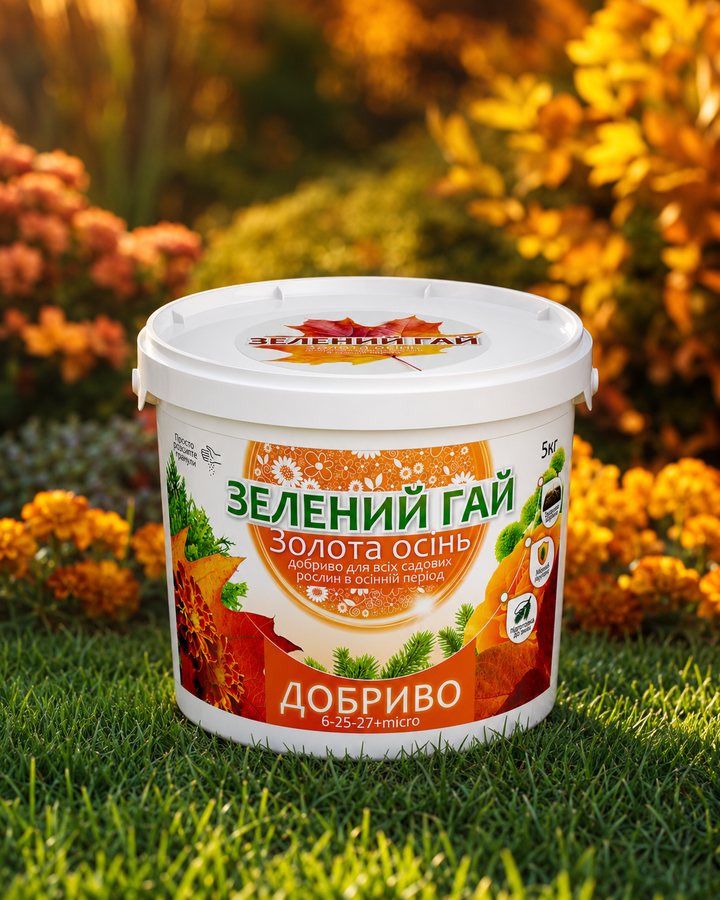
| Golden Autumn | 6-25-27 | All garden plants: fruit trees, berry bushes, ornamental shrubs, roses, perennials | 25 g per 1 m² or per bush, 60 g under mature shrubs and trees |
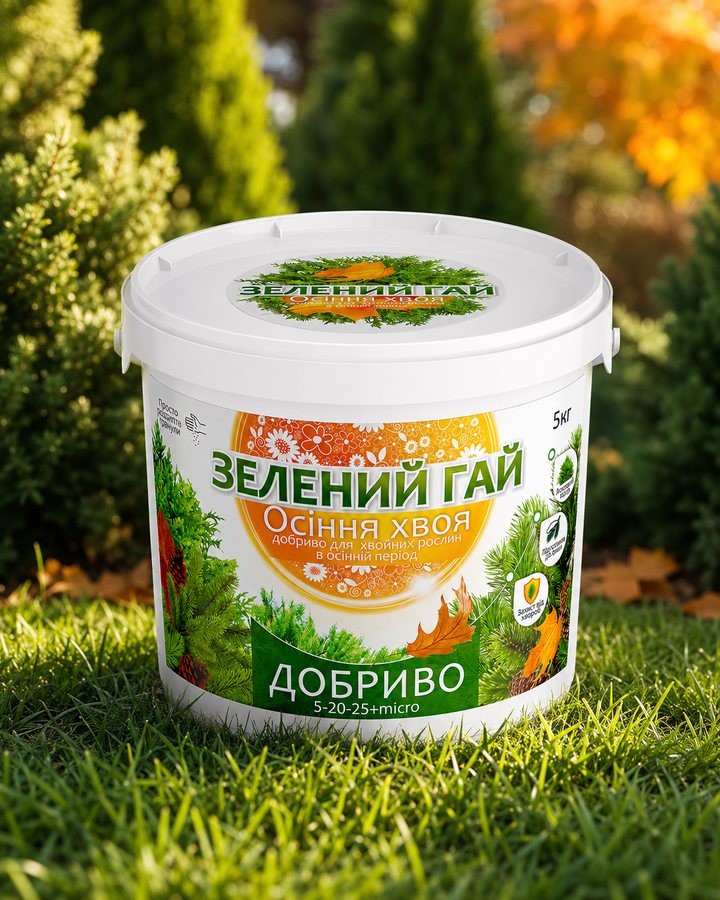
| Autumn Conifer | 5-20-25 | Thujas, junipers, pines, spruces | 25 g per 1 m² or per bush, 60 g under mature ones |
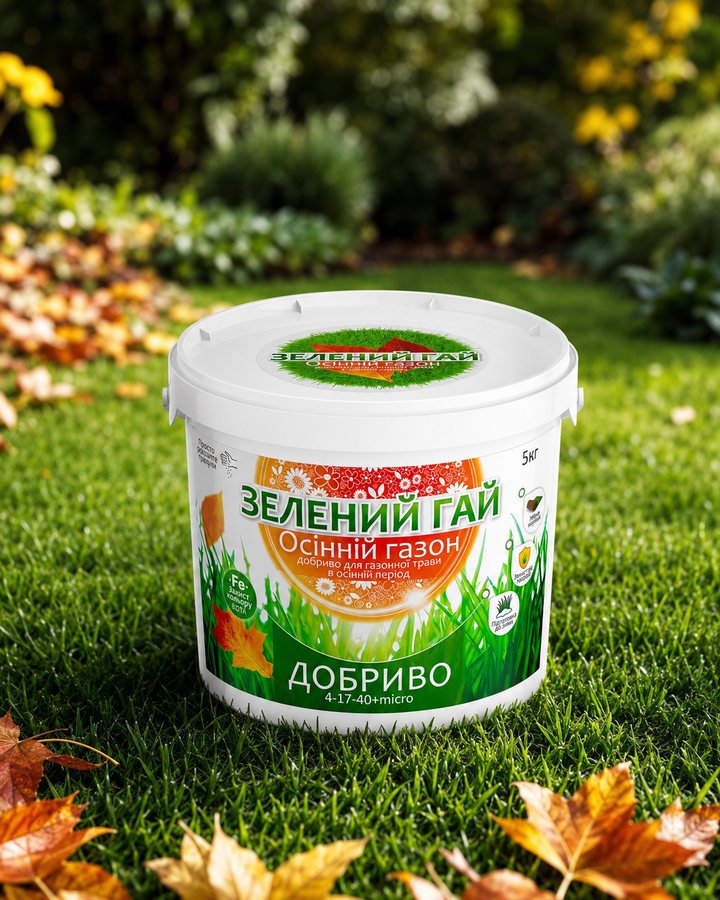
| Autumn Lawn | 4-17-40 | Lawn grass | 25 g per 1 m² |
| Autumn Hydrangea | 3-10-18 | Hydrangeas, blueberries, heathers | Mature bush 25 g, young seedling 12 g, bigleaf hydrangea 12 g, solid planting of blueberry or heather 25 g per 1 m² |
“Golden Autumn” is a universal autumn formula if you do not want to keep several packs. But for three groups of plants, specialised formulas make sense.
Lawn
Grass overwinters under snow and is the first to wake up in spring. “Autumn Lawn” 4-17-40 with very high potassium strengthens the turf: the lawn tolerates frost more easily and greens up early in spring. Apply after one of the last mowings on moist grass and be sure to water, so that the granules do not remain on the leaves.
Conifers
Thujas and junipers do not shed their needles in winter and keep evaporating water. If the autumn was poor in potassium, in spring they are more often “scorched” by the sun and the needles turn brown. “Autumn Conifer” 5-20-25 strengthens the needles before the cold. Other causes of browning are covered in the article why a thuja turns brown.
Hydrangeas and acid-loving plants
The bigleaf hydrangea blooms on last year’s shoots: if they do not ripen, there will be no flowers next summer. “Autumn Hydrangea” 3-10-18 does not push growth, but helps shoots ripen and set buds. For the bigleaf hydrangea — half the rate: it has the shallowest roots and the thinnest leaves. Panicle and smooth hydrangeas get the normal rate.
How to apply correctly
- Water the soil if it is dry: granules are scattered over moist ground.
- Scatter the fertiliser evenly over the area under the crown — where the feeder roots work, not right up against the trunk.
- Carefully work the granules into the top layer of soil.
- Water again. Avoid granules getting onto wet needles and leaves.
Granules are not suitable for plants in planters and containers: in a closed volume, salts accumulate near the roots. For them — the water-soluble “Aqua Autumn”.
Typical mistakes
- A summer universal fertiliser in September. The balanced 16-16-16 formula has too much nitrogen for autumn.
- Feeding in November. The soil is cold, the root is not working — the fertiliser just lies there.
- A double dose “for the whole winter”. A plant does not store fertiliser in reserve; excess salts burn the root.
- Dry soil. Without moisture the granules do not dissolve, and a concentrated solution near the roots does harm.
The place of autumn feeding in the overall season schedule is shown in the article garden feeding calendar.
Frequently asked questions
Is autumn feeding needed if I fed all summer?
Yes. The summer feedings worked for growth, and the autumn one works for overwintering. Besides, the potassium and phosphorus applied in summer have already been spent by the plant on leaves, flowers and fruit. The autumn formula replenishes exactly what will be needed for shoots to ripen and buds to form.
Can autumn fertiliser be applied together with digging?
Under trees and shrubs it is not worth digging deeply — you can damage the roots lying close to the surface. It is enough to scatter the granules over the area under the crown and shallowly work them in with a rake or hoe. In a bed you are preparing for spring planting, the granules can be worked in while cultivating the soil.
Should young seedlings planted this year be fed?
Yes, but carefully. For “Autumn Hydrangea”, for example, the rate for a young seedling is half that of a mature bush: 12 g instead of 25 g.