

Zelenyi Hai Aqua · 300 g
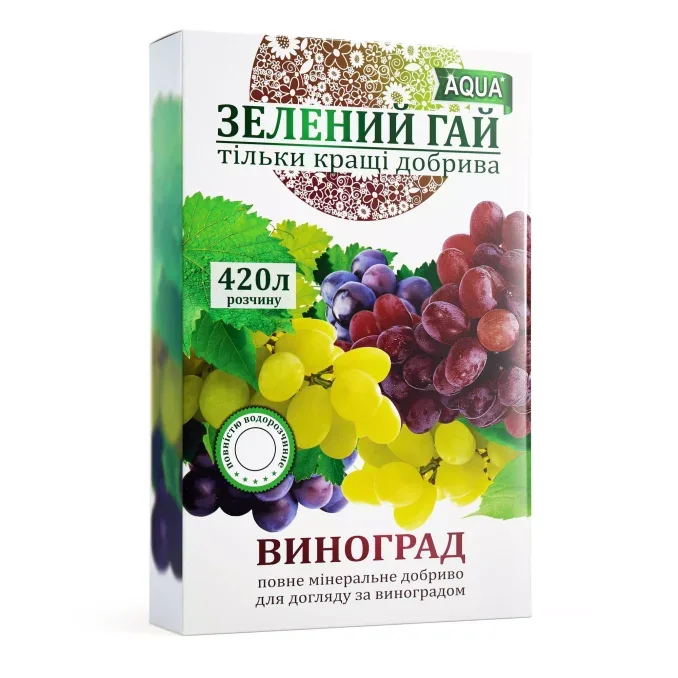
Aqua Grape — water-soluble fertiliser for grapes, 300 g
For grapes — for bunch size and ripening of the vine.
75 UAH
Travels in one parcel with the rest of your order — no separate delivery to pay for. The minimum order amount is 250 UAH. Shipped by Nova Poshta or Ukrposhta within 1–3 days all over Ukraine. Questions and orders by phone: (093) 727-55-00 — we are the manufacturer.
| Pack size | 300 g |
|---|---|
| Form | water-soluble |
| Price | 75 UAH |
| SKU | 562008 |
| Manufacturer | Gileya brand, Ukraine |
What this fertiliser is
The package says “complete mineral fertiliser for the care of grapes”. The powder dissolves completely in water, so the nutrition can be given both at the root and on the leaves. A 300 g box makes 420 l of solution; a mature vine needs a few litres at a time, so the pack is meant to last more than one season.
When the plant needs it
Grapes differ from annual crops in one thing: next year's harvest is set this summer. So feeding here affects not only the bunches hanging now, but also what will come in a year and how the vine overwinters.
The most common symptom is pale areas between the veins of the old lower leaf, while the veins themselves stay bright green. The leaf looks marbled, then these areas turn brown. It usually appears in the second half of summer, regularly on sandy soils, and precisely on the shoots that carry bunches: the bunch pulls the nutrition to itself.
The second signal is the leaf edge turning brown and curling downwards once the berries have started gaining weight.
The third is the cane staying green and herbaceous along its whole length at the end of August instead of turning brown from the base. An unripened cane does not survive the winter.
And separately about what fertiliser does not explain: small hard seedless berries mixed in with normal ones are a consequence of the weather during flowering or a trait of the variety, not hunger.
How to apply
The solution is prepared according to the dosage on the package and poured into the root zone — in a circle about half a metre from the trunk, not right under the stem: the main roots of a mature vine spread wide and go deep.
The rhythm follows the growth stages, and in grapes it is very pronounced. Before flowering — feeding for bunch formation. After flowering, when the berry is pea-sized — for its growth. At the start of berry softening and colour change the emphasis shifts: nitrogen is no longer needed; potassium and phosphorus are needed for sugar and for ripening the cane.
Foliar spraying on grapes gives a fast effect, because the leaves are large; do it in the evening, wetting the underside too.
The last feeding for growth — no later than the end of July or the start of August. After that the cane should ripen, not grow.
What this fertiliser will not do
Fertiliser has no effect on downy mildew and powdery mildew. Oily spots with a white coating on the underside of the leaf or a grey powdery coating on the bunches are fungi; there are separate products for them, and no feeding will replace them.
It does not enlarge the berries of a variety in which they are small by nature, and does not fix the consequences of a cold, rainy flowering.
It does not rescue a vine that has been waterlogged: grapes do not like permanently wet roots.
And the main caveat: do not feed grapes with nitrogen in September. The vine will go into growth, the cane will not have time to ripen, and in winter you will lose both the shoots and the buds for next year's harvest set on them. From the end of August switch to autumn feeding — “Aqua Autumn” or granular “Golden Autumn” 6-25-27, which is low in nitrogen on purpose.
Which pack to choose
300 g of “Aqua” (75 UAH) — for a few vines in the yard and for a quick response when the leaves have already started to marble.
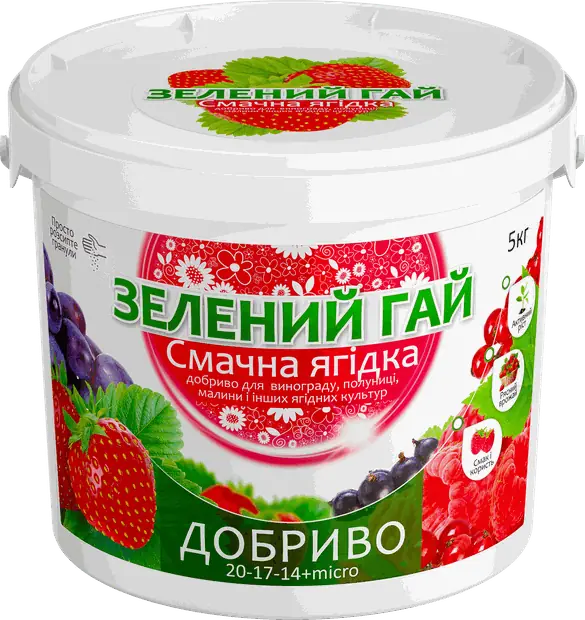
500 g of granular “Tasty Berry” (89 UAH) — for one or two mature vines per season.
A 5 kg bucket of “Tasty Berry”, NPK 20-17-14 (610 UAH) — when the grapes are planted in a row and counted in dozens of vines. The granule rate for a mature vine is 60 g. A 10 kg bucket (1090 UAH) — for a large vineyard plot.
Autumn feeding of grapes is better not skipped: it is what determines what kind of cane the vine goes into winter with.
The same for the whole plot
Tasty Berry — a bucket for the plot
View the bucket
Grapes, strawberries, raspberries. NPK 20-17-14. 5 kg — 610 UAH · 10 kg — 1 090 UAH. Discount by number of buckets: 2 — −4%, 5 — −7%, 10 — −10%.
Frequently asked questions
Why have the lower leaves turned marbled?
Pale patches between the veins with bright green veins on old leaves are a very common picture on grapes in the second half of summer, especially on light sandy soils and on shoots with heavy bunches. This is a case where the soluble form acts faster than granules, particularly when sprayed on the leaves.
When should grapes be fed for the last time?
With fertiliser for growth — until the end of July or the start of August. After that the vine should direct its strength into ripening the cane, and late nitrogen directly hinders this.
Will this increase berry size?
It may — if the vine is hungry and that is exactly why the berries are small. But if the variety has small berries by nature or flowering took place in cold rain, fertiliser will change nothing.
How much solution does a mature vine need?
A few litres per feeding, depending on age and size. Given the 420 l of solution from a pack, a box is enough for a small vineyard for the whole season.
More for this plant
The whole “Zelenyi Hai Aqua” line
A powder that dissolves in water: nutrition reaches the plant through both the roots and the leaves, so it works fast. 75 UAH per pack.

Aqua Petunia
300 gFor petunias, surfinias and calibrachoa in hanging baskets and balcony boxes.
75 UAH


Aqua Universal
300 gOne fertiliser for the whole plot — flowers, shrubs, trees, vegetable garden.
75 UAH


Aqua Strawberry
300 gFor strawberries, wild strawberries and raspberries — for berry flavour and size.
75 UAH


