


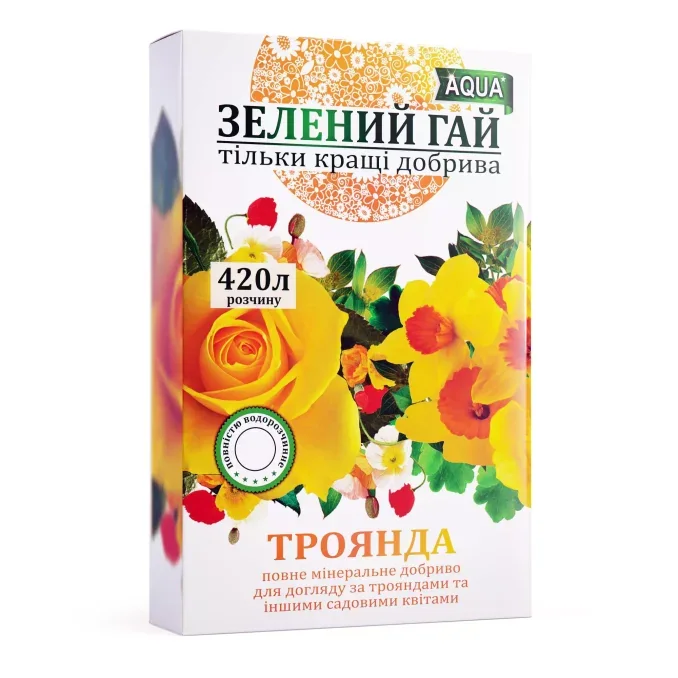
Zelenyi Hai Aqua · 300 g
Aqua Rose — water-soluble fertiliser for roses, 300 g
For roses and garden flowers during budding and flowering.
75 UAH
Travels in one parcel with the rest of your order — no separate delivery to pay for. The minimum order amount is 250 UAH. Shipped by Nova Poshta or Ukrposhta within 1–3 days all over Ukraine. Questions and orders by phone: (093) 727-55-00 — we are the manufacturer.
| Pack size | 300 g |
|---|---|
| Form | water-soluble |
| Price | 75 UAH |
| SKU | 562002 |
| Manufacturer | Gileya brand, Ukraine |
What this fertiliser is
The package puts it briefly: “complete mineral fertiliser for the care of roses and other garden flowers”. The form is a powder that dissolves completely in water, so the nutrition gets in both through the roots and through the leaves. A 300 g pack makes 420 l of solution; the figure is on the front of the box. For a garden with a dozen bushes, that is a supply for more than one season.
When the plant needs it
A rose lives in waves, and it is precisely at the transition between waves that you can see whether it has enough nutrition. The first bloom in June is almost always good — the bush spends what it stored last year. The problem starts after it.
Sign one: after the spent flowers are cut off, the bush takes a long time to produce new shoots, and those that appear are thin and short — about fifteen centimetres instead of half a metre. The second wave comes out half as rich as the first, the flower is smaller, the colour duller.
Sign two: the leaves turn yellow and drop from the bottom and the inside of the bush, while the top is still green. The plant itself moves the remaining nutrition from the old leaves into the young ones — and that is exactly the moment it needs feeding.
A separate picture occurs on limestone soils: the young leaves at the top turn yellow while their veins stay bright green. This is not the same as general yellowing from below, and the two should not be confused.
How to apply
The powder is diluted in water and used to water under the bush or to spray the leaves; the exact dosage is printed on the package.
Rhythm matters more than dose. The first feeding is when the shoots have grown 10–15 cm in spring. The second is right after the first wave of flowers has been cut; this is the most useful moment of the whole season. Then once every two to three weeks while the bush is in bloom.
And the main rule, which kills more roses than frost does: feeding for growth stops at the end of August. A shoot that starts growing in September does not have time to turn woody before the frosts, freezes in winter and takes part of the bush with it. In autumn a rose needs a different fertiliser — “Aqua Autumn” or granular “Golden Autumn”.
What this fertiliser will not do
Fertiliser does not cure black spot or powdery mildew. If the leaves have brown spots with blurred edges or a white coating, that is a fungus and you need a fungicide. A sick rose that gets fed simply grows more leaves for the fungus to live on.
It has no effect on the aphids that cover the buds.
It does not rescue a bush planted in permanent shade: a rose needs at least 5–6 hours of direct sun, and no feeding will replace that.
And do not feed a freshly planted bare-root plant in the first two to three weeks — the roots have to get going first. For this period the range has a separate product, “Aqua Rooting”.
Which pack to choose
300 g of “Aqua” (75 UAH) is taken when there are not many bushes or they grow in large pots, and also when it needs to work fast — the plant has already shown that it is lacking something.
500 g of “Bright Flowerbed” granules (89 UAH) — for one rose bed. The granules are scattered once, and they release nutrition gradually for several weeks.
A 5 kg bucket of “Bright Flowerbed”, NPK 14-17-18 (610 UAH) — for roughly 100 m² of plantings per season; 10 kg (1090 UAH) — twice as much. This is the choice when roses are counted not in bushes but in rows. Rate for granules: 25 g under a young bush or per square metre, 60 g under a mature one.
The autumn choice is separate: “Golden Autumn” 6-25-27 in a bucket or “Aqua Autumn” in a box.
The same for the whole plot
Bright Flowerbed — a bucket for the plot
View the bucket
Roses and garden flowers. NPK 14-17-18. 5 kg — 610 UAH · 10 kg — 1 090 UAH. Discount by number of buckets: 2 — −4%, 5 — −7%, 10 — −10%.
Frequently asked questions
When should a rose be fed for the last time in the season?
With fertiliser for growth — until the end of August. Later the bush produces young shoots that do not have time to ripen before the frosts and freeze. From September switch to autumn fertiliser, where the emphasis shifts to phosphorus and potassium.
Will it help against black spot?
No. It is a fungal disease, and it is treated with a fungicide. Fertiliser only affects how strong the leaves the bush grows next will be.
Granules in a bucket or “Aqua” — which is better for roses?
They are different tools. Granules are planned feeding of a bed several weeks ahead. “Aqua” is first aid for a plant that has already paled or stalled, and the only convenient option for a rose in a pot. Many people have both on their plot.
How long does a pack last?
The box states 420 l of solution from 300 g. If you feed a dozen bushes once every two weeks, very little is used — the pack carries over to the next season. Store it tightly closed in a dry place.
More for this plant
The whole “Zelenyi Hai Aqua” line
A powder that dissolves in water: nutrition reaches the plant through both the roots and the leaves, so it works fast. 75 UAH per pack.

Aqua Petunia
300 gFor petunias, surfinias and calibrachoa in hanging baskets and balcony boxes.
75 UAH

Aqua Universal
300 gOne fertiliser for the whole plot — flowers, shrubs, trees, vegetable garden.
75 UAH


Aqua Strawberry
300 gFor strawberries, wild strawberries and raspberries — for berry flavour and size.
75 UAH


