
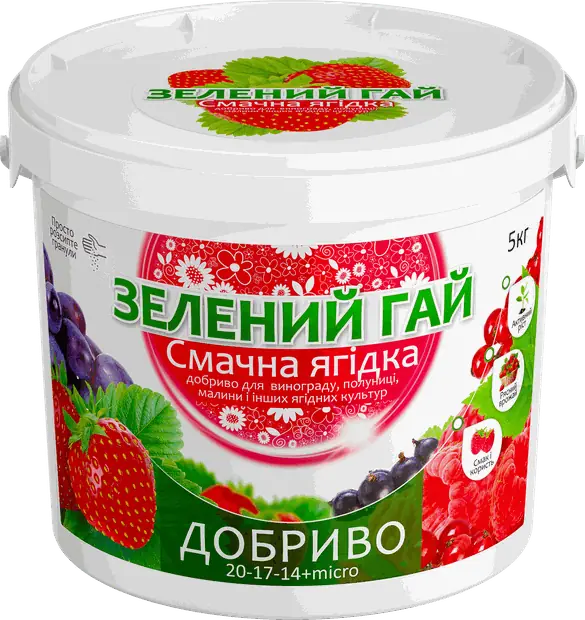


Zelenyi Hai · 500 g
“Tasty Berry” 500 g — fertiliser for strawberries, raspberries and grapes
A bag of “Tasty Berry” — for strawberries, raspberries and grapes.
89 UAH
Travels in one parcel with the rest of your order — no separate delivery to pay for. The minimum order amount is 250 UAH. Shipped by Nova Poshta or Ukrposhta within 1–3 days all over Ukraine. Questions and orders by phone: (093) 727-55-00 — we are the manufacturer.
| Pack size | 500 g |
|---|---|
| Form | granular |
| NPK formula (printed on the pack) | 20-17-14 + micro |
| Treatment area (printed on the pack) | for 20 m² |
| Price | 89 UAH |
| SKU | 563006 |
| Manufacturer | Gileya brand, Ukraine |
What this fertiliser is
“Tasty Berry” is a fertiliser for berry crops: strawberries, raspberries, currants, gooseberries, grapes. The pack is printed with 20-17-14+micro and “for 20 m²”, and the label lists directly what it is responsible for: active growth of leaves and roots, early and abundant fruiting, a tasty and healthy harvest. The proportion here differs from the flower formula: there is more nitrogen (20), because berry plants first need to build up the bush and the leaves that later feed the berry — but phosphorus and potassium are not far behind, and it is they that work for size and sugar. The NPK on the pack matches the formula of the “Tasty Berry” 5 and 10 kg buckets.
When the plant needs it
Berry crops show deficiency not through the leaves but through the berry itself. Strawberry: the first flush is normal, then the berries get smaller with every picking, turn sour and watery, lots of runners, little harvest. Raspberry: the replacement canes are pencil-thin instead of thick, and the berry falls apart into drupelets right in your hand. Grapes: there are bunches, but they show “hen and chicken” — some berries stay small and hard, and the leaves at the bottom of the vine yellow and drop as early as July. The common feature in all three: the bush gives the fruit more than it gets from the soil. Berry crops deplete the ground beneath them faster than ornamentals, because they fruit every year in one and the same place for many years in a row.
How to apply
25 g per 1 m² of strawberry bed or per bush of currant, gooseberry or young raspberry; 60 g — per mature bush or established vine. That is how you get the 20 m² printed on the pack. The granules are spread between the rows and around the bush on moist soil, mixed into the top layer and watered — under strawberries it is convenient to do this before mulching with straw. The granules must not get onto the leaves or the berries themselves. The point missed most often: feeding works for the future harvest, so the main applications are before flowering and right after picking, when the bush sets the fruit buds for next year.
What this fertiliser will not do
This is a summer formula with high nitrogen — it is not applied before winter; autumn feeding of berry crops is done with “Golden Autumn”, which has 6 nitrogen instead of 20. Second: the fertiliser does not protect against grey mould on strawberries, raspberry anthracnose or downy mildew on grapes — these are fungal diseases that need fungicides, and feeding only helps the bush recover. Third, and the hardest to accept: if strawberries have grown in one place for the fourth or fifth year, no fertiliser will bring back their yield — the bed has to be replanted, with new plants and in a new place. And it does not work for blueberries and cranberries: heathers need acidic soil and a separate formula, “Magic Blueberry”.
Which pack to choose
20 m² is roughly four strawberry beds five running metres long, or a row of raspberries along a fence; one pack for 89 UAH covers such an area in one application. Since berry crops are fed at least twice a season — before flowering and after picking — count two packs straight away, that is 178 UAH. A 5 kg bucket for 610 UAH gives 122 UAH per kilogram and pays for itself from a hundred square metres of berry patch; a 10 kg bucket for 1090 UAH — 109 UAH per kilogram, which is already about vineyards and commercial strawberries. The 500 g pack has its own clear scenario: the first year of a bed, a few currant bushes at the edge of the plot, or trying the formula before buying a bucket. For pots and vertical beds there are water-soluble “Aqua Strawberry” and “Aqua Grape” at 75 UAH for 300 g.
The same for the whole plot
Tasty Berry — a bucket for the plot
View the bucket
Grapes, strawberries, raspberries. NPK 20-17-14. 5 kg — 610 UAH · 10 kg — 1 090 UAH. Discount by number of buckets: 2 — −4%, 5 — −7%, 10 — −10%.
Frequently asked questions
Is this the same as in the “Tasty Berry” bucket?
Yes. The pack is printed with 20-17-14+micro — the same formula stated for the 5 and 10 kg buckets. We checked the print on the packaging itself rather than copying it from someone else’s description.
When should strawberries be fed to get bigger berries?
Before flowering — for the current harvest, and right after picking — for the next one, because that is when the bush sets its fruit buds. Applying at the height of fruiting has almost no effect on berry size.
How far does a pack go?
20 m² of bed at a rate of 25 g per square metre — this is printed on the packaging. For mature bushes and vines the rate is 60 g, and then a pack is enough for about eight plants.
My strawberries have produced small berries for the fourth year running — will this help?
Partly, but the root of the problem is different. After three or four years in one place the plants age and accumulate soil diseases; feeding will support them a little, but only a new bed of young plants can bring the yield back.
More for this plant

Aqua Strawberry
300 gFor strawberries, wild strawberries and raspberries — for berry flavour and size.
75 UAH

Magic Blueberry 500 g
500 gA bag of “Magic Blueberry” — for blueberries, cranberries and bilberries.
89 UAH
The whole Zelenyi Hai range
The same granules as in the bucket, just in a bag — for when you need one flowerbed, not the whole plot. 89 UAH per pack.


Exquisite Hydrangea 500 g
500 gA bag of “Exquisite Hydrangea” — for hydrangeas, azaleas, rhododendrons.
89 UAH


Autumn Hydrangea 500 g
500 gA bag of “Autumn Hydrangea” — the last feeding of the season for hydrangeas, azaleas and rhododendrons.
89 UAH