


Exquisite Hydrangea 500 g
500 gA bag of “Exquisite Hydrangea” — for hydrangeas, azaleas, rhododendrons.
89 UAH
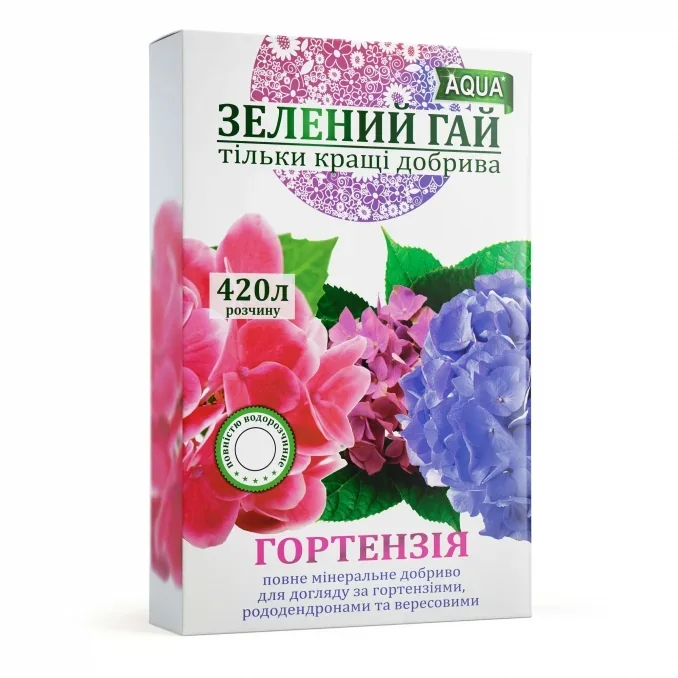
Zelenyi Hai Aqua · 300 g
For hydrangeas, azaleas and rhododendrons — plants that love acidic soil.
Travels in one parcel with the rest of your order — no separate delivery to pay for. The minimum order amount is 250 UAH. Shipped by Nova Poshta or Ukrposhta within 1–3 days all over Ukraine. Questions and orders by phone: (093) 727-55-00 — we are the manufacturer.
| Pack size | 300 g |
|---|---|
| Form | water-soluble |
| Price | 75 UAH |
| SKU | 562005 |
| Manufacturer | Gileya brand, Ukraine |
The pack says “complete mineral fertiliser for the care of hydrangeas, rhododendrons and heathers”. One box for the whole group of plants that need acidic soil. The powder dissolves completely in water; 300 g makes 420 l of solution, and this figure is printed on the front of the pack.
Hydrangea is the most popular crop in our range, and complaints about it repeat year after year in three scenarios.
The first: the leaves turn yellow while the veins stay green. It starts with the youngest leaves at the top, and the leaf gradually turns lemon-yellow with a sharp green network. The classic picture for a hydrangea growing on limestone soil or watered with hard tap water: there is iron in the soil, but the plant cannot take it up.
The second: the leaf edge darkens, dries and curls in the July heat — first along the outline, then inwards. Here two factors almost always overlap: lack of moisture and lack of potassium.
The third: there are flower heads, but they are small and faded. The shrub looks healthy, but the heads are half the size of those in the variety photo and quickly turn brown.
Separately — a situation the fertiliser does not solve at all: a bigleaf hydrangea shrub is all green, vigorous, and without a single flower. Most often these are last year's shoots, which should have carried the buds, damaged by frost, or incorrect spring pruning. Nutrition has nothing to do with it.
The powder is diluted in water according to the dosage on the pack and poured under the shrub. Hydrangea has a shallow fibrous root system, so pour over the whole crown projection, not at one point next to the stem.
The key moments of the season: April–May, when the leaves are growing; June, when the flower heads are set and filling; early August for panicle hydrangea, which flowers on this year's shoots. After that, once every two to three weeks while flowering continues.
Foliar spraying makes particular sense here: with chlorosis, when the root cannot cope with uptake, nutrition arrives faster through the leaf. Do it in the morning or evening, always wetting the underside of the leaf as well.
And separately about water: if your tap water is hard, water the hydrangea with rainwater or water that has been left to stand. This is cheaper than any fertiliser and often gives a bigger effect.
This fertiliser will not turn a hydrangea blue. The flower colour of bigleaf varieties depends on soil acidity and the availability of aluminium, not on feeding. A pink variety on neutral soil will stay pink however much fertiliser you give it. Blue is obtained with separate acidifiers, and not with all varieties.
It does not lower soil acidity by itself. If the soil is limestone, acidic peat and conifer litter are added under the hydrangea, rather than relying on fertiliser.
It will not help a shrub that wilts every day at noon. Hydrangea has a large leaf area and evaporates a lot of water — what it needs is watering and mulch, not nutrition.
And do not feed hydrangea with nitrogen in September: the shoots will not have time to ripen and will be damaged by frost, and with them next year's flower buds.
300 g “Aqua” (75 UAH) is quick help for a shrub that has already turned yellow, and the most convenient option for a hydrangea in a large pot.
A 5 kg bucket of “Exquisite Hydrangea”, NPK 15-10-20 (610 UAH), is the most popular product on the site, and not by chance: hydrangeas are rarely planted singly. The granule rate is 60 g under a mature shrub, 25 g under a young one.
A 10 kg bucket (1090 UAH) — when hydrangeas are planted in a group or as a hedge; per kilogram it is the best price.
Usually people take a bucket as the main nutrition for the season and keep a box of “Aqua” in reserve — for when the leaves start turning yellow and you do not want to wait a month.
Hydrangea, azalea, rhododendron. NPK 15-10-20. 5 kg — 610 UAH. Discount by number of buckets: 2 — −4%, 5 — −7%, 10 — −10%.
No. The colour of a bigleaf hydrangea is set by soil acidity and available aluminium, not by fertiliser. We do not promise what the product does not do.
Typical chlorosis on alkaline soil or from watering with hard water. Try two steps at once: foliar feeding, because uptake through the roots is worse in this state, and switching to rainwater or water left to stand.
Rhododendron is named directly on the pack together with heathers, to which blueberry also belongs. These are plants with the same requirement for acidic soil. For large blueberry plantings we have a separate granular fertiliser, “Magic Blueberry”, NPK 15-12-20.
Most likely not. In bigleaf hydrangea the buds are set on last year's shoots — if they were damaged by frost in winter or cut off in spring, there will be no flowers regardless of nutrition. Panicle and smooth hydrangeas flower on this year's shoots; with them the cause is more often deep shade.
A granule is planned nutrition for the season: you apply it once and it works for months. “Aqua” is for when you need to act this week. They are not competitors but different tasks.
A bag of “Exquisite Hydrangea” — for hydrangeas, azaleas, rhododendrons.

A bag of “Autumn Hydrangea” — the last feeding of the season for hydrangeas, azaleas and rhododendrons.


A powder that dissolves in water: nutrition reaches the plant through both the roots and the leaves, so it works fast. 75 UAH per pack.

For petunias, surfinias and calibrachoa in hanging baskets and balcony boxes.


One fertiliser for the whole plot — flowers, shrubs, trees, vegetable garden.


For strawberries, wild strawberries and raspberries — for berry flavour and size.


