

Zelenyi Hai Aqua · 300 g
Aqua Tomato — water-soluble fertiliser for tomatoes and peppers, 300 g
For tomatoes in the greenhouse and in open ground.
75 UAH
Travels in one parcel with the rest of your order — no separate delivery to pay for. The minimum order amount is 250 UAH. Shipped by Nova Poshta or Ukrposhta within 1–3 days all over Ukraine. Questions and orders by phone: (093) 727-55-00 — we are the manufacturer.
| Pack size | 300 g |
|---|---|
| Form | water-soluble |
| Price | 75 UAH |
| SKU | 562006 |
| Manufacturer | Gileya brand, Ukraine |
What this fertiliser is
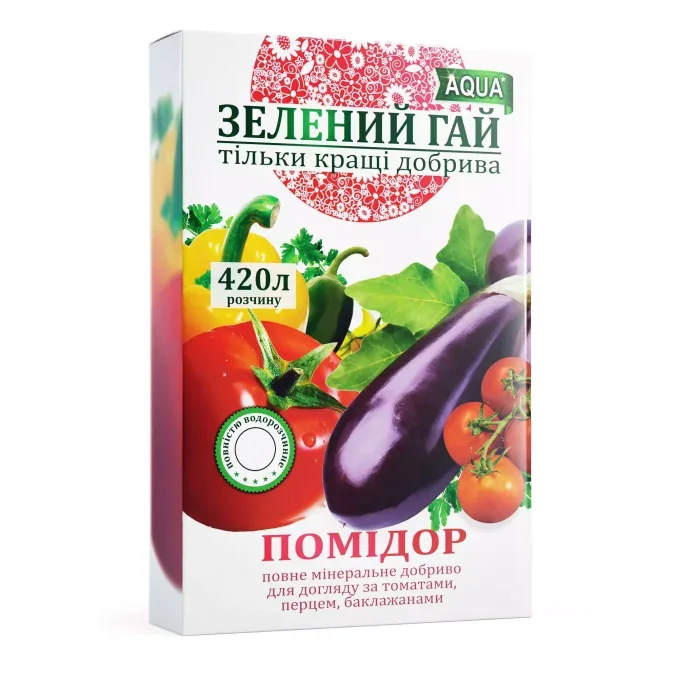
The box says “TOMATO” in large letters, and below — “complete mineral fertiliser for the care of tomatoes, peppers, aubergines”. So one pack covers all the nightshades in the greenhouse. The powder dissolves completely in water; 300 g makes 420 l of solution, and for a greenhouse that is a lot of waterings.
When the plant needs it
The tomato is convenient in that it shows its needs on its leaves, and they should be read from the bottom up.
The lower leaves turn yellow evenly while the top stays dark green: the plant itself takes nutrition from the old leaves and moves it into the young ones and into the fruit set. The signal usually appears when the first truss is filling out.
The leaf edge pales, then turns brown and dry, and the leaf curls like a boat — a typical picture for the period when several trusses hang on the plant at once.
Leaves with a purple tint on the underside call for caution with conclusions. This happens with a phosphorus deficiency, but far more often on cold soil in May, when there is phosphorus in the ground but the cold roots do not take it up. After a week of warmth it all passes by itself.
And separately — blossom-end rot, a dark sunken spot on the tip of the fruit. People regularly try to treat it with fertiliser, but the cause is almost always something else: uneven watering. Calcium moves through the plant with the flow of water, and when the soil alternately dries out and gets flooded, it simply does not reach the fruit, however much of it there is in the ground.
How to apply
The solution is prepared according to the dosage on the package and watered at the root. For tomatoes this is especially fitting: the soluble form can be given with a regular watering, without trampling the greenhouse soil one extra time.
The rhythm follows the growth stages: the first feeding two weeks after planting out, when the seedlings have established; then every 10–14 days. The moment that gives the most is the start of the first truss filling out.
Foliar spraying in a greenhouse is done in the morning, so that the leaves have time to dry before night: moisture on the leaves at night is a direct path to fungus.
One more practical point: before feeding, water the bed with clean water, and only then give the solution. On dry soil a concentrated solution can burn the fine roots.
What this fertiliser will not do
Fertiliser has no effect on late blight. Brown wet spots on the leaves and fruit in a damp August are a fungus; you need a fungicide and greenhouse ventilation. What is more, a plant overfed with nitrogen, with thick soft leaves, gets sicker.
It does not cure blossom-end rot. Set up even watering without drying out and mulch the soil — that gives more than any feeding.
It will not make a flower set fruit if it has dropped from the heat: above 32 °C the pollen is sterile, and only shading and ventilation will help here.
And do not feed nitrogen to a plant that is running to leaf — a thick stem, a curled top, solid foliage and no fruit set. Such a plant needs the opposite: less nitrogen and drying out a little.
Which pack to choose
Here the choice is simpler than for ornamental crops.
300 g of “Aqua Tomato” (75 UAH) is the working format for a greenhouse and a few beds. 420 l of solution lasts the season with a margin, and the soluble form suits tomatoes better than granules, because their needs change sharply from stage to stage.
There is no specialised granular fertiliser for tomatoes in the range. For large vegetable plots people take “Universal”: 500 g (89 UAH) for a bed, a 5 kg bucket of NPK 16-16-16 (610 UAH) for roughly one hundred square metres at a rate of 25 g per square metre, 10 kg (1090 UAH) for two hundred.
For seedlings on the windowsill before planting out there is a separate box — “Aqua Seedling”.
Frequently asked questions
Will it help against blossom-end rot?
Almost certainly not. Blossom-end rot arises not from a lack of calcium in the soil, but from it not reaching the fruit when watering is uneven. Correct the watering routine and mulch — that is more effective.
One fertiliser for tomatoes, peppers and aubergines — isn't that too weak?
These three crops are relatives from one family with a very similar feeding rhythm. That is exactly why the manufacturer names them together on the package.
When should I start feeding after planting out?
Roughly two weeks later, when the seedlings have established and started growing. Feeding right after transplanting is not advisable — the roots have to start working first. For this period there is “Aqua Rooting”.
Why is the NPK formula not given?
It is not printed on this package, and we are not going to make it up. Where the formula is on the pack — on the buckets and on some of the 500-gram bags — we give it.
More for this plant
The whole “Zelenyi Hai Aqua” line
A powder that dissolves in water: nutrition reaches the plant through both the roots and the leaves, so it works fast. 75 UAH per pack.

Aqua Petunia
300 gFor petunias, surfinias and calibrachoa in hanging baskets and balcony boxes.
75 UAH


Aqua Universal
300 gOne fertiliser for the whole plot — flowers, shrubs, trees, vegetable garden.
75 UAH


Aqua Strawberry
300 gFor strawberries, wild strawberries and raspberries — for berry flavour and size.
75 UAH


