

Magic Blueberry 500 g
500 gA bag of “Magic Blueberry” — for blueberries, cranberries and bilberries.
89 UAH
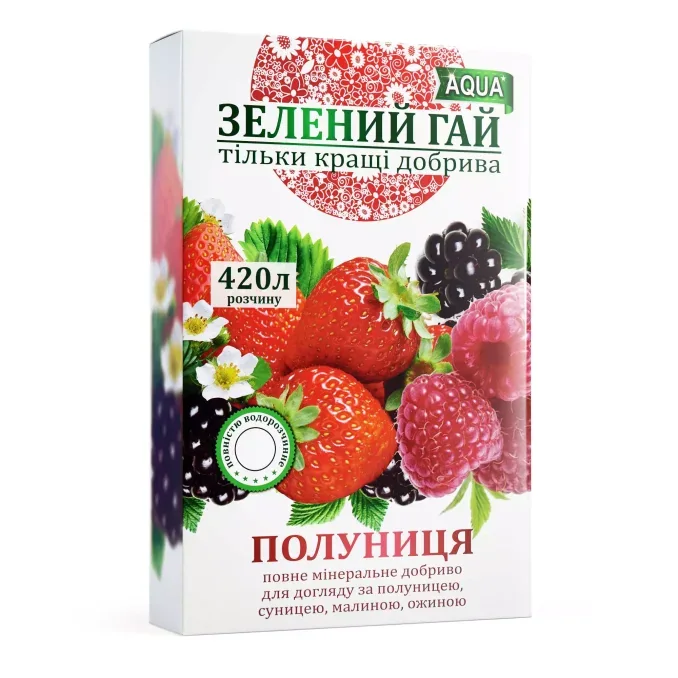
Zelenyi Hai Aqua · 300 g
For strawberries, wild strawberries and raspberries — for berry flavour and size.
Travels in one parcel with the rest of your order — no separate delivery to pay for. The minimum order amount is 250 UAH. Shipped by Nova Poshta or Ukrposhta within 1–3 days all over Ukraine. Questions and orders by phone: (093) 727-55-00 — we are the manufacturer.
| Pack size | 300 g |
|---|---|
| Form | water-soluble |
| Price | 75 UAH |
| SKU | 562009 |
| Manufacturer | Gileya brand, Ukraine |
“Complete mineral fertiliser for the care of strawberries, wild strawberries, raspberries, blackberries” — that is what the package says. One box for all the berry bushes and beds. The powder dissolves in water without sediment, and a 300 g box makes 420 l of ready solution.
The most important thing about strawberries concerns not symptoms but the calendar, and hardly anyone writes about it.
A strawberry gives its whole harvest in three to four weeks. Once the berry has started to whiten and fill out, feeding has little effect on that harvest — the plant allocated its resources earlier. So feeding at the height of fruiting is mostly too late.
The two moments that really work are different ones. The first: early spring, as soon as the leaves start to regrow. The second, which almost everyone skips: right after the harvest has been picked, in July–August. That is exactly when the strawberry sets its flower buds for the next year. What you feed the plant in August, you will eat next June.
What you see on a hungry bed: the old leaves take on a reddish-brown tint along the edge and dry from the edges; the berries are small, pale and bland even in a variety that used to be sweet; the plant sends out runners in all directions, but there are few flower stalks.
The solution is prepared according to the dosage on the package and poured under the plant, trying not to flood the crown — the growing point in the centre of the rosette. A wet crown easily rots in the heat.
The calendar for garden strawberries: the first feeding in spring on the regrowing leaves; the second at the budding stage, before flowering; the third and most important right after the harvest, once the old leaves have been cut off; if needed, a fourth at the start of autumn.
Raspberries and blackberries live by a different rhythm: they are fed in spring on the regrowing canes and after fruiting. The replacement canes growing this year are next year's harvest, so August feeding makes sense for them too.
Foliar spraying is done before flowering and after the harvest. Spraying over ripening berries is not advisable at all.
Fertiliser does not stop grey mould. A berry covered in fluffy grey coating in a rainy June is a fungus; what helps is mulch under the berries, thinning and treatment with a product. Excess nitrogen only makes it worse, because it makes the plant denser.
It does not rescue a bed that is more than four years old. Old strawberries get smaller regardless of feeding — such a bed is moved to a new spot using young rosettes.
It has no effect on the weevil that gnaws through flower stalks, or on the mite in the crown of the rosette.
And do not feed with nitrogen at the end of September or in October: the plant should go into dormancy, not into growth.
300 g of “Aqua” (75 UAH) — for a small bed and for those feedings that have to be done quickly, in a specific window. 420 l of solution is a great deal for a home bed; the pack carries over to the next season.
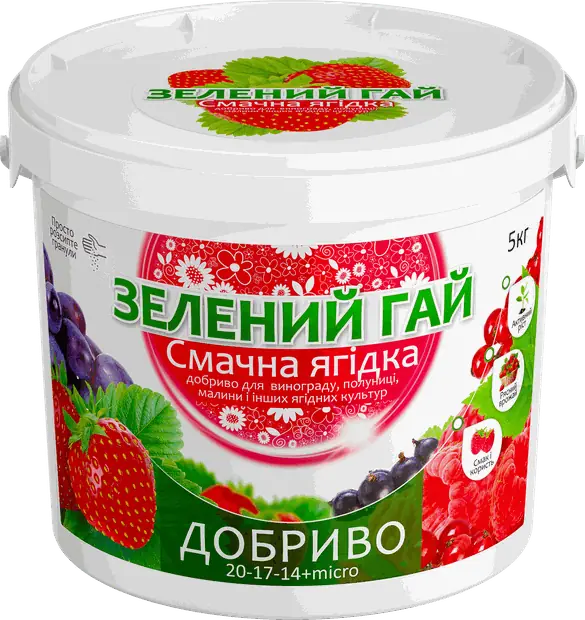
500 g of granular “Tasty Berry” (89 UAH) — for one bed or a few raspberry bushes.
A 5 kg bucket of “Tasty Berry”, NPK 20-17-14 (610 UAH) — for roughly one hundred square metres of berry patch per season; 10 kg (1090 UAH) for two hundred. For strawberries planted in rows, granules are more convenient: you scatter them over the bed once and get on with things.
Many people do this: granules in spring as the base, “Aqua” for the August feeding after the harvest, when speed matters.
Grapes, strawberries, raspberries. NPK 20-17-14. 5 kg — 610 UAH · 10 kg — 1 090 UAH. Discount by number of buckets: 2 — −4%, 5 — −7%, 10 — −10%.
Right after the harvest, in July–August. This is when next year's flower buds are set. It is the most underrated feeding in the whole berry calendar.
Only slightly. A strawberry gives its harvest in three to four weeks and allocates its resources in advance. Feed before flowering, not during picking.
Yes, both are named on the package together with wild strawberries and blackberries. The difference is not in the fertiliser but in the calendar: for raspberries the feeding of the replacement canes that will give next year's harvest is what matters.
No. It is a fungus, and it is dealt with by mulch, thinning and a fungicide. Excess nitrogen, on the contrary, makes the problem worse by making the plant denser.
A bag of “Magic Blueberry” — for blueberries, cranberries and bilberries.

A powder that dissolves in water: nutrition reaches the plant through both the roots and the leaves, so it works fast. 75 UAH per pack.

For petunias, surfinias and calibrachoa in hanging baskets and balcony boxes.


One fertiliser for the whole plot — flowers, shrubs, trees, vegetable garden.


