

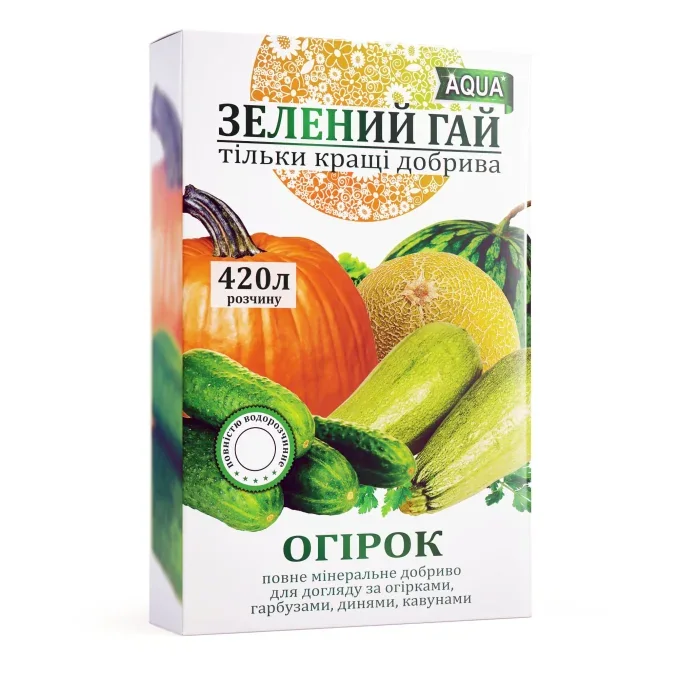
Zelenyi Hai Aqua · 300 g
Aqua Cucumber — water-soluble fertiliser for cucumbers and cucurbits, 300 g
For cucumbers — for fruit set and long fruiting.
75 UAH
Travels in one parcel with the rest of your order — no separate delivery to pay for. The minimum order amount is 250 UAH. Shipped by Nova Poshta or Ukrposhta within 1–3 days all over Ukraine. Questions and orders by phone: (093) 727-55-00 — we are the manufacturer.
| Pack size | 300 g |
|---|---|
| Form | water-soluble |
| Price | 75 UAH |
| SKU | 562007 |
| Manufacturer | Gileya brand, Ukraine |
What this fertiliser is
“Complete mineral fertiliser for the care of cucumbers, pumpkins, melons and watermelons” — that is what the box says. So it is a fertiliser for all cucurbits, not just cucumbers. The powder dissolves completely in water; a 300 g pack makes 420 l of ready solution.
When the plant needs it
The cucumber is a sprinter of a plant. It has a huge leaf surface and shallow roots, and it gives its harvest in waves, so it gets exhausted faster than anything else in the vegetable garden. And it sends its signals quickly too.
The most recognisable one is a pale rim along the edge of an old leaf, which gradually turns brown and dries out while the veins and the middle of the leaf are still green. It looks as if the leaf had been outlined in pencil. It usually appears on the lower tier during the second wave of fruiting.
Next comes the shape of the fruit. A cucumber that is narrow at the stalk end and swollen at the tip, thin at the end or bent like a hook: this deformation comes both from uneven watering and from a lack of nutrition while the fruit is filling out. If crooked fruit appears en masse at the end of July, the cause is most often that the plant has not been fed since the start of the season.
The third signal is the plant shedding its ovaries en masse: the tiny cucumbers turn yellow at the base and drop off. Here heat, poor pollination and a lack of nutrition after intensive harvesting all overlap.
And the general background of exhaustion: the vines get thinner, new leaves get smaller, and the plant bears fruit only at the ends of the vines.
How to apply
Dilute the powder in water according to the proportion on the package and water at the root on moist soil. Cucumber roots sit in the top 20–25 cm, so there is no point in pouring deep — the solution should stay where the roots are.
The rhythm is more frequent than for most crops: roughly once every 7–10 days from the start of flowering to the end of fruiting. The most important moment is right after each big wave of harvesting: the plant has just given everything and needs to recover for the next wave.
Foliar spraying works well here, because cucumber leaves are large and thin. Do it in the evening and be sure to treat the underside of the leaf.
Do not feed cucumbers in the midday heat — neither at the root nor on the leaves. Wait until the temperature drops.
What this fertiliser will not do
Bitterness in cucumbers does not come from fertiliser and is not cured by fertiliser. It is caused by water stress — drying out, watering with cold water, sharp swings — plus the variety's tendency.
Downy mildew and powdery mildew are fungal diseases. Yellow angular spots on top and a grey coating on the underside of the leaf mean you need a fungicide, not feeding.
Hollows inside the fruit at the end of the season cannot be fixed by feeding either.
And there is no point feeding a plant whose stem base has rotted: this is root rot, most often from watering with cold water or overwatering, and the plant has nothing left to take up the nutrition with.
Which pack to choose
300 g of “Aqua Cucumber” (75 UAH) is the main format for a greenhouse and vegetable beds. Cucumbers need frequent feeding for two to three months, and 420 l of solution covers that with a large margin.
There is no specialised granular fertiliser for cucumbers in the range. For a large vegetable plot people take “Universal”: 500 g (89 UAH) for a bed, or a 5 kg bucket of NPK 16-16-16 (610 UAH) for roughly one hundred square metres; 10 kg (1090 UAH) for two hundred.
Cucumber seedlings are fed with “Aqua Seedling” before planting out — it is designed precisely for the small volume of soil in a cup.
Frequently asked questions
Why do cucumbers grow hook-shaped?
The two most common causes are uneven watering and a lack of nutrition exactly while the fruit is filling out. Regular feeding with watering removes the second one; the first is cured by a watering routine and mulch.
How often should cucumbers be fed?
More often than most crops: roughly once every 7–10 days during fruiting. The most useful moment is right after you have picked a big wave of the harvest.
Is it suitable for watermelons and melons?
Yes, they are named directly on the package together with pumpkins. It is one family with very similar needs.
Will it remove bitterness?
No. Bitterness is a reaction to water stress and a property of the variety. Fertiliser does not affect it, and promising the opposite would be a lie.
More for this plant
The whole “Zelenyi Hai Aqua” line
A powder that dissolves in water: nutrition reaches the plant through both the roots and the leaves, so it works fast. 75 UAH per pack.

Aqua Petunia
300 gFor petunias, surfinias and calibrachoa in hanging baskets and balcony boxes.
75 UAH


Aqua Universal
300 gOne fertiliser for the whole plot — flowers, shrubs, trees, vegetable garden.
75 UAH


Aqua Strawberry
300 gFor strawberries, wild strawberries and raspberries — for berry flavour and size.
75 UAH


