


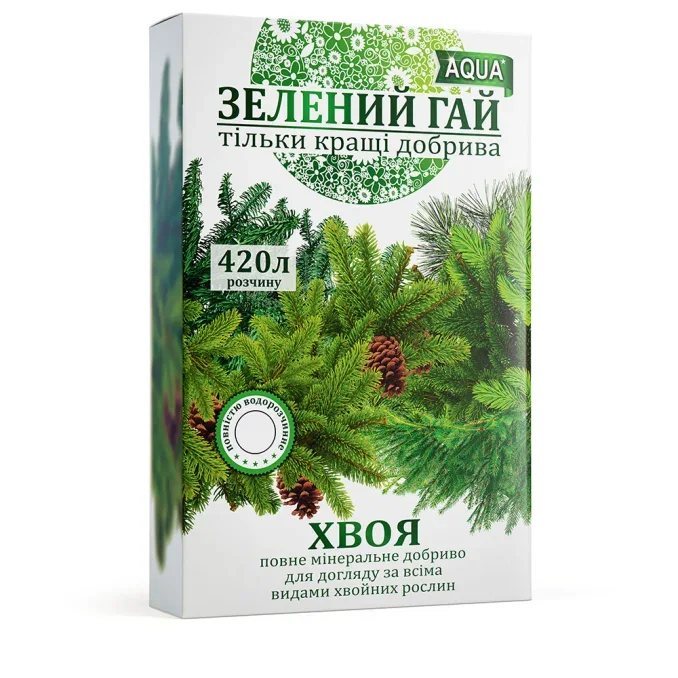
Zelenyi Hai Aqua · 300 g
Aqua Conifer — water-soluble fertiliser for thujas and conifers, 300 g
For thujas, junipers, pines and spruces — against browning of the needles.
75 UAH
Travels in one parcel with the rest of your order — no separate delivery to pay for. The minimum order amount is 250 UAH. Shipped by Nova Poshta or Ukrposhta within 1–3 days all over Ukraine. Questions and orders by phone: (093) 727-55-00 — we are the manufacturer.
| Pack size | 300 g |
|---|---|
| Form | water-soluble |
| Price | 75 UAH |
| SKU | 562004 |
| Manufacturer | Gileya brand, Ukraine |
What this fertiliser is
“Complete mineral fertiliser for the care of all types of conifers” — that is what the box says. The powder dissolves completely in water, so it works both through the roots and over the needles. 300 g makes 420 l of solution; for a thuja hedge that is many treatments.
When the plant needs it
“My thuja is turning brown” is the most common query about conifers, and in most cases the cause is not fertiliser. So first work out what exactly you are seeing.
If the old scales inside the crown, closer to the trunk, turn brown and drop while the outer layer is green — this is the normal seasonal change of needles; a thuja does this every year at the end of summer. There is nothing to feed for.
If the plant has turned brown or taken on a bronze tint evenly, on top and on the south side, and this happened at the end of winter or in March — it is winter burn. The needles evaporate water in the February sun, and the frozen roots do not supply it. Fertiliser is neither the cause nor the cure here; what is needed is shading and spring watering.
A real deficiency looks different: the plant gradually dulls over the season, growth is short, the young needles are lighter and smaller than last year's, and the shoot tips turn yellow. On poor sandy soils it is often last year's needles that turn yellow, starting from the tips, while the young ones are still normal. A spruce meanwhile goes bare from the bottom, and a juniper loses density and starts to look see-through.
How to apply
The solution is prepared in the proportion given on the pack and poured over the root zone — not right at the base of the trunk, but over the crown projection, because that is where the living roots work. Thujas in containers are watered in the usual way until water runs out of the drainage.
Spray over the needles only in cloudy weather or in the evening: the needles are covered with a waxy layer, and in the sun the solution dries on them in spots.
The season is from April to August. Conifers react slowly: do not expect a change within a week — you are feeding the growth of the coming months, not what has already grown. The most effective moments are May–June, when thuja and juniper put on their main growth, and August, when what the plant will take into winter is laid down.
What this fertiliser will not do
A needle that has turned brown will not turn green again. This is the most important thing to say honestly: dead needles do not recover, fertiliser affects only new growth, and the old brown patches will eventually drop or will have to be trimmed out.
Fertiliser does not save thujas planted in a hole in heavy clay where water stands after rain: the roots die there, and there is nothing left to take up the nutrition.
It has no effect on pests. If there is webbing inside the crown and the needles are covered with tiny dots — it is a mite or a leaf-mining moth, and you need a pesticide.
And do not feed conifers with nitrogen fertiliser in September–October: young growth will not have time to ripen. From the end of August switch to the autumn formula — “Autumn Conifer” has NPK 5-20-25, meaning it contains little nitrogen on purpose.
Which pack to choose
300 g “Aqua” (75 UAH) — when you have a few thujas, when they are in containers, or when the plant has already started to dull and you want to act quickly.
500 g of granular “Lush Conifer” (89 UAH) — for a few mature shrubs: the granule is applied once and forgotten for several weeks.
A 5 kg bucket of “Lush Conifer”, NPK 10-10-15 (610 UAH) — for a hedge and a group of conifers; 10 kg (1090 UAH) — when there are dozens of thujas along the fence. The granule rate: 25 g under a young plant or per square metre, 60 g under a mature shrub or tree.
The autumn option is separate, and it is better not to skip it: a bucket of “Autumn Conifer” 5-20-25 or a box of “Aqua Autumn”.
The same for the whole plot
Lush Conifer — a bucket for the plot
View the bucket
Thujas, junipers, pines, spruces. NPK 10-10-15. 5 kg — 610 UAH · 10 kg — 1 090 UAH. Discount by number of buckets: 2 — −4%, 5 — −7%, 10 — −10%.
Frequently asked questions
The thuja has turned yellow inside — is it from a lack of nutrition?
Most likely not. Shedding of old scales inside the crown at the end of summer is a natural process for a thuja. The worrying symptom is different: when the tips of young shoots and the outer layer of the crown turn yellow or brown.
Will the needles turn green after feeding?
Those already brown — no. The new growth will be green. That is why the result is seen not after a week but after a season.
When should thujas be fed for the last time?
For growth — no later than the last days of August. After that only autumn feeding, with low nitrogen, otherwise the young growth will go into winter unripened and be damaged by frost.
Can I spray the needles over the crown?
Yes, and this is one of the advantages of the soluble form. Just not in the sun: choose the morning, evening or a cloudy day.
How much solution does a pack make?
420 l — the figure is printed on the box. A mature thuja needs a few litres per watering, so a pack is enough for a hedge for the whole season.
More for this plant

The whole “Zelenyi Hai Aqua” line
A powder that dissolves in water: nutrition reaches the plant through both the roots and the leaves, so it works fast. 75 UAH per pack.

Aqua Petunia
300 gFor petunias, surfinias and calibrachoa in hanging baskets and balcony boxes.
75 UAH


Aqua Universal
300 gOne fertiliser for the whole plot — flowers, shrubs, trees, vegetable garden.
75 UAH


Aqua Strawberry
300 gFor strawberries, wild strawberries and raspberries — for berry flavour and size.
75 UAH


