


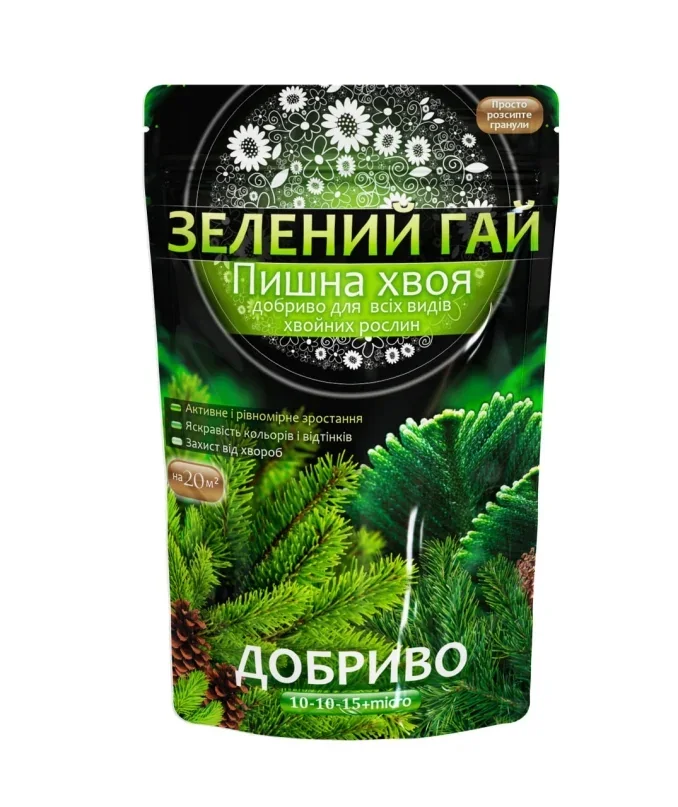
Zelenyi Hai · 500 g
“Lush Conifer” 500 g — fertiliser for thuja, junipers and pines
A bag of “Lush Conifer” — for a few thujas or junipers.
89 UAH
Travels in one parcel with the rest of your order — no separate delivery to pay for. The minimum order amount is 250 UAH. Shipped by Nova Poshta or Ukrposhta within 1–3 days all over Ukraine. Questions and orders by phone: (093) 727-55-00 — we are the manufacturer.
| Pack size | 500 g |
|---|---|
| Form | granular |
| NPK formula (printed on the pack) | 10-10-15 + micro |
| Treatment area (printed on the pack) | for 20 m² |
| Price | 89 UAH |
| SKU | 563002 |
| Manufacturer | Gileya brand, Ukraine |
What this fertiliser is
“Lush Conifer” is a fertiliser for thuja, junipers, pines, spruces and every other conifer on the plot. The pack is printed with 10-10-15+micro and, as a separate badge, “for 20 m²” — that is all the maths: 500 g at a rate of 25 g per square metre gives those same twenty metres. The NPK on the pack matches the formula of the “Lush Conifer” 5 and 10 kg buckets, so the pack is not a simplified version but the same product for one hedge instead of a whole alley. There is more potassium than nitrogen here, 15 versus 10, and that is no accident: conifers need not lush greenery but a dense and resilient crown.
When the plant needs it
A hungry thuja can be recognised by four signs. The first is colour: instead of a rich green the crown turns dull lime or grey, as if dusted. The second is browning from inside: the older needles deep in the bush turn rusty and drop, while from outside the plant still looks decent. The third is growth: this year’s young shoots are noticeably shorter than last year’s, the crown stops thickening and starts to show light through. The fourth — the lower branches yellow first, because the plant pulls the remaining nutrients up to the top. All this is typical of conifers that sit in one place for years: nobody changes the soil under a thuja, adds humus or digs the ground, and meanwhile the roots have taken everything they could reach.
How to apply
25 g — per square metre of the trunk circle or per young thuja; 60 g — per mature tree or large bush. The granules are spread around the circle of the crown’s projection, not in a heap by the trunk: conifers’ feeder roots spread outwards, and that is where the fertiliser is needed. The soil should be moist; the granules are mixed into the top layer and then watered. Granules must not be spread on wet needles — if they land on the branches, shake them off. A 500 g pack is enough for about eight mature thujas at a rate of 60 g or for twenty square metres of young plantings and hedges — the figure “for 20 m²” is right there on the packaging.
What this fertiliser will not do
“Lush Conifer” is a summer formula and is not applied in autumn: nitrogen before frost produces soft growth that freezes first, and for autumn there is a separate “Autumn Conifer”. Second: the fertiliser does not cure spring scorch. If a thuja comes out of winter rusty brown on the south, sunny side, that is not hunger. Those are dried-out needles: at the end of winter the sun warms the crown, it evaporates water, and the roots in frozen ground cannot supply it. What saves it is shading and moisture-charging watering in late autumn, not feeding in spring. Third: needle cast (Schütte), rust and other fungal diseases of conifers are treated with fungicides. Fourth — an overwatered thuja looks exactly the same as a hungry one, so check the drainage before spreading granules.
Which pack to choose
A 500 g pack for 89 UAH covers 20 m² — a hedge of a dozen young thujas or a few junipers in a mixed border. A 5 kg bucket for 610 UAH is 122 UAH per kilogram versus 178 UAH in the pack, and it makes sense when you have more than a dozen conifers or they are mature and take 60 g each. A 10 kg bucket for 1090 UAH (109 UAH per kilogram) is for alleys, hedges around the whole perimeter and nurseries. If you have just one or two thujas and the crown is already pale and needs a quick response, there is water-soluble “Aqua Conifer” 300 g for 75 UAH: it is diluted in water and acts faster, but also lasts less. Granules are for the whole season; “Aqua” is for the next few weeks.
The same for the whole plot
Lush Conifer — a bucket for the plot
View the bucket
Thujas, junipers, pines, spruces. NPK 10-10-15. 5 kg — 610 UAH · 10 kg — 1 090 UAH. Discount by number of buckets: 2 — −4%, 5 — −7%, 10 — −10%.
Frequently asked questions
Is this the same as in the “Lush Conifer” bucket?
Yes. The pack is printed with 10-10-15+micro — the same formula stated for the 5 and 10 kg buckets. We checked the print on the packaging itself.
How many thujas can one pack feed?
About eight mature ones — at a rate of 60 g per mature tree. For young plantings and hedges the count is different: the pack says “for 20 m²”, i.e. 25 g per square metre of the trunk circle.
My thuja has turned yellow — will this help?
It depends on exactly how it yellowed. If the whole crown lost colour gradually and growth is short — yes, that looks like a nutrient deficiency. If the browning is sudden, on one side, after winter — that is scorch, and fertiliser will not fix it. If the thuja is waterlogged — drainage first.
How often should conifers be fed?
The frequency “every 3–4 weeks, up to 5 times” stated by the manufacturer applies to lawns and flowers. We do not publish a separate frequency for conifers: the granules release nutrients gradually, and one application per season is the working minimum. See the pack for exact recommendations.
Can the granules be spread on dry soil or on snow?
No. The instruction has one clear condition: moist soil and watering after application. On dried-out or frozen ground the granules just lie there and do not work.
More for this plant

The whole Zelenyi Hai range
The same granules as in the bucket, just in a bag — for when you need one flowerbed, not the whole plot. 89 UAH per pack.


Magic Blueberry 500 g
500 gA bag of “Magic Blueberry” — for blueberries, cranberries and bilberries.
89 UAH


Exquisite Hydrangea 500 g
500 gA bag of “Exquisite Hydrangea” — for hydrangeas, azaleas, rhododendrons.
89 UAH


Autumn Hydrangea 500 g
500 gA bag of “Autumn Hydrangea” — the last feeding of the season for hydrangeas, azaleas and rhododendrons.
89 UAH