Gardening tips
Fertiliser for thuja: how to feed throughout the year
Thuja grows slowly but every year, and each trim takes away part of its reserves. We explain what to feed thuja with and when, from spring to autumn, how the routine differs for young plants, hedges and solitary trees, and which mistakes to avoid.
What thuja needs from a fertiliser
Thuja has a reputation as an undemanding plant, and that is exactly why it is often not fed at all. In the first years this goes unnoticed: the young plant lives on the reserves of its container substrate and the garden soil. Then the soil under the crown becomes depleted, and thuja roots lie shallow and cannot reach nutrients in the lower layers. The foliage gradually becomes paler, the annual growth shorter, and the crown thins out from the inside.
For thuja, what matters is not just the presence of nitrogen, phosphorus and potassium but the ratio between them. Nitrogen drives growth, but an excess of it makes the shoots soft and vulnerable to frost. Potassium strengthens the tissues and helps the foliage survive winter and the spring sun. Magnesium and iron deserve a separate mention: chlorophyll depends on them, and so does the rich green colour for which thuja is planted in the first place. That is why for thuja you choose formulas with moderate nitrogen, increased potassium and micronutrients, rather than just any fertiliser off the shelf.
Feeding calendar for the year
The annual routine for thuja has two parts: spring and summer feeding for growth, and one autumn feed for overwintering.
| Period | What is happening to the thuja | What to do |
|---|---|---|
| Winter to early spring | Dormancy, the soil is cold or frozen | Do not feed |
| April, when the soil has thawed and warmed up | Waking up, growth starts | First application of “Lush Conifer” |
| May — June | Main growth | Second application, a few weeks after the first |
| From the second half of July | Young shoots ripen | No more nitrogen fertilisers |
| August — first half of October | Preparation for winter | One application of “Autumn Conifer” |
| Late October — November | The plant goes dormant | A deep pre-winter watering before the frosts |
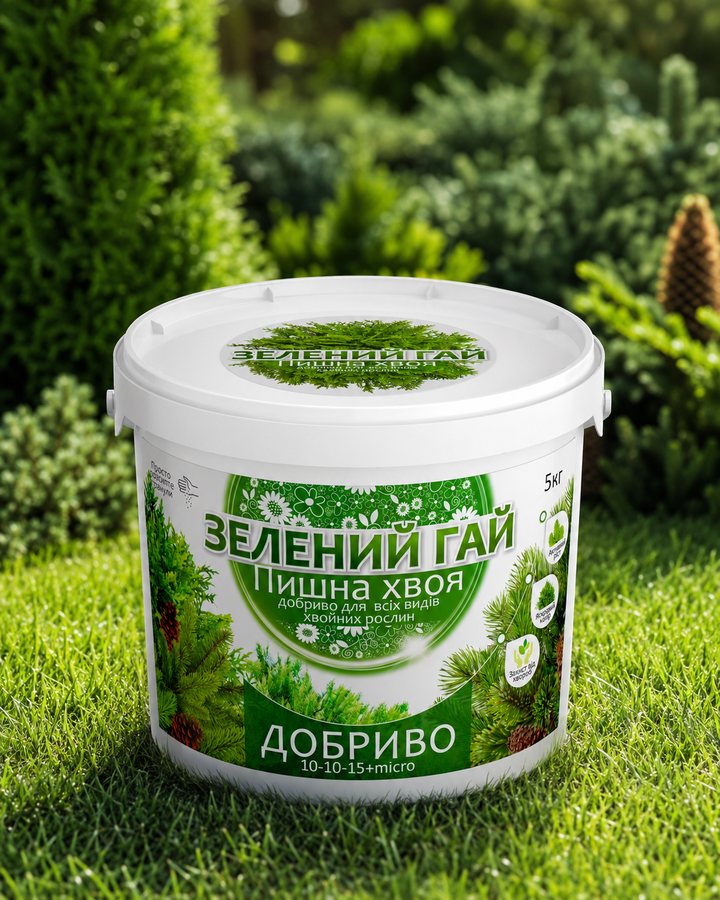
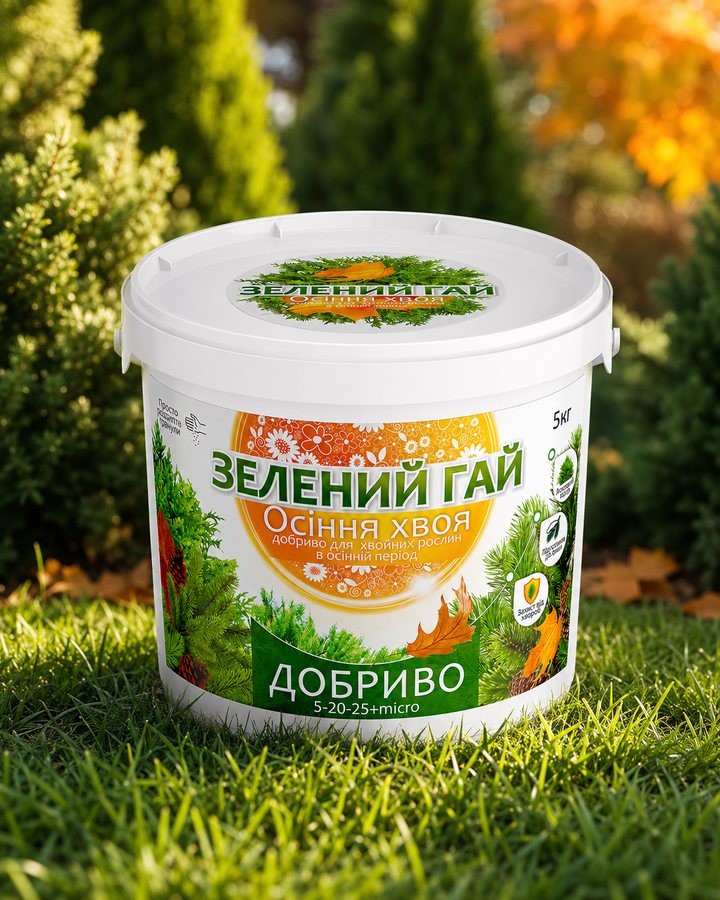
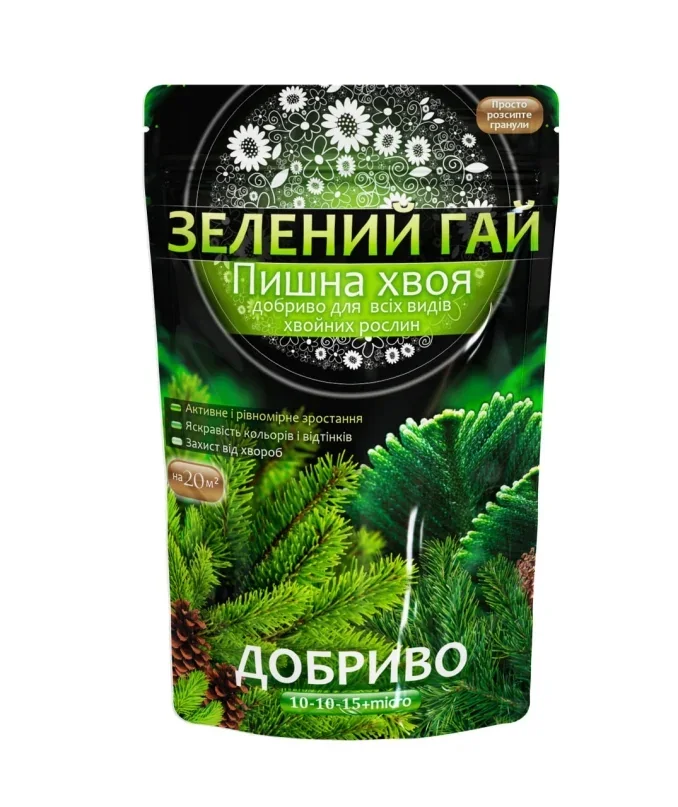
For spring and summer feeding, granular “Lush Conifer” with NPK 10-10-15 is suitable: its nitrogen is moderate, there is more potassium than the other nutrients, and its micronutrients include magnesium and iron. In autumn it is replaced by “Autumn Conifer” with NPK 5-20-25 — little nitrogen, a lot of phosphorus and potassium. It does not push growth but helps the foliage and roots prepare for the cold.
How to get off to the right start after winter — when to remove the cover, how to water and how to make the first application — is described in detail in the article on spring feeding of conifers. Here we will focus on what happens next.
Summer: feeding without haste
In summer thuja grows most actively, but that is exactly when it is easiest to make a mistake. Heat and drought exhaust the plant on their own, and granules on dry soil do not dissolve and do not work. So the summer rule is simple: water first, then fertiliser. The second application is made on moist soil — after rain or a generous watering — and watered in again afterwards.
The main summer cut-off is mid-July. After it, thuja gets no more nitrogen: shoots that grew at the end of summer do not have time to become woody and are the first to suffer frost damage or turn brown in spring. If you missed spring and remembered about feeding only in August, do not make up for lost time with “Lush Conifer” — go straight to the autumn formula.
In hot weather, sprinkling the crown in the evening or early morning is good for thuja: it washes off dust, refreshes the foliage and makes conditions less comfortable for spider mites, which love dry, stuffy heat. However, sprinkling does not replace watering at the root.
Autumn: the most important feed of the year
Autumn feeding is often considered optional, although for thuja it is no less important than spring feeding. The foliage does not drop: it keeps working and evaporating water all winter. A plant with a good reserve of potassium retains water in its tissues better and copes more easily with the frosty sun of late winter, when thuja most often gets scorched.
“Autumn Conifer” is applied once — ideally in August or early September, while the soil is warm and the roots are active. The first half of October is the latest date: after that the granules will mostly lie in the cold ground until spring. At the end of autumn, before the frosts, thuja is given a deep pre-winter watering, especially if the autumn has been dry.
Young and mature thuja: different rates
The rate per application is the same for both fertilisers and depends on the size of the plant:
| Plant | Rate per application |
|---|---|
| Young thuja, sapling, dwarf form | 25 g — 1 scoop |
| Mature thuja | 60 g |
| Continuous planting, a border of dwarf thuja | 25 g per 1 m² |
A freshly planted thuja does not need fertiliser in the first weeks: it needs to root, and excess salts near young roots only get in the way. It is fed once it has established and started growing — at the rate for a young plant. Thuja planted at the end of summer or in autumn gets only the autumn formula in the year of planting.
A mature thuja gets 60 g per application, and this portion should not be increased for large old trees. If a thuja is pale, look for the cause in water, soil or disease, not in too small a dose. The granules are spread under the outer edge of the crown, not next to the trunk: that is where the feeder roots are.
For one or two thuja by the entrance a bucket is not essential: “Lush Conifer” also comes in a 500 g pack — it is the same fertiliser. It is enough for twenty applications under a young thuja or eight under a mature one.
A hedge and a solitary thuja
A solitary thuja has all the space around it, and its roots spread in all directions. For it, the granules are spread in a ring along the edge of the crown, lightly raked in and watered.
In a hedge everything is different. The plants stand close together, the roots of neighbours intertwine, and they compete for the same soil. On top of that, the wall is trimmed at least once a year, and with every shoot cut off the thuja loses part of its stored nutrition. That is why a hedge without feeding thins out faster than individual trees. The rate is calculated for each plant in the row, and the granules are spread in a strip along the row on both sides. Planting, watering and trimming a green wall are covered in the article on a thuja hedge.
A hedge often borders a lawn. High-nitrogen lawn fertiliser that reaches the thuja root zone does not replace a separate feed for them: the grass gets denser from it, while the thuja produce soft growth that overwinters worse.
What not to do
- Do not apply fresh manure. It burns the shallow roots and gives an excess of nitrogen. Well-rotted compost as a mulch is quite another matter.
- Do not feed thuja with nitrogen after mid-July. Late growth does not have time to ripen before the frosts.
- Do not scatter granules on the foliage or right up against the trunk. Especially on wet foliage: granules that stick to it leave burns.
- Do not feed on dry soil. Water first, then granules, then water again.
- Do not treat brown foliage with fertiliser. Browning has several causes — from spring scorch to disease — and brown foliage will not turn green again. How to recognise the cause is explained in the article why a thuja turns brown.
- Do not increase the dose “to be on the safe side”. A double portion does not give double growth, and excess salts damage the roots.
Frequently asked questions
How many times a year should you feed thuja?
Usually three times: twice with “Lush Conifer” from April to mid-July and once with “Autumn Conifer” from August to the first half of October.
Can you feed thuja in late autumn or in winter?
No. In cold soil the roots do not absorb nutrients, and the granules will simply lie there until spring. The last application of the season is “Autumn Conifer”, no later than the first half of October.
What should you feed a thuja in a pot on a terrace with?
In a container the salts are not washed down into the depths, so granules easily overfeed the roots. For thuja in pots, water-soluble “Aqua Conifer” is more convenient: the solution is watered in at the root at the dosage on the pack.
Do thuja need the soil acidified?
No. Thuja are not acid-lovers like blueberries or rhododendrons, and grow well in ordinary garden soils. There is no need to deliberately acidify the soil under them.