Gardening tips
Why thuja turns brown and yellow
Brown foliage on a thuja is a symptom, not a diagnosis. Behind it is one of six or seven causes, and they are treated differently. We look at how to tell them apart by where exactly and when the colour changed.
The main thing first: brown foliage does not turn green again
Needles that have already turned brown do not recover — not from watering, not from fertiliser, not from treatments. Everything you do works on new growth and on stopping the damage from spreading. That is why the result of treating a thuja is visible not in a week but over a season: the dry patches shed or are clipped out, and young foliage closes over the crown.
Second: not every yellowing is a problem. At the end of summer and in autumn a thuja sheds old scales inside the crown, near the trunk. This is the natural renewal of foliage. It is worth worrying when the tips of young shoots or the outer layer of the crown change colour.
How to identify the cause by the symptom
| What you see | Most likely cause |
|---|---|
| At the end of winter or in spring the south side of the crown has turned brown | Spring sunburn |
| A rust-coloured patch low down on one side, as if scorched | Dogs or cats |
| The whole plant yellows, especially the tops, in hot weather or after a dry winter | Drying out |
| The tips of older foliage turn yellow or bronze, the crown “fades” in patches | Magnesium deficiency |
| Young growth is pale yellow, the soil on the plot is alkaline | Iron deficiency (chlorosis) |
| The whole plant is pale green, growth is weak | Nitrogen deficiency, poor soil |
| Individual branches turn brown, shoots die back from the bottom up | Fungal disease, root damage |
| Webbing, tiny pale dots on the foliage, chewed shoots | Pests: mites, aphids, moths |
Sunburn and drying out: water and sun
Spring sunburn
The most common cause of spring browning. At the end of winter the sun is already bright, the foliage warms up and starts evaporating water, while the roots in frozen soil cannot yet supply it. The foliage literally dries out. Young thujas and the south side of the crown suffer.
What to do: from February until the soil thaws, shade young plants with facade netting, burlap or white non-woven fabric, without wrapping them tightly. In late autumn, be sure to do moisture-charging watering. Do not touch damaged areas in spring until you can see whether the buds have woken, and then clip out the dry parts.
Drying out
Thuja has shallow roots and tolerates drought poorly, especially in the first two or three years after planting. In summer heat it yellows across the whole crown; in winter it dries out after a dry autumn.
What to do: infrequent but deep watering, mulch of bark or sawdust a few centimetres thick, sprinkling the crown in the evening on hot days. The opposite extreme also does harm: in a hole of heavy clay where water stands after rain, the roots rot, and the thuja browns just as it does from drought.
Magnesium and iron deficiency
Magnesium is part of chlorophyll. When it is lacking, the foliage turns yellow and bronze — the older foliage first, at the tips. This is common on light sandy soils and on acidic leached soils. Iron is responsible for the green colour of young growth; on alkaline, limy soil it becomes unavailable, and new foliage grows pale yellow. More on how to tell a deficiency of one micronutrient from another is in the article on micronutrients for plants.
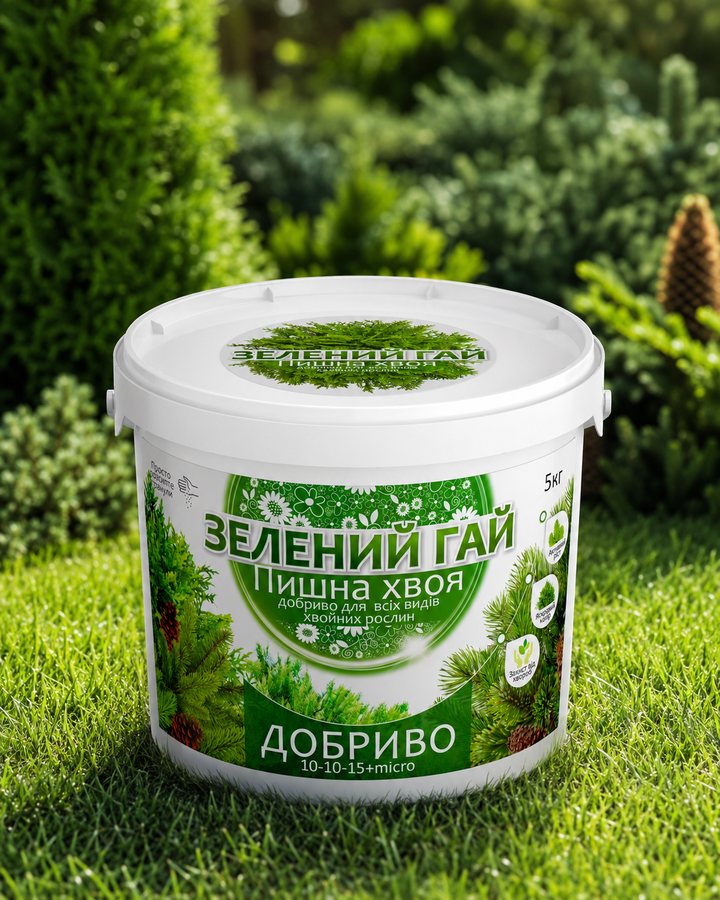
What to do: feed conifers with a balanced fertiliser with magnesium and iron during the growing season. For thujas, junipers, pines and spruces we recommend the granular “Lush Conifer” (NPK 10-10-15 with MgO, Fe and other micronutrients). The rate is 25 g (1 scoop) for a young plant, 60 g for a mature one. The granules are scattered over moist soil under the spread of the crown, lightly worked in and watered.
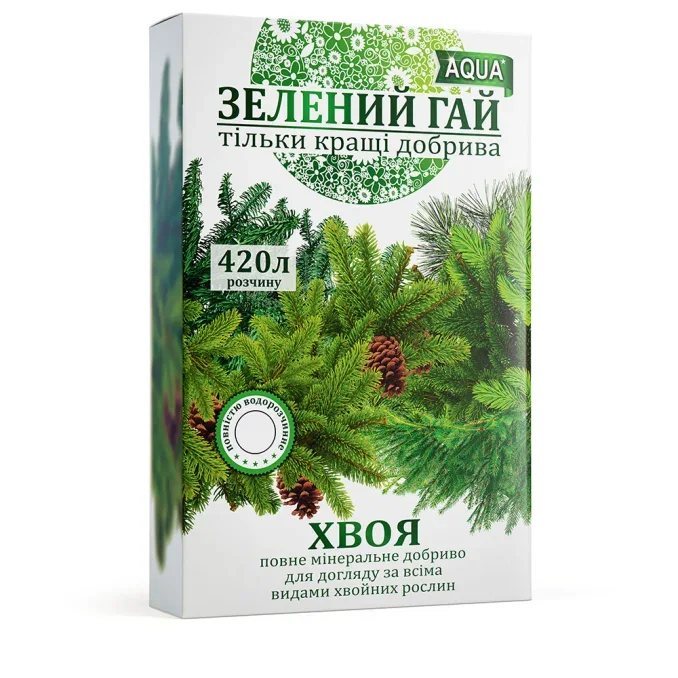
When a faster effect is needed, the water-soluble “Aqua Conifer” works: it is given with watering or sprayed on the crown in overcast weather or in the evening. Dosage is on the packaging.
Dogs and cats
A rust-coloured patch low on the crown on one side is almost always a sign of animals. Urea and salts burn the foliage and salinise the soil near the roots.
What to do: immediately rinse the crown and soil generously with water, put up a low fence or netting. Clip out dry branches once it is clear they will not grow back.
Diseases and pests
Fungal diseases of conifers — schütte (needle cast), fusarium dieback, rust — develop more often in dense plantings, in damp weather and on weakened plants. The typical picture: individual branches turn brown or shoots die back from the bottom up, and dark specks or a coating are visible on the foliage. Here you need fungicides, removal of affected branches and thinning of the planting. Fertiliser does not cure disease, but a healthy, well-fed thuja gets sick less often.
Spider mites, thuja aphids and leaf-mining moths produce tiny pale dots, webbing inside the crown and chewed shoots. Insecticides or acaricides are needed, according to the instructions.
How to feed thujas through the year
- April — mid-July: “Lush Conifer”; the most effective moments are May–June, when the main growth happens.
- From the second half of July: we no longer give fertilisers with nitrogen — young growth will not have time to ripen and will be frost-damaged.
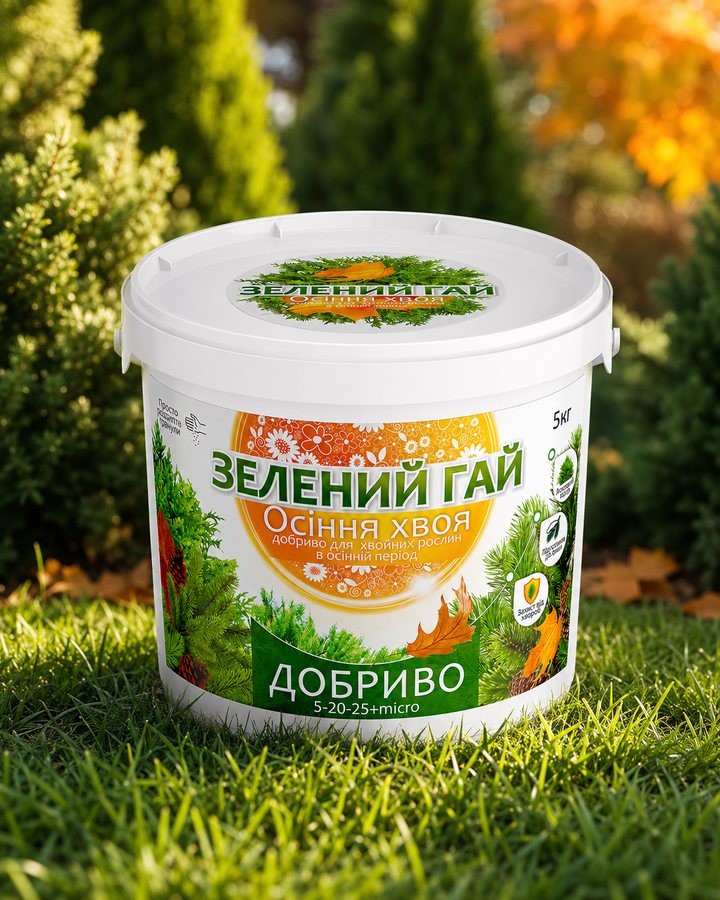
- Autumn: “Autumn Conifer” (NPK 5-20-25) — little nitrogen, a lot of phosphorus and potassium. It strengthens the foliage and roots before the cold, and this is direct protection against spring sunburn and winter drying out.
More on autumn feeding of the whole garden is in the article on autumn feeding.
Frequently asked questions
Can thujas be fed with manure or ash?
Fresh manure burns the shallow roots and gives excess nitrogen, which makes growth soft and worse at overwintering. Ash makes the soil more alkaline and impairs iron uptake — and that is a direct path to yellow growth. For conifers a balanced fertiliser with magnesium and micronutrients is more reliable.
How much fertiliser does a hedge need?
Count by plants: 25 g for each young thuja, 60 g for a mature one. For a hedge of young plants it is more convenient to scatter the granules in a strip along the row, on both sides, at a distance from the trunks.
Do junipers and pines need the same?
Yes, the rules are the same for thujas, junipers, pines and spruces: the feeding season runs from April to August, and in autumn an autumn formula with low nitrogen.
The thuja has yellowed on the inside in autumn. Is it a disease?
Most likely not — it is the natural shedding of old foliage near the trunk. The warning sign is when the outer layer and the tips of the shoots change colour.
When should brown branches be clipped out?
In spring, when the buds have started and you can see which part of the shoot is alive. Cut back to living green tissue.