Gardening tips
Planting young trees and shrubs
Most young plants die not from frost or disease but in the first season — from drying out, wrong depth and too much fertiliser in the hole. We go step by step through how to plant a tree or shrub so that it establishes.
When to plant
The planting time depends on how the plant is sold.
- Bare-root — only during dormancy: in spring before bud break or in autumn after leaf fall, with enough time before hard frosts for the root to take. A plant with open leaves and bare roots establishes poorly: the leaves evaporate water, and the damaged root cannot supply it fast enough.
- In a container — almost all season, as long as the ground is not frozen. But in hot weather planting requires especially thorough watering and shading for the first days.
For warmth-loving crops and plants of doubtful winter hardiness, spring planting is safer: over the season they have time to root before the first winter.
Preparing the plant
- Inspect the roots. Cut broken, dry and rotten roots back to healthy pale tissue.
- Soak bare roots in water for a few hours before planting if they dried out in transit. A root that has dried out is the main reason a plant “doesn't wake up” in spring.
- Water a container plant an hour before planting. If the roots have tightly circled the root ball, carefully tease them loose on the outside, otherwise they will keep growing in a ring in the hole.
The hole: width matters more than depth
Young roots grow mostly sideways, in the top layer of soil. So the hole is made noticeably wider than the root system — roughly one and a half to two times — and only deep enough for the roots to fit without bending upward. A hole that is too deep, filled with loose soil, settles over time, and the plant ends up buried too deep.
The fertile topsoil from the hole is set aside separately — it will be used to cover the roots. If the soil is heavy, well-rotted compost is added to it, but it is not entirely replaced with peat or a bought mix: a root used to a “soft cushion” is reluctant to grow beyond the hole into the dense surrounding soil.
What not to put in the hole
- Fresh manure — it burns the roots and heats up as it decomposes.
- Mineral fertiliser granules in direct contact with the roots. Concentrated salts next to a damaged root that is not yet working are one of the common causes of young plants dying. The first feeding is done later, on the surface, once the plant has taken.
- An unknown “nutrient mix” in an amount that fills the whole hole.
Planting step by step
- Pour a mound of fertile soil at the bottom of the hole. For trees, drive in a stake beforehand on the side the prevailing winds blow from — later, next to the roots, this is awkward and dangerous.
- Set the plant on the mound and spread the roots down its slopes. A container plant is set in with its root ball.
- Check the depth. The root collar — the place where the root turns into the trunk — should be at soil level, allowing for the soil in the hole still settling. On fruit trees the graft union is left above the soil. Burying the root collar is one of the most common mistakes: the tree grows weakly, and the bark at the base may rot. The exception is some shrubs, such as currants, which are planted deeper so that they bush out.
- Cover the roots with fertile soil gradually, lightly shaking the plant and firming the soil with your hands so no air pockets remain between the roots.
- Form a basin with a soil ridge around the plant so the water does not run off.
- Tie the tree to the stake with a soft strap in a figure of eight, not tight against it.
The first watering and rooting fertiliser
Right after planting, the plant is watered generously with plain water — not a glass, but several buckets under a tree, so the soil settles and fits closely around the roots. If after watering the soil has sunk and exposed the roots, add more soil.
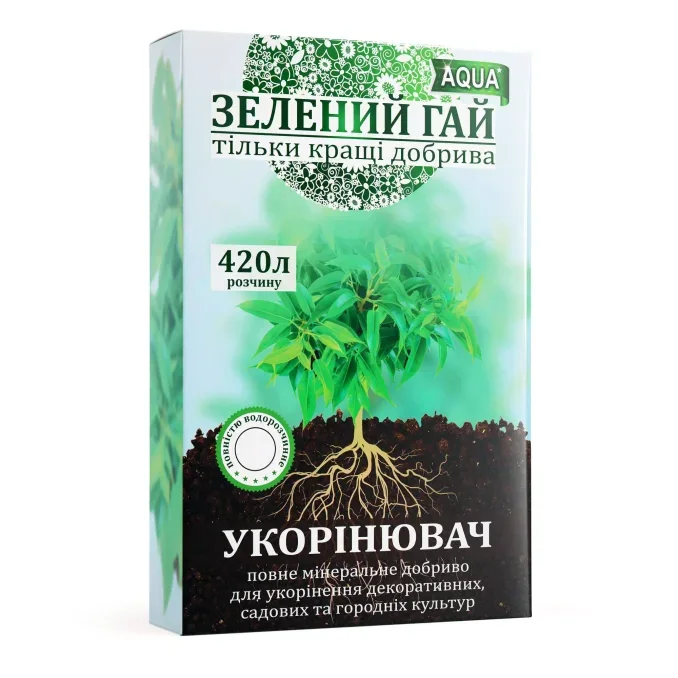
Next, the first weeks matter: the above-ground part is already evaporating water, while the root, damaged when dug up, works at half capacity. In this period “Aqua Rooting” helps — a water-soluble mineral fertiliser for rooting. It is not a hormonal stimulant: it feeds the plant while it rebuilds its roots. The solution is prepared in the proportion on the pack and the plant is watered with it after the first watering with plain water, and then two or three more times at 7–10 day intervals until the plant starts growing. With autumn planting it makes just as much sense: the root works until the soil freezes.
After watering, the area around the trunk is mulched with well-rotted compost, bark or grass clippings, without heaping mulch on the trunk itself. Mulch holds moisture and stops the soil drying out, and for a young plant this is the main thing throughout the first summer: in a drought, water less often but deeply.
The first feeding
A plant set in a prepared hole lives at first off what is in the soil. The first mineral feeding is done when the plant has taken and started growing — new leaves and shoots have appeared. With spring planting this is usually the end of spring — start of summer; with autumn planting, the following spring.
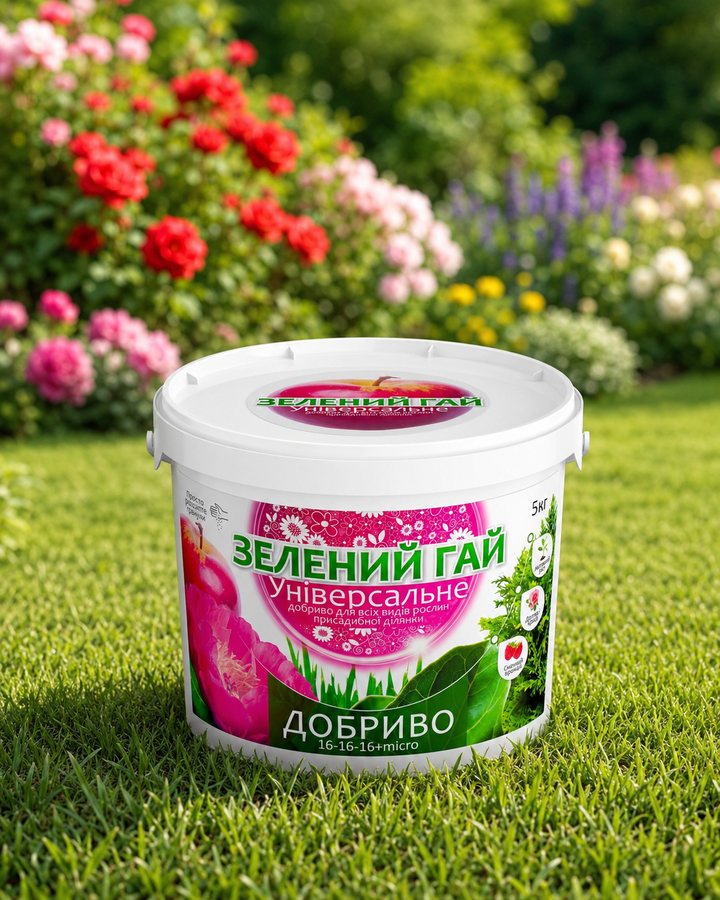
For most fruit and ornamental trees and shrubs the granular “Universal” (NPK 16-16-16) suits: per young shrub or young tree — 25 g, one scoop. The granules are scattered over moist soil in a circle at a distance from the trunk, carefully mixed into the top layer and watered in. From the second half of summer young plants are not fed nitrogen: late growth does not have time to ripen before the frosts.
How to feed the tree in the following years is covered in the article on feeding fruit trees, while young conifers need a separate formula — see the article on feeding conifers in spring.
Typical mistakes
- Buried root collar or graft union below ground.
- Fertiliser in the hole right against the roots.
- One watering at planting — and nothing more until autumn.
- Bare roots dried out in transit.
- A plant without support, rocked by the wind, tearing the young roots.
- Grass and weeds right up to the trunk in the first year: they take the water before the young plant does.