Gardening tips
Overfeeding with fertiliser: signs of burn and how to save the plant
An excess of fertiliser does harm faster and more severely than a deficiency. We explain how to recognise a burn, what to do in the first hours and how to dose so that it does not happen again.
Why excess fertiliser burns
A mineral fertiliser is salts. At normal concentration they dissolve in the soil water and the root takes them up together with the moisture. When there are too many salts, the solution around the roots becomes more concentrated than the sap in the cells, and water starts to move in the opposite direction — from the root into the soil. The plant wilts on wet ground, and the tender feeder rootlets die. This is chemical burn.
Most often it happens not because of a “bad” fertiliser, but because of a few typical mistakes: the dose was poured by eye, the granules were applied to dry soil, piled in a heap at the stem, the plant was fed twice in a row, or garden granules were put into a pot.
Signs of acute burn
Acute burn is visible a few days after application:
- the plant wilts even though the soil is moist;
- the edges and tips of the leaves turn brown and dry out, as if scorched;
- the lower leaves turn yellow and drop;
- a white or yellowish salt crust appears on the soil surface or on the walls of the pot;
- on a lawn — brown or straw-coloured patches where the granules landed more densely.
Signs of chronic excess
If the rate is exceeded not once but constantly, the picture is different — slow and less noticeable:
- Excess nitrogen: lush dark-green growth without flowers or fruit, soft long shoots that overwinter poorly; aphids are more willing to settle on such plants.
- Salt build-up in a pot: growth stops, new leaves are small, leaf tips constantly dry out, the soil becomes crusted.
- An imbalance of elements: an excess of one blocks the absorption of another — for example, excess potassium interferes with magnesium, and yellowing appears between the veins on old leaves. The article why leaves turn yellow will help tell such cases apart.
How to save a plant in the garden
If the rate has been exceeded, you need to act at once — before the burn reaches the main roots:
- Remove the top layer of soil together with the granules — everything that has not yet dissolved must be physically removed.
- Water heavily with clean water 2–3 times at intervals of several hours. The water washes dissolved salts from the root zone deeper down.
- Shade the plant for 3–5 days. Damaged roots cannot supply enough water to the leaves in the sun.
- Do not feed until new growth appears. Fresh leaves or shoots are a sign that the root has recovered.
The plant usually recovers. Damaged leaves will not turn green again, but new ones will grow healthy.
How to save a plant in a pot
In a pot the situation is worse: the salts have nowhere to go, and that is exactly why garden granules are not intended for containers. What to do:
- Remove the top layer of substrate with visible granules or a salt crust.
- Flush the pot: slowly run through it a volume of water several times the volume of the pot, and let it drain through the drainage holes. Do not leave water in the saucer.
- If the plant keeps wilting, and on inspection the root is brown and slimy — repot into fresh substrate, cutting away the rotten parts.
- Keep the plant in partial shade and do not feed it at least until a new leaf appears. After repotting, the fresh soil already contains nutrients.
Lawn and seedlings
Lawn. Water the whole area where the granules landed heavily — preferably several times in a row. If granules have remained on the grass, wash them off the leaves. Yellowed patches usually grow back because the growing points of grasses sit near the ground; completely dead areas should be overseeded in spring or autumn.
Seedlings. An overfed seedling becomes thick, brittle and establishes worse. Flush the cup with clean water; if the stem has darkened near the soil, it is better to transplant the plant into fresh soil.
How not to overfeed: dosing rules
- Measure, do not pour by eye. The granule rate for the range is 25 g (1 scoop) per 1 m² or per bush, 60 g under mature shrubs and trees. There is no scoop in 500 g bags: a tablespoon holds about 17 g, so a scoop is roughly one and a half spoons.
- Only on moist soil. Dry soil concentrates the solution near the roots.
- Not at the stem, but over the area under the crown. For a hydrangea, for example, granules are scattered 10–15 cm away from the stem.
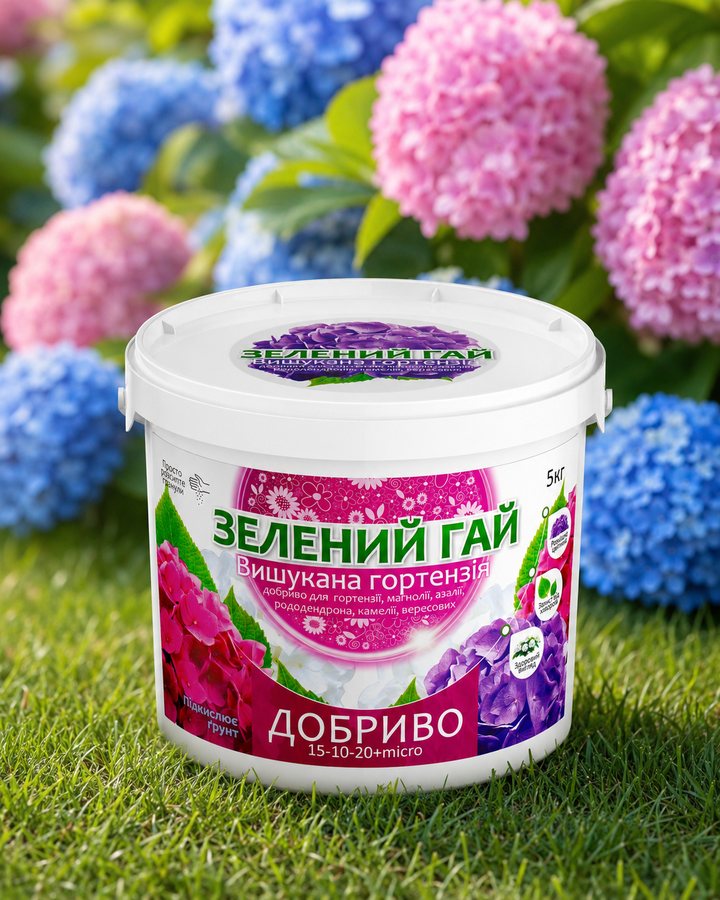
- Keep the interval. For “Exquisite Hydrangea” — at least three weeks between feedings. Do not boost the granules with a solution of the same formula on the same days.
- Sensitive plants get less. Bigleaf hydrangea — half the rate: it has the shallowest roots and the thinnest leaves.
- Do not feed a weakened plant. A freshly transplanted, sick or wilted plant will not absorb nutrition — deal with the cause first.
- Granules go into the soil, solutions into pots. How the forms differ and where each is appropriate is explained in the article granular or water-soluble fertilisers.
If you are not sure about the dose, take the smaller one: an underfed plant is easy to top up a week later, while an overfed one has to be rescued. How to convert the rate to the area of your plot is shown in the article how much fertiliser a plot needs.
Frequently asked questions
How quickly does a plant recover after a burn?
It depends on how badly the roots have been damaged. If help was given in the first days, new growth usually appears within a few weeks. Burned leaves do not recover — they can be removed once the plant starts growing.
Can the excess be neutralised with another fertiliser?
No. Any fertiliser means even more salts in the root zone. The only working method is to remove what has not dissolved and wash out what has dissolved with water.
Is it dangerous if granules get onto the leaves?
On dry leaves granules usually just roll off. On wet ones they dissolve and can leave burn spots. Shake them off or wash them off with water right after application.