Gardening tips
Micronutrients for plants: what each one does and how to recognise a deficiency
A plant needs only tiny amounts of micronutrients, but without them neither nitrogen, nor phosphorus, nor potassium works. We go through the eight elements found in every bucket of our range, and the signs of their deficiency.
Why micronutrients if there is NPK
Nitrogen, phosphorus and potassium are the foundation from which a plant builds itself. But the “building” itself happens through enzymes, and most enzymes do not work without an atom of a particular metal or other element. A plant needs minute amounts of iron, manganese, zinc or boron, but if even one is lacking, the rest of the nutrition is absorbed worse. The classic agronomic rule is the law of the minimum: the yield and condition of a plant are limited by the element that is scarcest, not the one that is most plentiful.
Every bucket of the garden range contains, besides NPK, MgO, Fe, Mn, B, Cu, Zn, Mo and Co. By the amount a plant takes up, magnesium is closer to the macronutrients, but by habit it is considered together with the micro ones.
The first key: old or young leaves
Before reading the table, remember one rule — it rules out half the options. A plant can move some elements from old leaves to young ones. When they are lacking, it sacrifices the lower leaves: symptoms appear at the bottom. This is magnesium (as well as nitrogen and potassium). Other elements are immobile: what has entered an old leaf stays there. Their deficiency is visible on young leaves and shoot tips. These are iron, manganese, boron, copper, zinc.
What each element does and what a deficiency looks like
Magnesium (Mg)
The central atom of the chlorophyll molecule. Without magnesium a leaf cannot be green. Deficiency: on old leaves the tissue between the veins turns yellow while the veins stay green; in some plants the leaves take on reddish or purple tints. It is common on light sandy soils and where potassium has been applied excessively.
Iron (Fe)
Needed for chlorophyll formation and cell respiration. Its deficiency is the best-known type of chlorosis: young leaves fade to lemon yellow while the veins stay bright green, like a net. The reason is rarely that there is no iron in the soil; more often it is there, but in alkaline soil the root cannot take it up. The first victims are hydrangea, blueberry, rhododendron, rose, grapevine. More details in the article why leaves turn yellow.
Manganese (Mn)
Takes part in photosynthesis. The deficiency resembles iron deficiency, but the picture is more mottled: a fine mosaic of pale spots appears between the veins, and the green bands along the veins are wider. It occurs in alkaline and over-limed soils.
Boron (B)
Responsible for cell division at growing points, pollen germination and fruit set. Deficiency: the growing tip dies, young leaves are deformed and brittle, flowers drop without setting fruit, fruits crack, the core of root crops turns brown. It occurs on sandy soils and after liming. Boron has a narrow range between deficiency and excess, so it is not applied separately “just in case”.
Copper (Cu)
Needed for respiratory enzymes and for lignification of tissues. Deficiency: the tips of young shoots wilt and curl, leaves turn pale, the plant seems to droop even in moist soil. Most often on peat soils.
Zinc (Zn)
Needed for the synthesis of growth substances. Deficiency: leaves are small and narrow, internodes are short, “rosettes” of tiny leaves form at the shoot tips. It occurs in alkaline soils and with excess phosphorus.
Molybdenum (Mo)
Without it a plant cannot convert nitrates into protein — the nitrogen is there but is not absorbed. The deficiency resembles nitrogen starvation: paleness, weak growth; in cabbage the leaf blade is underdeveloped and stays narrow. Unlike most micronutrients, molybdenum is less available in acidic soils.
Cobalt (Co)
Needed primarily by the nodule bacteria of legumes — peas, beans, lupins — which fix nitrogen from the air. For most plants its role is indirect, and a gardener usually does not notice any distinct visible deficiency symptoms.
Summary table
| Element | Where the deficiency shows | Main sign | Typical cause |
|---|---|---|---|
| Mg | Old leaves | Yellowing between green veins, reddish tints | Sandy soil, excess potassium |
| Fe | Young leaves | Lemon-yellow leaf, bright green veins | Alkaline soil, hard water |
| Mn | Young and middle | Mottled mosaic between the veins | Alkaline soil |
| B | Shoot tips, fruits | Dieback of the growing point, cracked fruits | Sandy soil, liming |
| Cu | Shoot tips | Wilting and curling of the tips | Peat soil |
| Zn | Young leaves | Small leaves, “rosettes” | Alkaline soil, excess phosphorus |
| Mo | All leaves | Paleness, as with nitrogen deficiency | Acidic soil |
| Co | — | Poor nodule formation in legumes | Poor soils |
Why a deficiency occurs even when the element is present
Most often micronutrients are not absent but unavailable. The main reasons:
- Soil pH. In alkaline soil, iron, manganese, zinc, copper and boron change into forms the root cannot take up. In acidic soil, molybdenum is less available. How to determine and correct acidity is explained in the article on soil pH.
- Cold and waterlogged soil. In such ground the root hardly works, so in spring chlorosis often passes by itself as soon as the soil warms up.
- An imbalance of one element. Excess potassium interferes with magnesium, excess phosphorus with zinc, lime with iron.
What to do
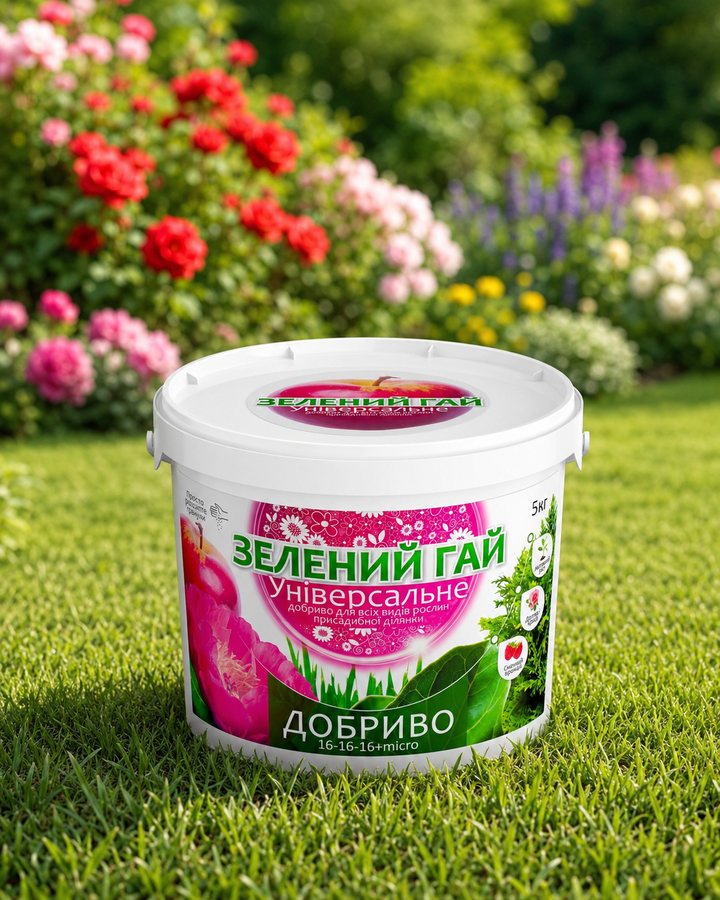
Prevention is regular feeding with a complex formula in which the micronutrients are already balanced: this is how, for example, Universal 16-16-16 and the rest of the buckets in the range are made. The feeds of the “Mister Tsvit” houseplant range carry the “STOP chlorosis” mark on the label — they contain micronutrients too.
Do not apply individual micronutrients “just in case”. The difference between the needed and the harmful amount is much smaller for them than for nitrogen or potassium, and an excess of one blocks the absorption of others. That is exactly why micronutrients are better obtained as part of a balanced fertiliser.
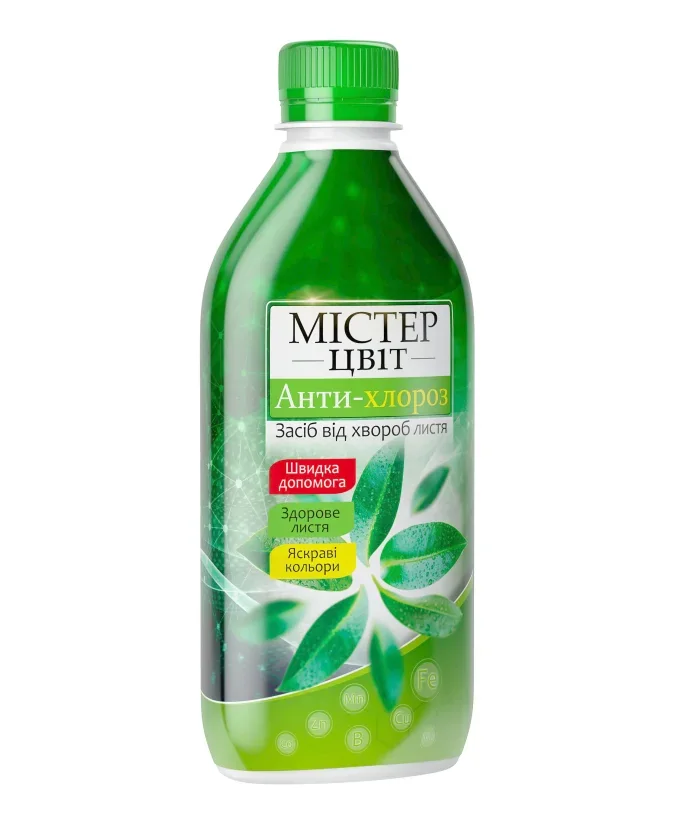
When symptoms have already appeared, targeted treatment will help. For houseplants and acid-loving plants in pots there is “Mister Tsvit Anti-Chlorosis” with Fe, Mn, Zn, Cu and B. But at the same time remove the cause — hard water, waterlogged soil, an alkaline reaction. Otherwise the yellowing will return. And remember: old yellowed leaves almost never turn fully green again — the result is visible in the new growth.