Gardening tips
Feeding rhododendrons and azaleas
Rhododendron and azalea do not forgive two things: alkaline soil and rough handling of the roots. Here is how to feed acid-lovers so that they flower every year, and what must not be done near them.
Soil first, then fertiliser
Rhododendrons and azaleas (garden azaleas botanically also belong to the genus Rhododendron) are acid-lovers. They need loose, moist but not wet soil with an acid reaction, roughly pH 4.5–5.5. On neutral or alkaline ground, iron and manganese turn into an unavailable form: the plant can stand in the best fertiliser and go hungry. The first sign is young leaves turning yellow while the veins stay green.
So before buying fertiliser, it is worth checking the pH and acidifying the soil if needed. How to do this at home and what is safe to acidify with is described in detail in the article on acid soil. The second condition is mulch of pine bark, conifer needles or acid peat. It retains moisture, protects the shallow roots from overheating and gradually maintains the acid reaction.
Why the roots demand care
The rhododendron root system is compact, fibrous and shallow — mostly in the top layer of soil. The roots are thin as hairs, so they are easily damaged by loosening and burned by concentrated salts. Hence the rules for applying granules:
- scatter evenly over moist soil along the crown projection, stepping back 10–15 cm from the stem;
- do not dig in, only gently mix into the top layer of mulch or soil;
- water and mulch again;
- do not let the granules get onto wet leaves.
What to feed with in spring and summer
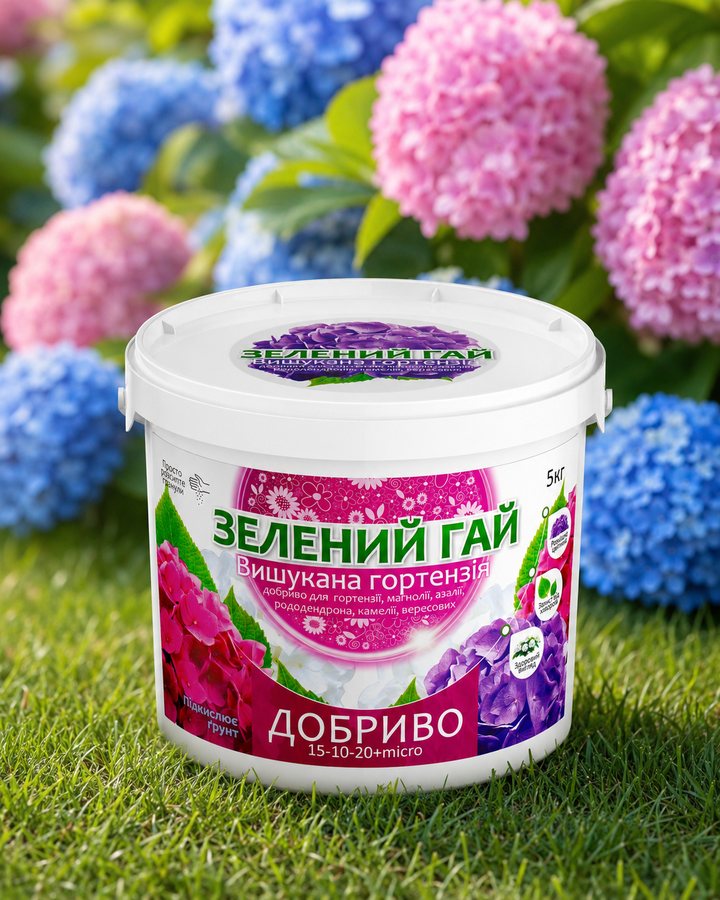
The granular “Exquisite Hydrangea” with NPK 15-10-20 is intended for hydrangeas, azaleas and rhododendrons. It acidifies the soil, and it has more potassium than nitrogen — good for abundant setting of flower buds. Trace elements, including iron and manganese, are already part of the formula.
| Plant | Rate per feed |
|---|---|
| A medium-sized bush or 1 m² of planting | 25 g — 1 scoop |
| Large spreading shrub | up to 37 g — 1.5 scoops |
Feed three times a season at intervals of at least three weeks:
- In April, when the soil has warmed to +10 °C. This often coincides with the swelling of flower buds.
- At the end of May — usually after flowering. This is when the bush builds up new growth on which next year's buds will be set.
- In the first half of July — the last feed with nitrogen.
After mid-July this fertiliser is not used. Nitrogen drives late growth that does not have time to ripen before the frosts, and the rhododendron enters winter with soft shoots. The 500 g packs have no scoop; a tablespoon holds about 17 g of this fertiliser.
Autumn feeding
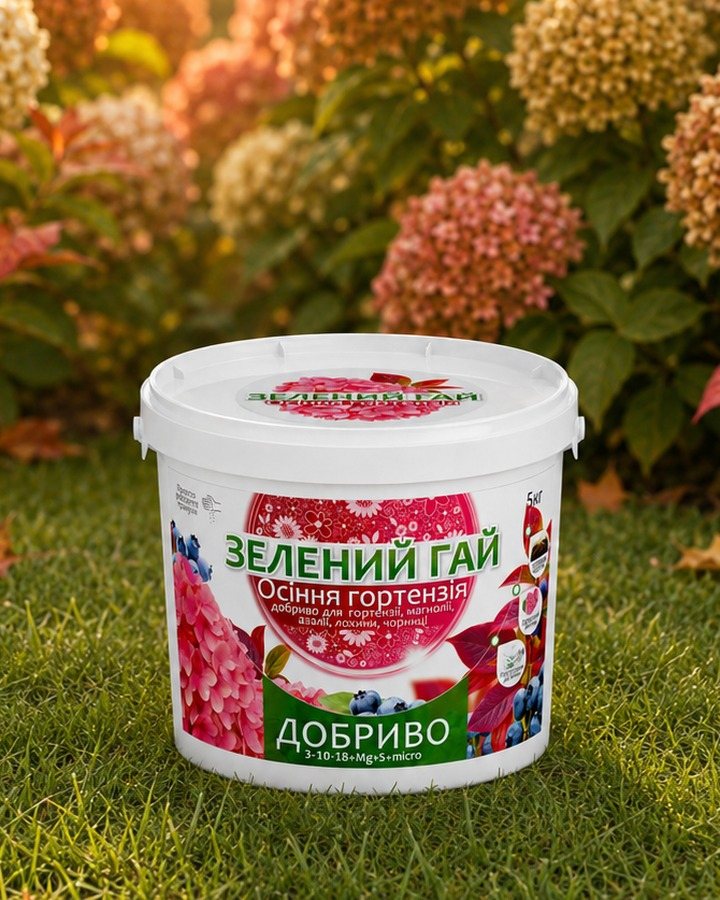
From August to the first half of October, while the soil is still warm, acid-lovers are given one autumn feed — “Autumn Hydrangea” with NPK 3-10-18. It has little nitrogen, so it does not provoke growth but helps the shoots ripen and set flower buds for next spring. The rate is 25 g under a mature bush, 12 g (0.5 scoop) under a young seedling. The granules are scattered along the edge of the crown projection, not right against the stem, lightly mixed into the top layer and watered in. This is the last feed of the season.
Evergreen rhododendrons keep evaporating water through their leaves in winter, so in autumn, before the soil freezes, they absolutely need an abundant moisture-charging watering. Leaves that curl into tubes in frost are a normal protective reaction, not a sign of disease.
An azalea in a pot is a separate story
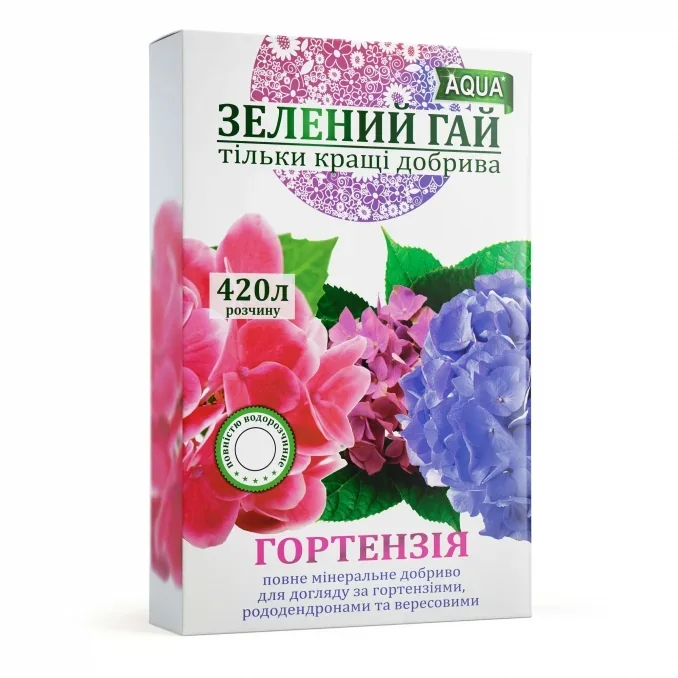
Indoor azaleas, as well as rhododendrons in containers on a terrace, are not fed with granular fertilisers. In a pot the salts are not washed down, and the concentration near the roots rises quickly. For potted plants the water-soluble “Aqua Hydrangea” is suitable — it is intended for hydrangeas, azaleas and rhododendrons. The solution is prepared according to the dosage on the pack.
It is best to water an indoor azalea with soft settled or rain water: hard tap water makes the substrate alkaline over time.
Typical mistakes
- Ash, lime, dolomite flour near acid-lovers. They make the soil alkaline — and within a season chlorosis appears.
- Planting near a concrete foundation or path. Lime from concrete gradually changes the reaction of the soil nearby.
- Watering with hard water for years. The effect accumulates slowly, so the cause is rarely linked to the water.
- Overfeeding. A doubled rate does not give double flowering — it burns the thin roots. If the leaves have browned at the edges after feeding, remove the top layer of soil with the granules, flush the bush generously with clean water (details in the article on overfeeding) and do not feed until new growth appears.
- Heat and open midday sun. Most rhododendrons do better in light dappled shade.
Frequently asked questions
The rhododendron does not flower. What is it lacking?
The most common causes: deep shade, a late nitrogen feed, drying out at the end of summer when the buds are being set, or pruning that cut off the flower buds. It is also useful to break off spent flower heads so that the bush does not waste energy on seed.
Can a rhododendron be fed with the same fertiliser as a hydrangea?
Yes, they have similar needs: acid soil, shallow roots, three feeds per season and one in autumn. The general rules for hydrangeas are in the article how to feed hydrangea.
When should a newly planted rhododendron be fed?
When the plant has established and started growing. For a young bush, use half the rate. The planting hole for a rhododendron is made wide and shallow and filled with acid substrate: a mix of acid peat, pine bark and conifer litter. The root collar is not buried — it should be at soil level.
The rhododendron's leaves turned brown on one side in spring. Is it hunger?
Most likely it is spring scorch: the sun is already bright, the leaves evaporate water, and the roots in cold soil cannot yet supply it. Fertiliser will not help here. Young bushes are shaded with non-woven fabric from February, and in late autumn a moisture-charging watering is a must. The damaged leaves eventually drop, and the new ones grow healthy.
Can I get by with only an autumn feed?
No. The autumn formula prepares the bush for winter and helps it set buds, but for spring growth the rhododendron needs nitrogen — without it new shoots are short and the leaves get smaller.