Gardening tips
Why leaves turn yellow: chlorosis, nitrogen deficiency or something else
Yellow leaves are a symptom, not a diagnosis. From which leaves are turning yellow and whether the veins stay green, the cause can be identified in a minute. Step by step — below.
Look at three things
Before applying anything, inspect the plant and answer three questions. They determine whether fertiliser is needed at all.
- Which leaves are turning yellow? Young ones at the top or old ones at the bottom?
- What about the veins? Do they stay green on a yellow background or turn yellow along with the leaf?
- What kind of yellowing? Even across the whole leaf, in spots, with brown edges or with dry areas?
Option 1. Young leaves yellow, veins green — iron-deficiency chlorosis
The most typical picture: the blade of a young leaf lightens to lime green or lemon, while the veins stay bright green, and the leaf looks like a ruled grid. In advanced cases the leaves turn almost white and the edges dry out.
The cause is rarely that there is no iron in the soil. It is there, but in an alkaline reaction the root cannot take it up. That is why chlorosis most often affects acid-loving plants — hydrangea, azalea, rhododendron, blueberry — as well as roses, grapes and citrus. Typical triggers: hard tap water, lime or building rubble in the soil, planting an acid-loving plant in ordinary garden soil, cold waterlogged soil in spring.
A similar picture, but on old leaves at the bottom — more often magnesium deficiency. A mottled mosaic of small spots between the veins — manganese. How to tell all the micronutrients apart is explained in the article on micronutrients.
Option 2. Old leaves turn yellow evenly — nitrogen deficiency
The yellowing starts from the lower leaves and creeps upwards. The leaf turns yellow entirely, veins included, without a grid. New leaves are smaller and paler than normal, growth is short, the plant seems frozen. Nitrogen is a mobile element: when it is lacking, the plant takes it from old leaves and gives it to young ones.
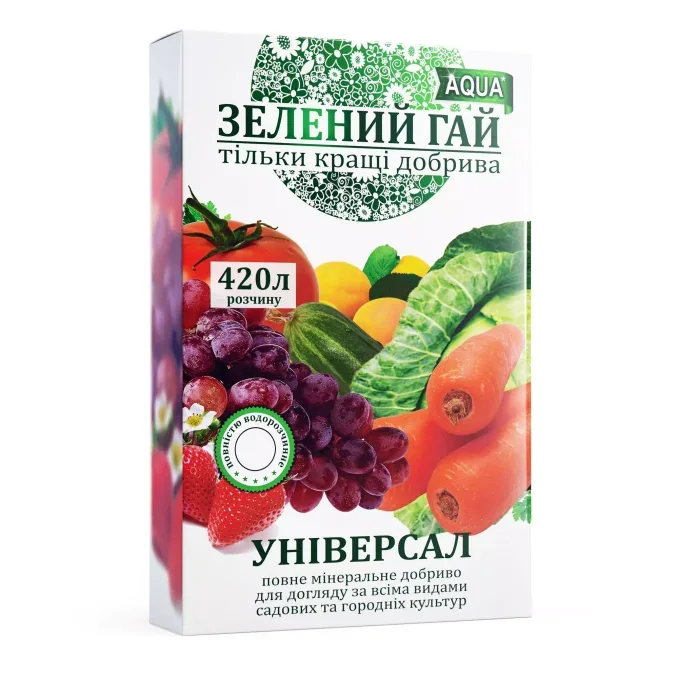
This is the simplest case. An ordinary feeding with a balanced formula helps; for a quick effect — water-soluble “Aqua Universal”, which acts through the root and the leaves. Recovery is seen in the new growth, not in the old leaves.
The exception is the second half of summer and autumn. If the lower leaves of a shrub turn yellow in August, nitrogen should not be given: it may be natural ageing, and nitrogen provokes late growth.
Option 3. Yellowing, but fertiliser has nothing to do with it
Many cases of yellowing are not related to nutrition at all. In these cases fertiliser will not help, and sometimes it will do harm.
- Overwatering. Leaves turn yellow and wilt while the soil is wet, lower leaves drop, the pot smells sour. The root is suffocating and rotting. First — watering and drainage.
- Drought. Leaves turn yellow and dry from the edges, become brittle; the soil is dry to a depth of several centimetres.
- Natural ageing. In autumn deciduous leaves turn yellow, and in thujas and pines the inner needles near the trunk. This is normal.
- Pests. Tiny pale dots, webbing, stickiness on the leaves — mites, aphids, thrips. Protection is needed, not nutrition.
- Transplant stress. The plant sheds a few lower leaves while the root establishes.
- Excess fertiliser. Leaf edges turn brown and dry, a white crust appears on the soil. What to do in this case is explained in a separate article on overfeeding.
Quick diagnosis table
| What you see | Likely cause | What to do |
|---|---|---|
| Young leaves yellow, veins green | Iron deficiency due to alkaline soil | Acidify the soil and water, chlorosis treatment |
| Old leaves yellow between green veins | Magnesium deficiency | Complex fertiliser with magnesium |
| Old leaves evenly yellow, weak growth | Nitrogen deficiency | Balanced feeding |
| Yellowing and wilting while the soil is wet | Overwatering, root rot | Stop watering, check drainage |
| Brown dry edges, crust on the soil | Overfeeding | Flush the soil, pause feeding |
| Pale dots, webbing | Pests | Protection products |
How to treat iron-deficiency chlorosis
- Check the soil pH. For acid-loving plants it should be acidic. How to do this at home and what to acidify with is covered in the article on soil acidity.
- Change your irrigation water. Hard water from the tap or a well gradually makes the soil alkaline. Rainwater or settled water is better.
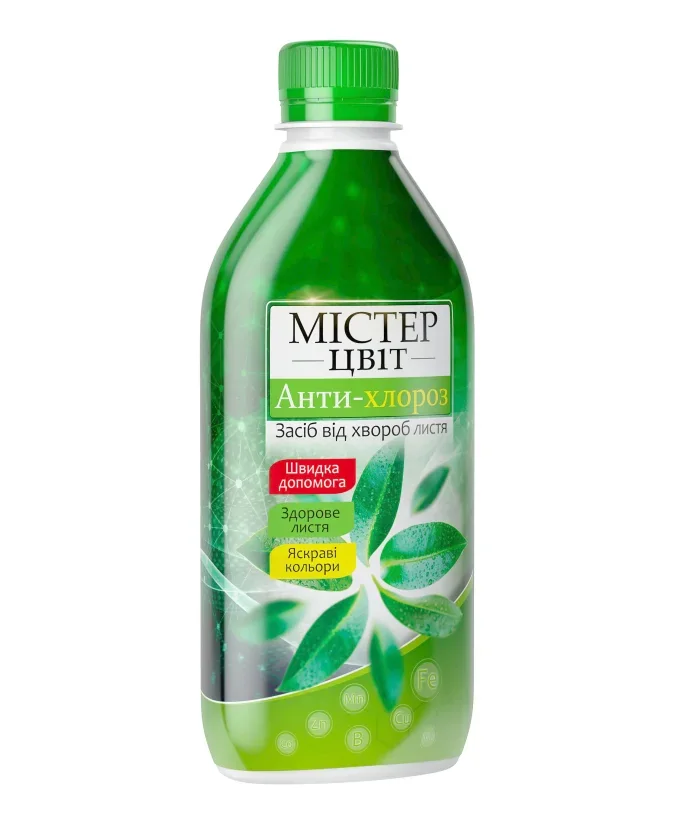
- Give targeted help. For plants in pots, indoor and container acid-loving plants — “Mister Tsvit Anti-Chlorosis” with Fe, Mn, Zn, Cu and B. Chlorosis is treated as a course: treatments are repeated as per the label until new leaves start coming out a normal colour.
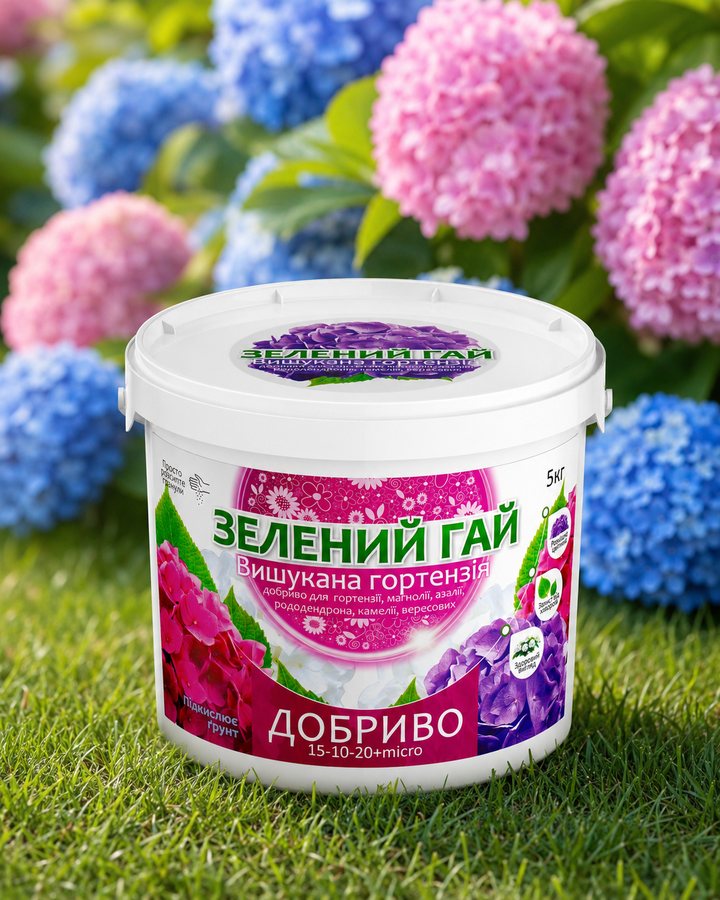
- Feed with the right formula. For hydrangeas, azaleas and rhododendrons in the garden — “Exquisite Hydrangea” 15-10-20: it acidifies the soil and contains micronutrients. An ordinary fertiliser for an acid-loving plant in alkaline soil will not solve the problem.
- Be patient. Old yellowed leaves almost never turn fully green again. The sign of success is new leaves of a normal colour.
How to prevent it from happening again
Chlorosis is a problem of the environment, not a one-off deficiency. It returns every time the cause returns. That is why acid-loving plants need acidic mulch, soft water and regular feeding with a special formula, not just a bottle kept “in case of yellowing”. For a hydrangea, for example, this means three feedings per season with a special formula — in April, at the end of May and in the first half of July.
Frequently asked questions
Why does chlorosis appear in spring and disappear by itself in summer?
In cold, wet soil the root hardly works, and even available iron enters the plant poorly. When the soil warms up, uptake resumes and new leaves come out green. If the yellowing persists all summer, the cause is in the soil or water, not the weather.
Will an iron nail or rust in the pot help?
No. Rust is insoluble iron that the root does not take up even in acidic soil, let alone in alkaline soil. A plant needs iron in an available form and the right acidity of the medium.
Why are the needles inside a thuja's crown turning yellow?
Most often this is natural ageing: the inner needles near the trunk die off and drop over time. It is worth worrying if the tips of shoots or whole branches on the outer side of the crown turn yellow or brown.