Gardening tips
Rooting products for plants: which to choose and when you need one
In short: a liquid product suits cuttings and houseplants, a water-soluble powder suits vegetable beds and saplings. A healthy, established plant does not need one.
What “rooting product” actually means
Products that work in different ways are sold under this name, and this is where people most often go wrong. There are hormonal root stimulants: they signal a cutting to start forming roots. There are feeds: they nourish the plant while it grows roots. And there are mixed products whose label lists both nutrients and special ingredients.
So read the label before you buy, not just the name. It decides what to expect: a feed will support the plant, but it will not make a cutting produce a root out of nothing.
When a rooting product is really needed
The most vulnerable time comes when leaves are already losing water and the root cannot yet take it up. There are three such situations:
- A cutting. There are no roots yet, and the plant lives on its own reserves.
- Repotting. Some of the root hairs are inevitably torn off, and the plant “stands still” for several weeks without new leaves.
- Planting out a sapling or seedlings. Especially if the root was cut back hard when dug up.
Here is how to recognise the problem: the soil is moist, yet the leaves droop at noon and recover by morning. This is not a lack of water. It is a root that is not working yet.
Liquid or powder: a table to choose by
| Task | What is more convenient | Why |
|---|---|---|
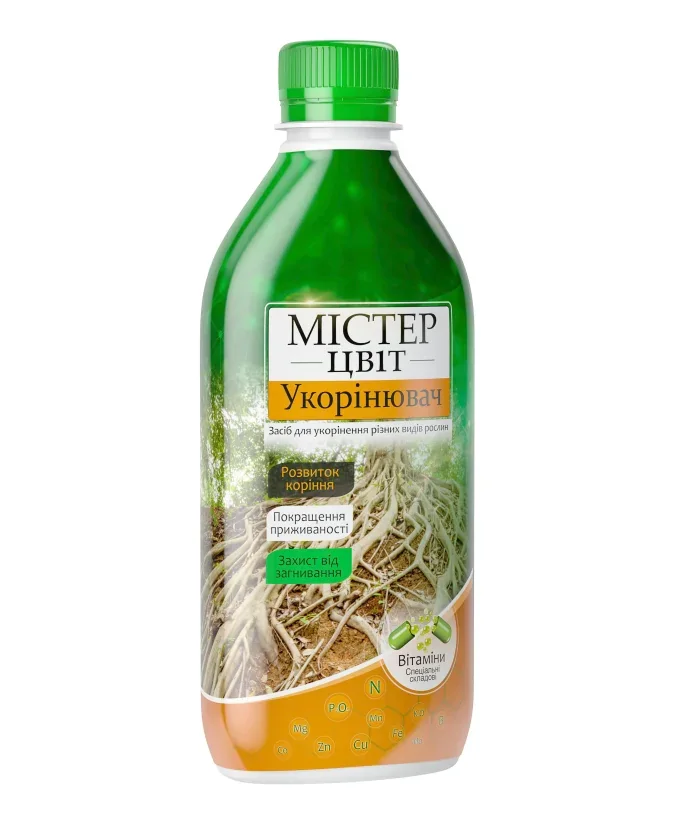
| Houseplant cuttings, a violet leaf, an orchid keiki | Mister Tsvit Rooting, 300 ml | liquid, dosed for a single pot; a cutting can be soaked in the working solution |
| A freshly repotted houseplant | Mister Tsvit Rooting | watered onto moist substrate |
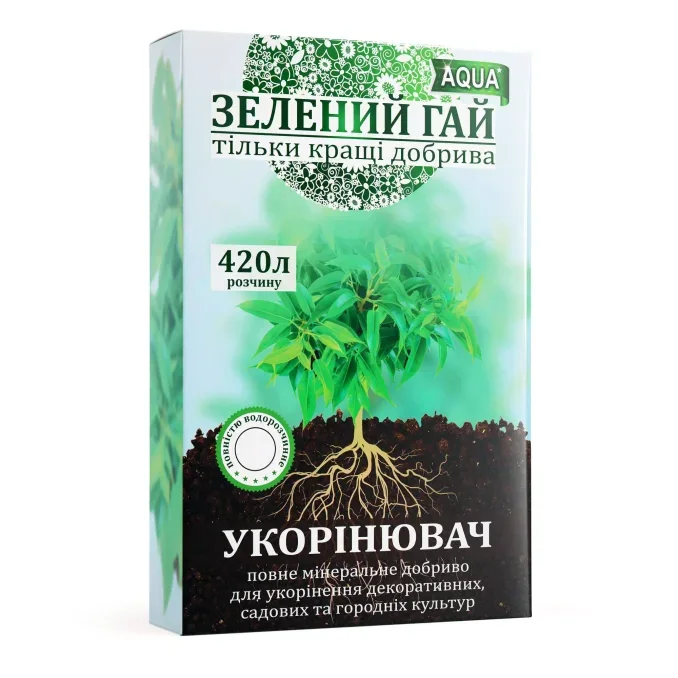
| Saplings in the garden, dividing perennials | Aqua Rooting, 300 g | the powder is diluted by the bucket; the box states a yield of 420 l of solution |
| Seedlings after pricking out | Aqua Rooting | enough for a whole bed |
How to apply
Always take the dose from the label of the specific product. The routine is simple.
Liquid Mister Tsvit Rooting
Cuttings are soaked in the working solution before planting, and freshly repotted plants are watered with it onto moist substrate. This is a course for the first weeks, not a single treatment. Once the plant has put out new leaves, put the product away.
Aqua Rooting powder
First water the plant with clean water so the soil settles against the root, then give the solution at the ratio on the pack. The simplest routine: right after planting, then two or three more times at 7–10 day intervals, until the plant starts growing. Water seedlings with the solution two or three days after pricking out, not on the same day.
A stronger solution does not work faster. A damaged root tolerates high concentration worst of all, so when in doubt, dilute more.
Rooting products for roses and cuttings
Roses are often grown from cuttings, and it is easy to see why people ask: such a cutting stays rootless for a long time and rots easily. Liquid Mister Tsvit Rooting also suits roses. But conditions matter more than the product: a fresh cut, a clean container, warmth, high humidity and diffused light. How to cut a stem and where to root it is covered in the article how to root cuttings.
What a rooting product will not do
- It will not revive a cutting with no growth bud or no leaves at all.
- It will not save a root that has already turned black and soft. That calls for cutting back to living tissue, not watering.
- It will not speed up what is slow by nature: fiddle-leaf fig, oleander and conifers take months to root whatever the product.
- It will not replace the right conditions. A cutting with no cover in a dry room will dry out before it puts out a root.
When to stop
A rooting product is needed for a short stretch. As soon as the plant has started growing and put out a few new leaves, its job is done. After that, move to the regular feed for your crop: for the garden see the feeding calendar, and for saplings the article on planting saplings. Keep both products tightly closed in a dry, dark place out of children's reach, and wear gloves while working.