Gardening tips
Month-by-month garden feeding calendar
The same fertiliser helps in April and does harm in September. We have put into one calendar when and what to feed in the garden from March to October.
The main principle: nitrogen first, then potassium
The whole garden calendar rests on one logic. In spring and early summer a plant builds up leaves and shoots — it needs nitrogen. In the second half of summer the shoots must ripen and the buds must be set for next year, so nitrogen is removed and phosphorus with potassium is given. The boundary is mid-July: after it perennials, shrubs and trees are not fed with nitrogen formulas, because late growth does not have time to turn woody before the frosts and is the first to be frost-damaged.
Exact dates depend on the region and the year. Go not by the date on the calendar but by the state of the soil: granules are applied when it has thawed, dried a little and warmed up. Fertiliser is not applied to frozen ground — meltwater will wash it away before the root starts working.
March: windowsill and seedlings
It is still early in the garden: the soil is cold, the roots are inactive. But on the windowsill the season has already begun. Seedlings that have produced true leaves need their first feeding — exactly when and how is explained in a separate article on feeding seedlings. As the days get longer, houseplants come out of winter dormancy: from March you can return to regular feeding.
In the garden at this time it is more useful to clear last year's leaves from the lawn, prune the roses and check whether water has collected in the circles around tree trunks. It is also a good moment to make a plan: work out the lawn area, the number of shrubs and trees, and prepare the required amount of fertiliser in advance, so that in April you do not apply it in a hurry and by eye. On southern plots, where the soil warms up earlier, the starter feeding sometimes shifts to the end of March — go by the state of the soil, not by the date.
April: starter feeding for the whole garden
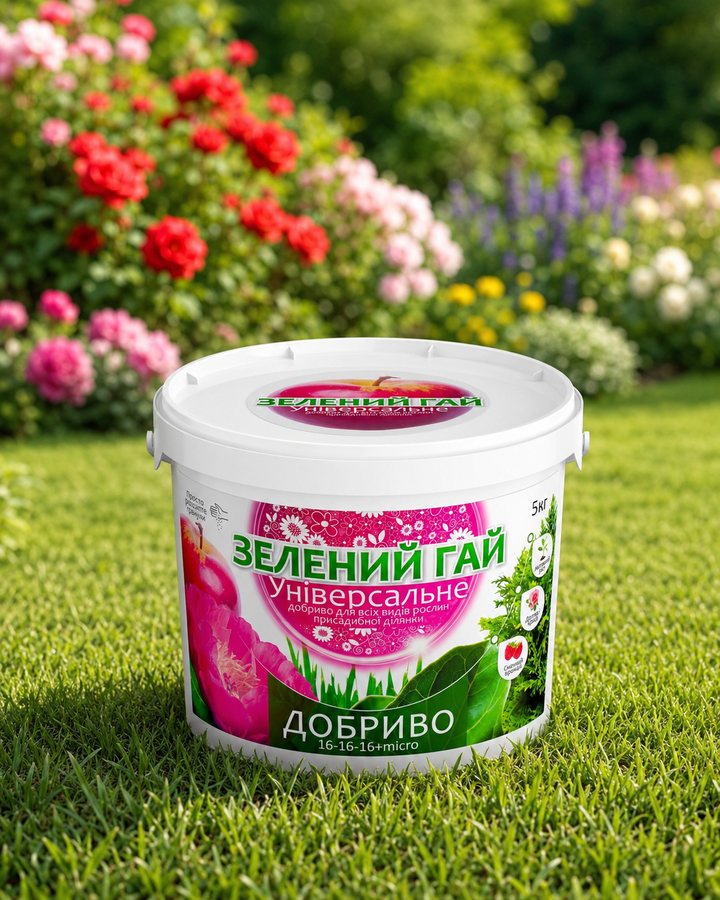
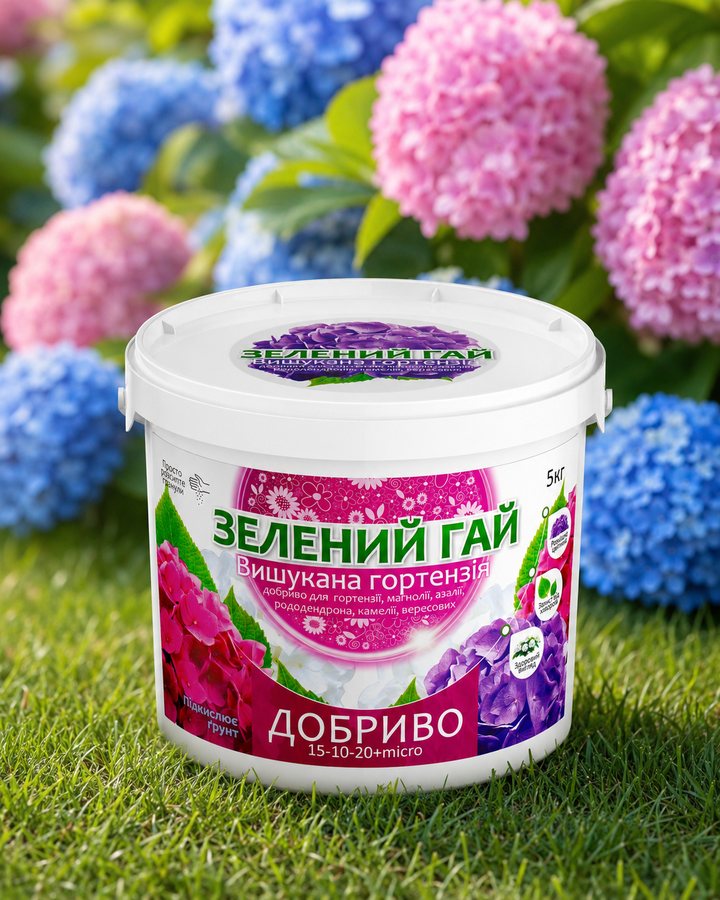
When the soil has warmed to about +10 °C, the main spring application begins. The lawn, shrubs, trees and perennials need nitrogen for a start — Universal 16-16-16 or a crop-specific formula will do: “Emerald Lawn” 27-4-10 for grass, “Lush Conifer” 10-10-15 for thujas and junipers, “Tasty Berry” 20-17-14 for strawberries and raspberries. Hydrangeas, azaleas and rhododendrons get the first of three seasonal feedings with “Exquisite Hydrangea”.
The rate for granules is 25 g (1 scoop) per 1 m² or per shrub, 60 g under mature shrubs and trees. Scatter over moist soil, work in shallowly and water.
May–June: growth, buds, first fruits
At the end of May — the second feeding of hydrangeas (at least three weeks between feedings). Roses and garden flowers at the budding stage are better switched to a formula with a predominance of phosphorus and potassium — “Bright Flowerbed” 14-17-18. A lawn that is mown actively is fed again — it is constantly regrowing its cut leaves.
In the vegetable garden the season of water-soluble fertilisers begins: tomatoes and cucumbers in the greenhouse and after planting out, strawberries during flowering and fruiting. For them “Aqua” is more convenient — the nutrition acts quickly and is easy to dose.
July: the last nitrogen
In the first half of July — the third and last feeding of hydrangeas. This is also the last moment for nitrogen formulas under all perennial plants: roses, conifers, berry bushes, trees. After the middle of the month — only watering and, if needed, nitrogen-free formulas.
After harvest, strawberries need to recover: the plant is setting flower buds for next year. Vegetables in the greenhouse continue to be fed on the usual schedule — the July boundary does not apply to annual crops.
August–September: autumn feeding
The autumn block begins in August. The goal is not growth but roots, ripening of shoots and winter hardiness:
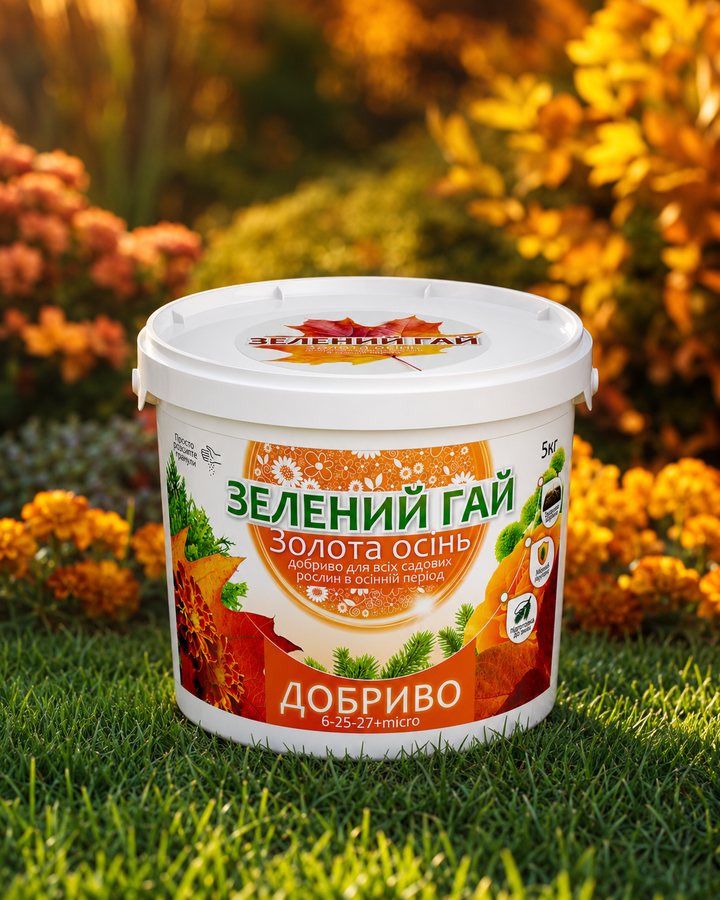
- “Golden Autumn” 6-25-27 — for all garden plants.
- “Autumn Conifer” 5-20-25 — for thujas, junipers, pines and spruces.
- “Autumn Lawn” 4-17-40 — for turf before winter.
- “Autumn Hydrangea” 3-10-18 — for hydrangeas, blueberries and heathers, once per autumn, from August to the first half of October.
September is also the season for autumn planting of saplings. Why nitrogen is harmful in autumn and how to apply autumn formulas correctly is covered in detail in the article on autumn feeding.
October: the last opportunity
If you are planting new shrubs and trees in autumn, nitrogen formulas are not put into the planting hole: right now a young plant needs roots, not leaves. An autumn formula with a low first number and generous watering after planting are enough.
The first half of October is the last window for autumn formulas, while the soil is still warm and the roots are working. Later on the fertiliser will simply lie in the cold ground. At the end of the month feeding in the garden comes to an end. Conifers and evergreens benefit from generous watering before the frosts: in winter they evaporate water but cannot take it from frozen soil.
Summary table
| Month | What to do | With what |
|---|---|---|
| March | Seedlings after true leaves, houseplants | Aqua Seedling, Mister Tsvit |
| April | Starter feeding for the lawn, shrubs, trees, conifers; 1st for hydrangeas | Universal, Emerald Lawn, Lush Conifer, Tasty Berry, Exquisite Hydrangea |
| May | Lawn again, 2nd for hydrangeas (end of month), vegetables after planting out | Emerald Lawn, Exquisite Hydrangea, Aqua |
| June | Roses and flowers at budding, lawn, greenhouse, strawberries | Bright Flowerbed, Aqua |
| July (1st half) | 3rd for hydrangeas, last nitrogen for perennials | Exquisite Hydrangea, crop-specific formulas |
| August | Start of the autumn block, lawn, conifers, acid-loving plants | Golden Autumn, Autumn Conifer, Autumn Lawn, Autumn Hydrangea |
| September | Autumn feeding of the whole garden, planting saplings | Golden Autumn and autumn formulas |
| October (1st half) | Last autumn applications, moisture-charging watering | Autumn formulas |
For specific crops there are separate guides: lawn, hydrangea, roses, strawberries, grapes.