Gardening tips
Feeding seedlings: from emergence to planting out
Seedlings are far easier to ruin with too much than with too little. We explain when they really need nutrition, how to feed after pricking out and what to do before planting out.
Light first, fertiliser second
The most common complaint about seedlings is that they get “leggy”. This is almost always a lack of light and too much warmth, not a lack of nutrition. A February windowsill gives a few hours of dim light, the radiator below keeps the temperature high, and the seedling stretches towards the window. Fertiliser will not fix this, and nitrogen only speeds up the stretching. The fix is supplementary lighting and a lower temperature.
Likewise, fertiliser does not save seedlings from damping-off. If the stem has pinched right at soil level and the seedling has fallen over, this is a fungal disease that develops from overwatering, overcrowded sowing and cold. What is needed is a drier regime, thinning and fresh soil.
What real hunger looks like
Seedlings need feeding when, with enough light and warmth:
- growth has stopped — the seedling has not produced a new leaf for a week or more;
- the lower leaves fade to lime green, then turn evenly yellow, and the yellowing creeps from the bottom up;
- the leaf is small, the stem thin, the plant seems frozen;
- roots are poking out of the cup's drainage holes, the soil has compacted — the substrate is exhausted.
This usually starts about two to three weeks after the true leaves appear, depending on the volume of the cup and the soil.
Feeding schedule
| Stage | What to do |
|---|---|
| Emergence, cotyledons | Do not feed: the cotyledons nourish the seedling themselves |
| First pair of true leaves | Do not feed yet, watch light and watering |
| 10–14 days after the true leaves | The first feeding |
| Pricking out | Do not feed on the day of transplanting; after 2–3 days — water with a rooting fertiliser |
| Then until planting out | Feed once every 10–14 days |
| A week to a week and a half before planting out | Stop feeding, start hardening off |
| Planting out in the ground | Water with plain water, then rooting fertiliser 2–3 times at 7–10 day intervals |
What to feed seedlings with
Granules are not applied to a 200 ml cup — they cannot be distributed evenly, and a single granule next to the root can burn the seedling. Seedlings need a water-soluble fertiliser: a solution spreads evenly even in the smallest volume.
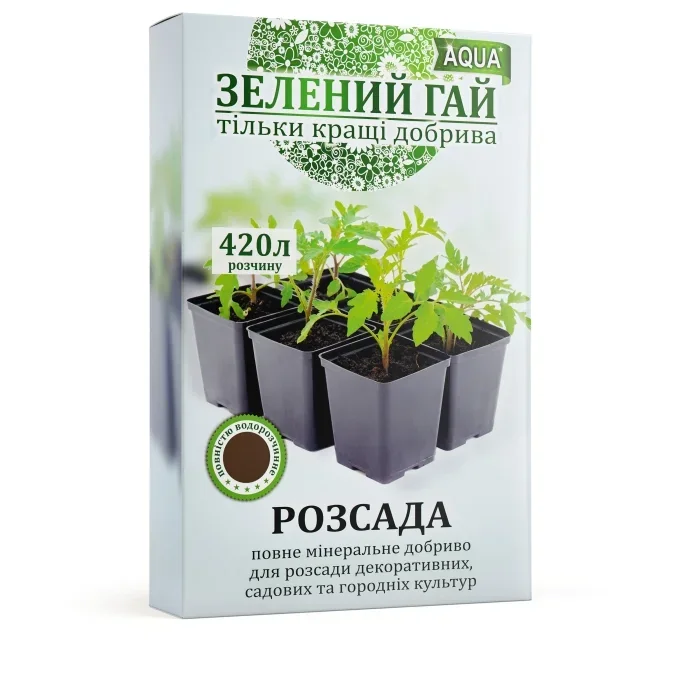
“Aqua Seedlings” is a complete mineral fertiliser for seedlings of ornamental, garden and vegetable crops. The solution is prepared according to the dosage on the pack and the seedlings are watered with it instead of one of the regular waterings. A 300 g box makes 420 l of solution — for home seedlings, where a hundred cups take a few litres, that is a supply for several seasons.
Rules that matter more than the dose:
- Water with the solution only onto moist soil. In a small volume, dry substrate is very easy to burn.
- If in doubt, dilute weaker. An overfed seedling becomes thick, brittle and establishes worse after planting out.
- Do not try to “feed up” overgrown seedlings. A crooked, stretched seedling will not straighten — plant it deeper instead.
Pricking out and planting out: the rooting period
The most vulnerable stretch is the first two to three weeks after transplanting. The leaves are already evaporating water at full rate, while the damaged root works at half capacity. The plant is not hungry in the usual sense — it simply cannot take up what is nearby. Signs: the seedling produces no new leaf, wilts at midday in moist soil, the lower leaves turn yellow and drop.
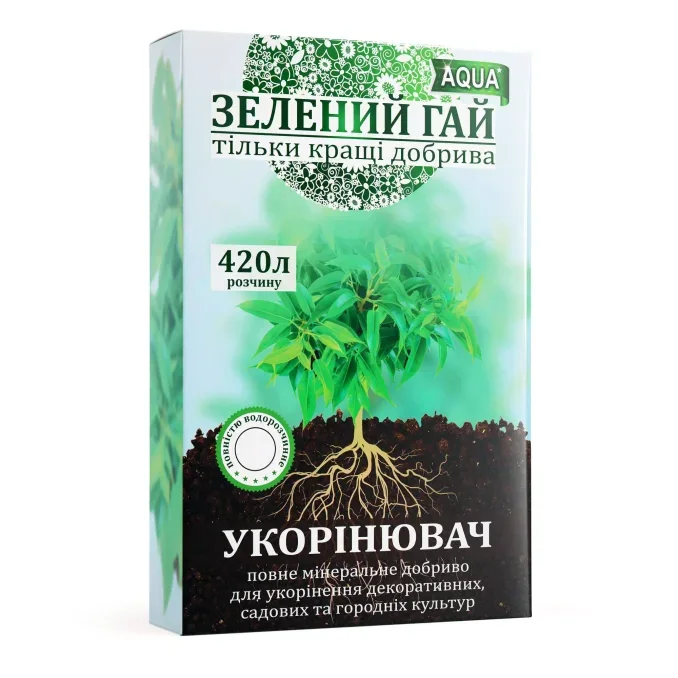
For this period there is “Aqua Rooting”. It is important to understand that this is a fertiliser, not a hormonal stimulant: it does not force a cutting to put out a root from nothing, it feeds the plant while it grows the root.
- After pricking out, water with the solution two to three days later, not on the day of transplanting.
- After planting out in the ground, first water with plain water so the soil settles and fits closely around the root. Then the solution, and two or three more times at 7–10 day intervals until the plant starts growing.
- Once several new leaves have appeared, the rooting fertiliser has done its job — switch to the fertiliser for the specific crop.
Hardening off
A week to a week and a half before planting out, feeding is stopped: the plant should not grow but toughen up. Hardening off begins.
- On a warm, windless day, take the seedlings outside into the shade for an hour or two.
- Increase the time outdoors every day and gradually accustom them to the sun — first morning sun, then midday sun. Direct sun on the first day burns un-hardened leaves to white spots.
- At the end, leave the seedlings outside overnight if there is no risk of frost.
- Water a little more moderately than on the windowsill, but do not let them wilt.
Hardened seedlings are sturdier, with a thicker stem and darker leaves. They cope better with planting out and establish faster.
After planting out
Once the plant has established and put out new leaves, it switches to the adult feeding regime, and each crop has its own. Schemes for the main crops are covered separately: feeding tomatoes, cucumbers, petunias. The general month-by-month schedule is in the garden feeding calendar.
Frequently asked questions
Can seedlings be fed with granular fertiliser?
No. In a cup a granule cannot be distributed evenly: next to it the concentration is too high, while the rest of the soil gets no nutrition. Water-soluble fertilisers are intended for seedlings.
The seedlings are purple underneath — is that a phosphorus deficiency?
A purple tint on the stem and the underside of the leaves, especially in tomatoes, often appears in cold soil: in the cold the root absorbs phosphorus poorly, even if there is enough of it. First check whether the cups are standing on a cold windowsill. If the tint does not go away once it gets warmer, regular feeding will help.
Should flower seedlings be fed the same way as vegetables?
The logic is the same: do not feed until the true leaves, the first feeding 10–14 days after them, then at the same interval. Petunia, with its very fine seed, grows slowly for a long time, so its feeding also starts after the true leaves, not by the calendar.