

Aqua Universal
300 gOne fertiliser for the whole plot — flowers, shrubs, trees, vegetable garden.
75 UAH
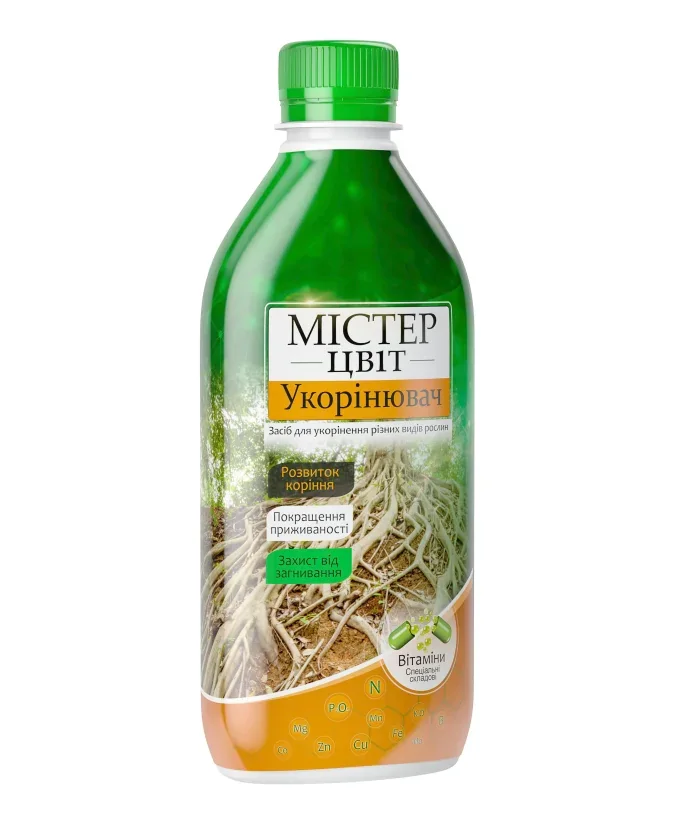
Mister Tsvit · 300 ml
For cuttings and freshly repotted plants.
Travels in one parcel with the rest of your order — no separate delivery to pay for. The minimum order amount is 250 UAH. Shipped by Nova Poshta or Ukrposhta within 1–3 days all over Ukraine. Questions and orders by phone: (093) 727-55-00 — we are the manufacturer.
| Pack size | 300 ml |
|---|---|
| Form | liquid |
| Price | 63 UAH |
| SKU | 558011 |
| Manufacturer | Gileya brand, Ukraine |
The label does not say “fertiliser” but “rooting product for various types of plants”, and that is a fundamental difference. There are no N-P-K figures on the bottle — at the bottom the elements N, P₂O₅, K₂O, Mg, Mn, Fe, Zn, Cu are listed, and in a circle there is a separate “vitamins, special components”. This is a starter product for the first weeks, not a permanent feed. The three statements on the label name the task precisely: root development, better establishment, protection from rotting.
The two situations in which it is needed are familiar to everyone. The first: a cutting has been standing in water or perlite for the third week, the cut has darkened, slime and rot have started at the bottom, and there are no roots. The most critical moment in a cutting's life is exactly the gap between the cut and the first rootlet: the plant is already spending water through its leaves but has nothing yet to take it up with. The second: a plant has been repotted or potted on, it is not dying, but it “stands still” for a month — not a single new leaf, and in the middle of the day it wilts in clearly moist soil. This is not a lack of water. It is a root that is not working yet: some of the absorbing root hairs are inevitably torn off during repotting, and the plant needs to regrow them.
Dosage and schedule are on the label, with the cap. It is used in two ways depending on the task: cuttings are soaked in the working solution before planting, and freshly repotted plants are watered with it on moist substrate. It is a course, not a one-off action — the product works through repeated treatments during the first weeks, until growth appears. As soon as the plant has started growing and produced new leaves, the rooting agent is put aside and you switch to the regular feed for its species. Keeping the plant on it permanently is a waste of the bottle.
It is not a fertiliser, and it does not replace feeding once the plant has established. It will not revive a cutting without a growth bud or without a single leaf — there is nothing to root. It will not save a root that has already turned black and soft: there you need to cut back to living tissue and dry the cut, not water. It will not speed up what is slow by nature: fiddle-leaf fig, oleander and conifers take months to root regardless of the product. And it will not make up for wrong conditions — a cutting without a greenhouse cover in a dry room will dry out before it puts out a root.
300 ml, 63 UAH, and this bottle lasts for a great many cuttings, because the solution is used in small portions and only for short periods. If you propagate houseplants, this format is entirely sufficient. If it is about the vegetable garden and the garden — tomato and pepper seedlings after pricking out, planting into the ground, dividing perennials — it is more convenient to take the water-soluble Zelenyi Hai Aqua Rooting Agent or Aqua Seedling, 300 g each (75 UAH each): the powder is diluted by the bucket for a whole bed, not by the watering can for a pot.
The label says “rooting product”. Unlike the rest of the line, there are no N-P-K figures on the bottle: the elements are listed here, and separately “vitamins, special components”. It is a starter product for the first weeks, not a permanent feed.
The label says “for various types of plants” — ficus, pelargonium, tradescantia, hoya, rose, a violet leaf, an orchid keiki. The manufacturer sets no restrictions by genus.
Yes, this is the second main scenario — exactly what the statement “better establishment” refers to. Water the substrate with it after repotting, while the plant has not yet put on growth.
No. The rotted part must be cut back to healthy tissue, the cut dried, and you start over. The product reduces the risk of rotting during rooting, but does not bring back tissue that is already lost.
One fertiliser for the whole plot — flowers, shrubs, trees, vegetable garden.


Liquid concentrate for houseplants: measure with the cap and water. 63 UAH per pack.


For petunias in hanging baskets, balcony boxes and hanging planters.

