Gardening tips
How to root cuttings
A cutting is a piece of a plant that has to survive without roots until it grows new ones. We explain how to take cuttings, where to root them and how to get through the riskiest first weeks without rot.
The riskiest period in a cutting’s life
A cutting already has leaves that evaporate water, but no roots yet to take that water up. It lives on its own reserves, and the longer this gap lasts, the greater the risk that the cutting wilts or rots. Everything you do when rooting comes down to two tasks: reduce water loss and create conditions in which the root appears as quickly as possible.
Hence the main rules: few leaves, high air humidity, warmth, diffused light and a clean, airy substrate.
How to take cuttings correctly
- Take healthy shoots without buds or flowers. A flowering shoot spends its energy on blooming, not on the root; it is better to remove buds from a cutting.
- Always with a node. Roots form most easily at nodes — the places where a leaf attaches to the stem. The bottom cut is made slightly below a node.
- With a clean, sharp tool. A cut crushed by a blunt knife rots more often.
- Remove the lower leaves that would end up in the water or substrate. Large remaining leaves can be cut in half — this way the cutting loses less moisture.
- Let succulents dry. Cuttings of cacti, jade plants and euphorbias are left to dry for a few days before planting so the cut can callus over. In moist substrate a fresh juicy cut rots.
Cuttings can be softwood (young herbaceous shoots — most indoor plants, pelargonium, chrysanthemum), semi-hardwood (summer shoots of shrubs — hydrangea, rose, lilac) and hardwood (mature one-year shoots cut in autumn or winter — currant, grape, poplar). Softwood cuttings root the fastest but wilt most easily; hardwood ones root slowly but are hardier.
In water or in substrate
In water
Convenient for tradescantia, syngonium, epipremnum, ivy, coleus, impatiens — plants that root easily. The advantage — you can see the roots appear. The drawback — water roots are thin and brittle, and after transplanting into soil the plant has to grow new “soil” roots. So plant the cutting as soon as the roots reach a few centimetres, without waiting for a thick “beard”. Change the water regularly; if it turns cloudy and the cut is slimy, the cutting is rotting.
In substrate
More reliable for most garden shrubs, roses, hydrangeas, conifers, and for plants that rot in water. The substrate must be light and airy — a mix of peat with perlite or sand, or pure perlite. Ordinary garden soil is too dense for rooting: the cut suffocates and rots in it. Keep the substrate moist but not wet.
Humidity, warmth, light
- Humidity. Cover the cuttings with a clear cover — a bag, a cut-off bottle or the lid of a mini greenhouse. Air them daily so that no condensation sits on the leaves.
- Warmth. Most cuttings root in warmth; cool substrate on a cold windowsill slows the process down a lot. Bottom heat from a warm surface helps more than warm air from above.
- Light. Bright and diffused, without direct sun: under a cover in the sun, cuttings “cook”.
- Patience. Do not pull the cutting out to check the roots. Signs of rooting are a new leaf at the tip and slight resistance when you gently tug the stem.
How to help the root
Rooting products do not replace correct technique, but they help get through the critical period. It is important to understand what exactly they do.
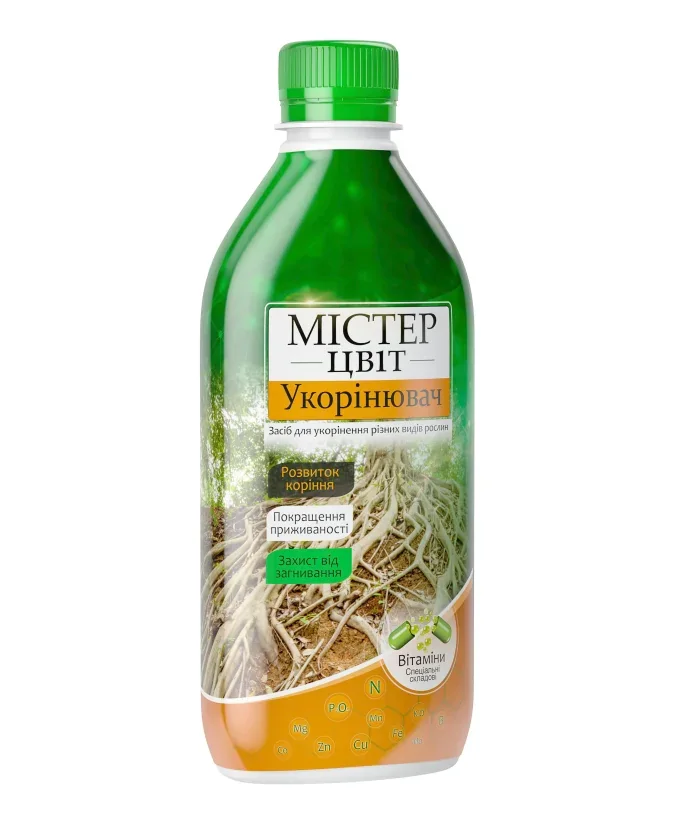
“Mister Tsvit Rooting” — a liquid rooting product for indoor plants. The label lists three tasks: root development, better establishment, protection against rotting. There are no NPK figures on the bottle; it lists nutrients and “vitamins, special components”. It is used in two ways: cuttings are soaked in the working solution before planting, and freshly transplanted plants are watered with it over moist substrate. Dosage and schedule — on the label.
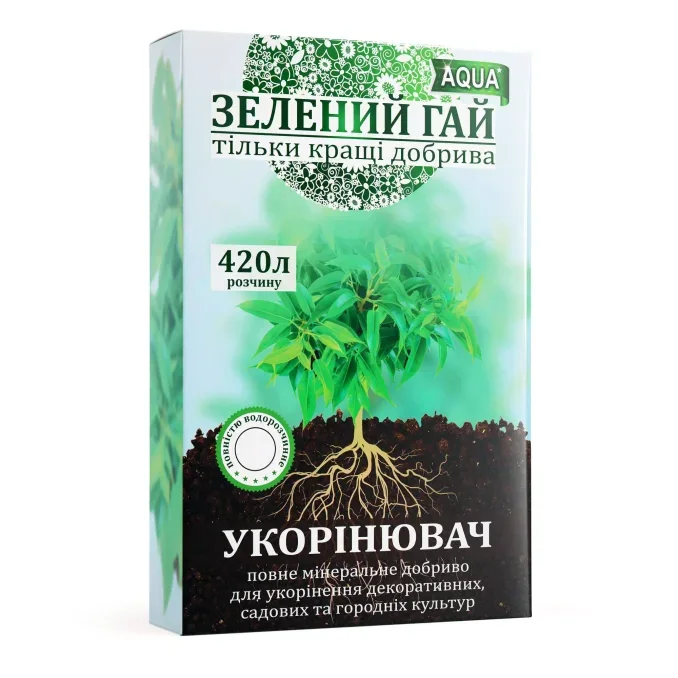
“Aqua Rooting” — a water-soluble mineral fertiliser for rooting ornamental, garden and vegetable crops. It is not a hormonal stimulant: it does not force a cutting to produce a root out of nothing, but feeds the plant during the period when it is growing roots. The solution is prepared according to the proportion on the package and used to water cuttings, young plants and pricked-out seedlings once they are already in the soil.
Both products are a course for the first weeks, not a permanent feed. As soon as the plant starts growing and puts out new leaves, the rooting product is set aside and you switch to the usual feeding for that species.
Why a cutting rots or wilts
| What you see | Cause | What to do |
|---|---|---|
| The cut has turned black, slimy, the stem softens from below | Rot: wet substrate, cold, dirty water | Cut back to healthy tissue, let it dry, re-root in a clean light substrate |
| Leaves wilt but the stem is firm | Evaporation is more than the cutting can withstand | Cover, fewer leaves, move out of the sun |
| The cutting sits for weeks without change | Cold, little light, a slow species | A warmer spot; some species take a long time to root |
| Mould on the leaves under the cover | No airing | Open the cover daily, remove affected leaves |
Rooting products will not save a root that has already turned black and soft, and will not revive a cutting without a single growth bud or leaf — there is nothing there to root. Nor will they speed up what is slow by nature: some woody species take months to root.
After rooting
A rooted cutting is transplanted into a small pot with ordinary soil for its species, and garden ones go to grow on in a nursery bed or container. For the first weeks after transplanting — no fertiliser, or only the rooting product; regular feeding begins when the plant starts growing. How to choose a formula for indoor plants — in the article on fertilisers for indoor plants, and how to plant a grown-on garden plant in its permanent place — in the article on planting young plants.
Frequently asked questions
When is the best time to root cuttings?
Indoor plants — in spring and early summer, when days are long and the plant is in active growth. Softwood and semi-hardwood cuttings of garden shrubs are taken in the first half of summer, hardwood ones — in autumn after leaf fall or in winter.
Can I root several cuttings in one cup?
Yes, if they are the same species. But when transplanting, the tangled roots will have to be separated, and some of them will be damaged. For valuable plants, separate small cups are more convenient.