Gardening tips
Feeding raspberries
Raspberry fruits on last year's canes, while this year's canes are already preparing next year's harvest. So it is fed not “whenever you remember” but at three specific moments — and carefully, because the roots lie almost at the surface.
How a raspberry bush lives
A raspberry patch is not one bush but two generations of canes at once. Last year's canes flower and bear berries, after which they die. Next to them young replacement canes grow from the rootstock: this summer they only grow, and they will crop next year. So every feed works for two harvests at once — the current one and the future one.
The second peculiarity is the roots. Most of them lie in the top layer of soil, not deep. Hence two consequences: raspberry quickly suffers from drying out and tolerates digging poorly. Granules for raspberry are not dug in with a spade but only lightly mixed into the top layer with a rake or cultivator — and always watered in.
Feeding calendar
| When | What for | With what |
|---|---|---|
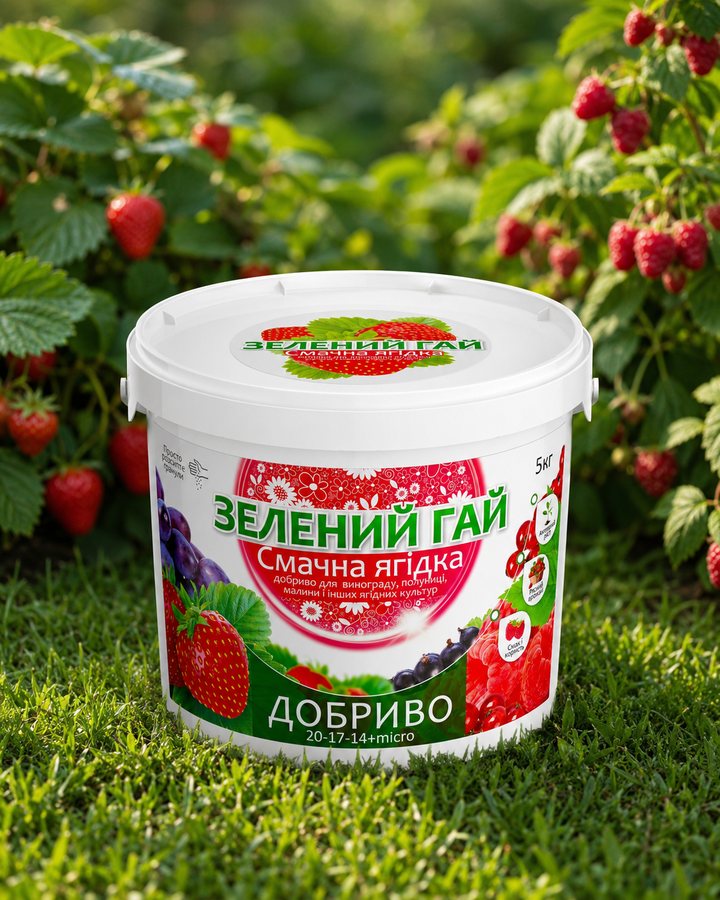
| Early spring, buds and shoots have started | Growth of leaves and young canes | “Tasty Berry”, granules |
| Before flowering — start of flowering | Fruit set and berry size | “Tasty Berry” or “Aqua Strawberry” |
| Right after picking the berries | Replacement canes — next year's harvest | “Tasty Berry”, no later than mid-July |
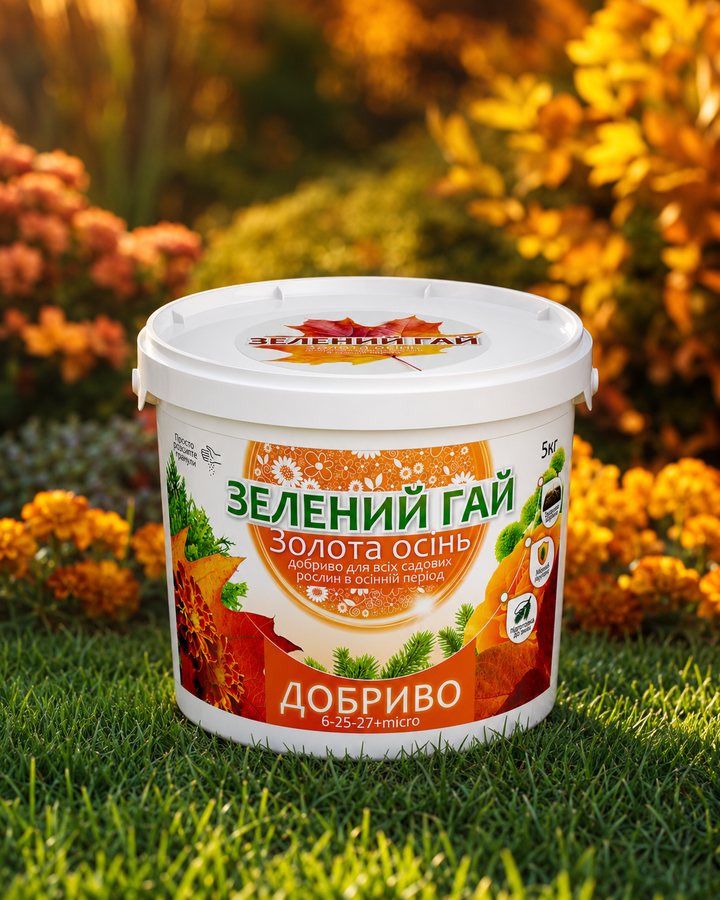
| August — first half of October | Cane ripening, winter hardiness | “Golden Autumn” |
Spring and flowering
The first feed is given when the snow has gone, the soil has thawed and the buds on the canes have started. For raspberry, the granular “Tasty Berry” with NPK 20-17-14 is suitable: it has enough nitrogen for the start, and phosphorus and potassium work for fruit set and berry taste. The rate is 25 g (1 scoop) per bush or per 1 m² of row, up to 60 g for large spreading bushes.
In row planting it is convenient to scatter the granules in a strip along both sides of the row, over moist soil. Then light loosening to a depth of a few centimetres, watering and mulch. Mulch of straw, cut grass or rotted sawdust is almost obligatory for raspberry: it keeps moisture over the shallow roots and suppresses weeds.
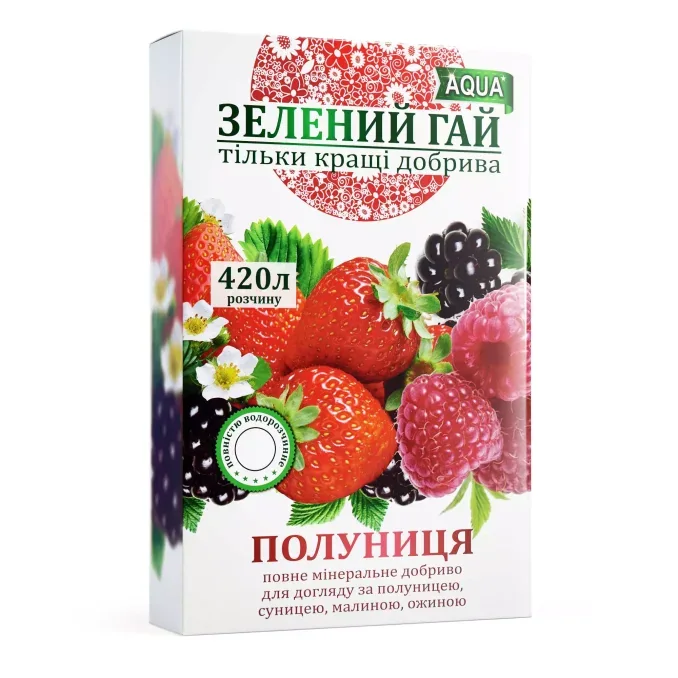
The second feed is appropriate before flowering. If faster action is needed — for example in a dry spring, when granules dissolve slowly — the bushes can instead be watered with a solution of “Aqua Strawberry”: it is a water-soluble fertiliser for strawberries, wild strawberries and raspberries. The solution is prepared according to the dosage on the pack and poured under the bush. It is sprayed on the leaves before flowering or after picking, but not over ripening berries.
After the harvest — the most important feed
It is the one most often skipped: the berries are picked, and the raspberry patch is forgotten until next spring. Yet it is at this moment that the replacement canes grow actively and set the buds from which next year's fruiting twigs will come. A bush fed in July gives more berries next summer — and vice versa.
The order is: cut out the canes that have fruited at ground level, thin the young canes leaving the strongest, then scatter “Tasty Berry” at the usual rate, loosen, water and mulch. For ordinary, not everbearing, raspberry this is the last nitrogen feed of the season: after mid-July nitrogen is no longer given, otherwise the canes keep growing until the frosts and do not have time to ripen.
Autumn: preparing for winter
From August to the first half of October raspberry is fed with an autumn low-nitrogen formula — “Golden Autumn” (NPK 6-25-27), 25 g per bush. Phosphorus and potassium help the canes become woody along their whole length and overwinter better. If the canes are green and soft right to the tip in autumn, it is a sign of excess late nitrogen or a long wet autumn.
The autumn application does not replace the spring one: it has little nitrogen, so in spring the bush will still need a start. Before winter it is also useful to renew the mulch and, if the autumn is dry, water the raspberry patch generously — dried-out soil freezes deeper, and raspberry roots lie close to the surface. In regions with little snow in winter, the canes are bent to the ground so that they overwinter under the snow.
Everbearing raspberry
Everbearing varieties give their main harvest on the current year's canes — at the end of summer and in autumn. They are often grown for a single crop: in autumn all canes are cut at ground level, and new ones grow in spring. Such a patch needs feeding earlier and more evenly:
- first feed — as soon as the canes have appeared;
- second — a few weeks later, in the phase of active growth;
- third — before flowering, at the start of summer.
After mid-July everbearing raspberry is also switched to formulas without nitrogen: the berries are already setting, and it is time for the plant to prepare for winter.
When the problem is not the fertiliser
- Small dry berries — most often a lack of moisture during filling. Raspberry drinks a lot, and the roots are shallow.
- Yellow young leaves with green veins — chlorosis from iron deficiency, typical on alkaline and limestone soils. Raspberry likes slightly acid soil. How to tell chlorosis from hunger is in the article on yellow leaves.
- An overcrowded raspberry patch — shade and poor ventilation reduce the harvest more than any nutrient deficiency. Thinning matters more than an extra scoop of fertiliser.
- Canes drying out, spots on the stems — diseases that fertiliser cannot cope with.
Frequently asked questions
Can raspberries be fed with manure?
Rotted manure or compost as mulch — yes, raspberry loves organic matter. Fresh manure — no: it burns the shallow roots and gives too much nitrogen.
Is the same fertiliser suitable for strawberries?
Yes, “Tasty Berry” and “Aqua Strawberry” are intended for both crops, but the feeding rhythm for strawberries is different — it is described in the article on feeding strawberries.
How many times a season should raspberries be fed?
Usually three or four: spring, before flowering, after the harvest and autumn. On rich, well-mulched soils you can limit yourself to the spring, post-harvest and autumn feeds.