Gardening tips
Feeding currants and gooseberries
Currants and gooseberries fruit in one spot for decades and take a lot out of the soil every year. We go through when and how much to feed them so the berries don't shrink and the bush doesn't get sick.
Why berry bushes get smaller berries
Currants and gooseberries are often planted and forgotten: the bushes are hardy, grow for years without care and still give something. But with age the picture is predictable. The annual growth becomes short, the berries get smaller, the branches age, and fewer and fewer young shoots appear. The soil under the bush gives up nutrients for years and gets nothing back — especially if the area around the base is overgrown with grass that competes with the roots.
Blackcurrant fruits mainly on two- to three-year-old branches, red and white currants on older ones, gooseberry on two- to four-year-old ones. So feeding works not only for this year's crop: strong growth now means berries in a year or two. A hungry bush puts out no new shoots, and the yield falls gradually, over years, until the owner decides that “the variety has degenerated”.
Where the nutrition needs to reach the roots
The roots of currants and gooseberries lie shallow; most of the feeder roots are in the top layer of soil around the perimeter of the crown, not next to the stems themselves. So the granules are scattered over the crown's footprint, in a wide ring, stepping back from the base of the bush.
Do not dig deeply under the bush: the spade tears exactly the roots that should take up the fertiliser. It is enough to loosen the top layer shallowly with a rake or hoe to mix the granules into the soil, then water and mulch.
Spring: two feedings
At the start of growth
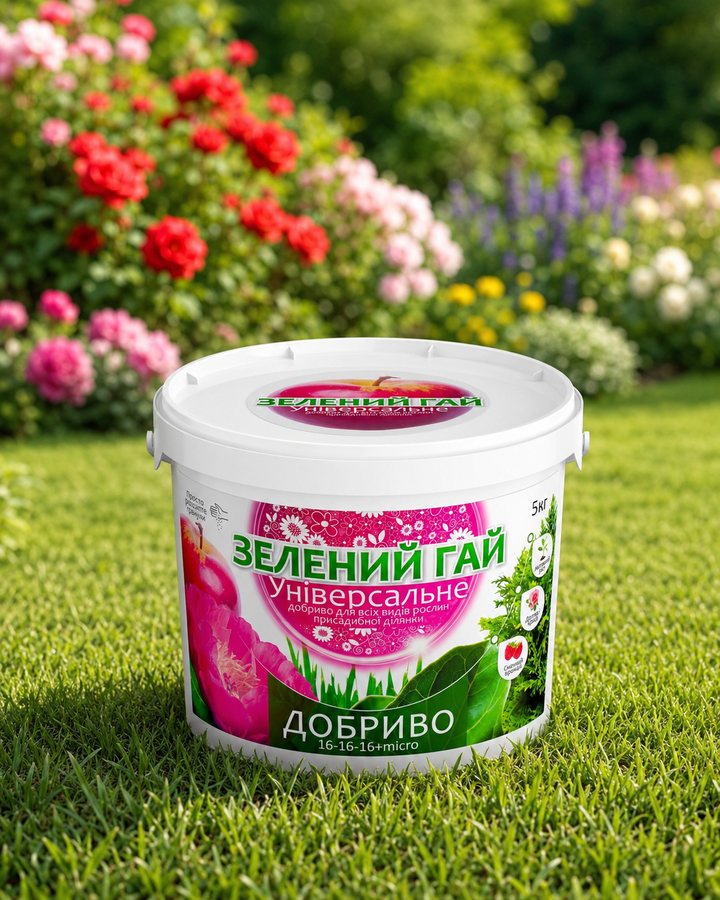
The first feeding is in early spring, when the soil has thawed and the bushes have started growing. At this time nitrogen is needed for shoots and leaves, as well as phosphorus and potassium for the flowers, which were already set last year. The balanced granular “Universal” (NPK 16-16-16) covers exactly this:
- mature fruiting bush — 60 g;
- young bush in the first years after planting — 25 g, one scoop.
The granules are scattered over moist soil, mixed into the top layer and watered in. Make sure the granules do not stay on wet leaves or young shoots.
After flowering
The second feeding is after flowering, when the berries have set. At this point the bush is simultaneously filling the crop and growing young shoots for next year, and this is the most demanding period of the season. The rate is the same: 60 g per mature bush, 25 g per young one. If the spring is dry, be sure to water after application — without moisture the granules don't work, and in a drought the berries shrink fastest.
Summer: no nitrogen
After harvest, from the second half of summer, currants and gooseberries are not fed nitrogen. Late nitrogen drives new growth that does not have time to ripen before the frosts and gets frost-damaged in winter. In addition, gooseberry overfed with nitrogen is noticeably more affected by powdery mildew — a white coating on shoots and berries. For blackcurrant, prone to the same problems, the rule is the same.
Summer is the time for watering and mulch. Currants are especially sensitive to the soil drying out while the berries fill, and gooseberries tolerate drought better but also respond to a dry July with small berries.
Autumn: potassium and phosphorus for overwintering
The autumn feeding is the most important for the future crop. It is at the end of summer and in autumn that the bush sets the flower buds for next year and prepares its shoots for winter. Here the formula needed is the opposite of the spring one: little nitrogen, a lot of phosphorus and potassium.
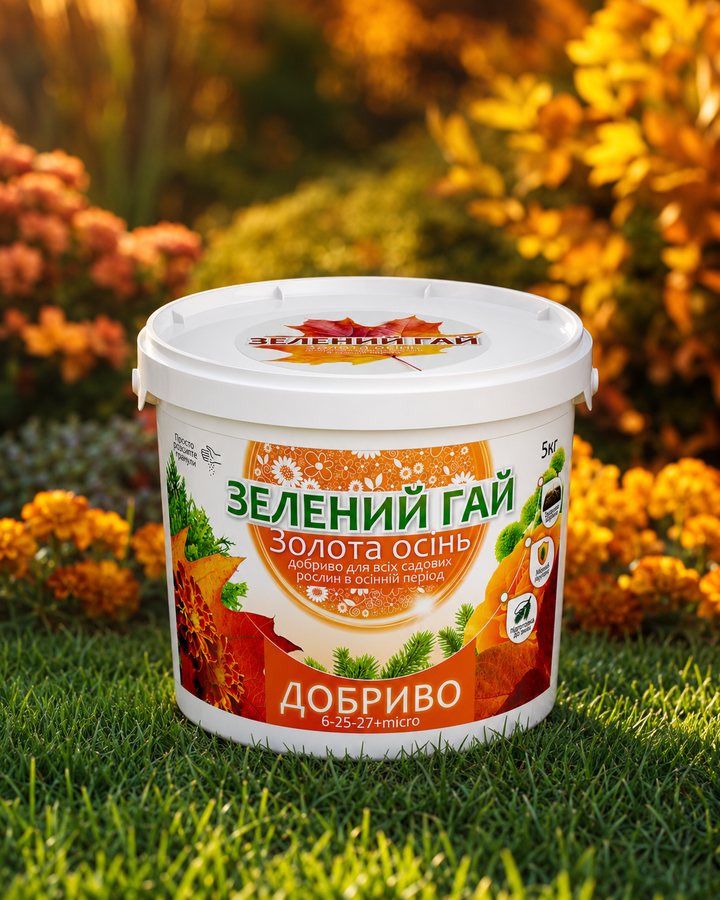
“Golden Autumn” (NPK 6-25-27) suits this task. It is applied the same way as the spring one: 60 g per mature bush, 25 g per young one, onto moist soil over the crown's footprint, worked into the top layer and watered in. The best time is after harvest, at the end of summer or the start of autumn, while the soil is still warm and the root is actively working. The general principles of autumn feeding in the garden are covered in the article on autumn feeding.
The calendar in brief
| When | With what | Mature bush | Young bush |
|---|---|---|---|
| Early spring, start of growth | “Universal” 16-16-16 | 60 g | 25 g |
| After flowering | “Universal” 16-16-16 | 60 g | 25 g |
| Second half of summer | No nitrogen, only watering and mulch | — | — |
| After harvest, end of summer — start of autumn | “Golden Autumn” 6-25-27 | 60 g | 25 g |
For a few bushes you don't have to buy a bucket: there are 500 g bags of “Universal” and 500 g bags of “Golden Autumn”.
What matters more than fertiliser
- Pruning. Old branches that no longer put on growth are cut out at the base. Without rejuvenation, a bush with any feeding gradually ages, and the berries move to the tips.
- Mulch. Well-rotted compost, grass clippings or straw keep moisture in the top layer, where the roots lie, and stop the soil drying out.
- A clear area around the base. Turf under the bush takes water and nutrients before the currant can get to them.
- Sun. In the shade under trees, currants grow, but the berries are small and sour — this cannot be fixed by feeding.
Frequently asked questions
Can all the fertiliser be applied at once in spring?
Better not. A double rate at once means excess salts at the roots and unnecessary nitrogen. The signs and what to do if you overdo it are described in the article on overfeeding.
How is feeding redcurrant different?
Fundamentally, it isn't: the same scheme and the same rates. Redcurrant is slightly less demanding about moisture, but just as sensitive to late nitrogen.
Red blisters on currant leaves — is something lacking?
No. Red or yellowish raised spots on the upper side of the leaf, with tiny insects sitting underneath, are the currant blister aphid. Fertiliser won't help here, and excess nitrogen, on the contrary, makes young leaves juicier and more attractive to it. A pest treatment is needed.
The leaves are yellowing between the veins — what to do?
If the young leaves at the shoot tips turn yellow while the veins stay green, it looks like chlorosis, which often occurs on alkaline soils. If the old leaves at the bottom turn yellow, it is more often about magnesium. Both cases are covered in the site's articles on chlorosis and micronutrients; start by checking the soil reaction.
Should a newly planted bush be fed?
In the year of planting the bush lives off what is in the prepared soil. The first feeding is done when it has established and started growing, at the rate for a young bush.