Gardening tips
Feeding strawberries
Strawberry gives its harvest in a few weeks, but prepares for it for almost a year. So the most important feed is not the spring one but the one most often forgotten: right after picking the berries.
How strawberry allocates its energy
To feed strawberries correctly, it helps to know their annual cycle. In spring the plant restores its leaves using the reserves accumulated since autumn. The flower buds from which the flower stalks will appear in spring are set in the second half of summer and early autumn — that is, next year's harvest is formed when the current one has already been picked.
Hence two conclusions. First: feeding during picking hardly affects the current harvest — the resources have already been allocated. Second: a plant left without nutrients after fruiting will produce fewer flower stalks next year.
Feeding calendar for garden strawberries
| When | What for |
|---|---|
| Early spring, on the regrowing leaves | Leaf recovery, start of growth |
| Budding, before flowering | Amount and quality of fruit set |
| Right after the harvest | New leaves and flower bud formation |
| If needed — in early autumn | Preparation for winter |
In spring
First put the bed in order: remove dry and diseased leaves, loosen between the rows, renew the mulch. The first feed is given when the soil has thawed and young leaves have started.
Before flowering
The second feed is in the budding phase, before the flowers open. It works for fruit set and berry size. During flowering itself and berry filling, fertilisers are not applied.
After picking
The most underrated feed in the whole berry calendar. After fruiting the old leaves are cut off, surplus runners are removed, the bed is weeded and watered — and fed right away. The plant builds up new leaves and sets buds for next year.
What to feed with
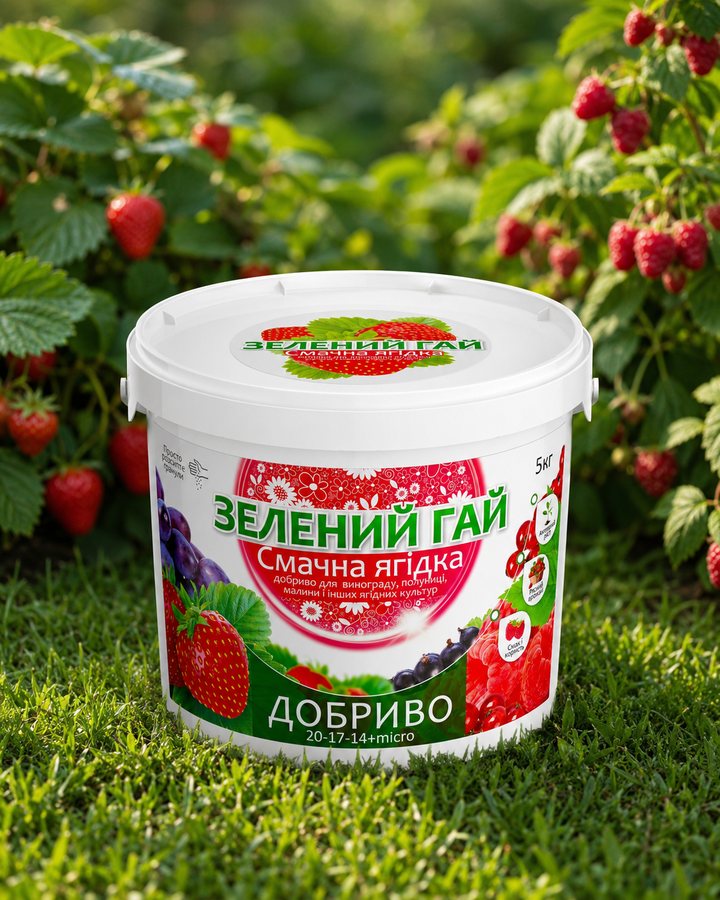
For strawberries, raspberries and grapes we recommend the granular “Tasty Berry” (NPK 20-17-14 with trace elements). It boosts fruit set, berry size and taste and feeds the plants throughout fruiting.
- The rate is 25 g (1 scoop) per 1 m² of bed.
- Scatter the granules between the rows and between the plants over moist soil, not onto the rosettes.
- Carefully work them into the top layer with a hoe and water.
- Make sure the granules do not get into the centre of the plant or onto wet leaves.
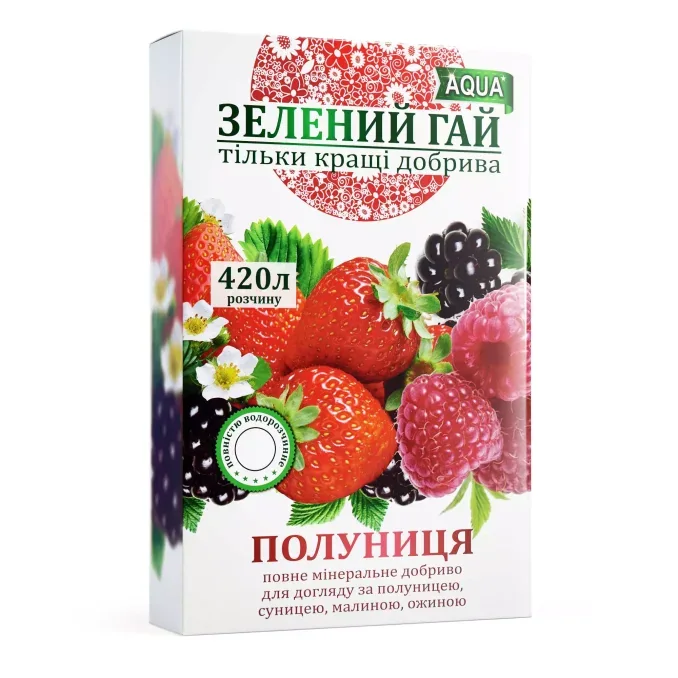
When fast action is needed — for example, the plants have turned pale after winter or the bed is small and it is more convenient to feed from a watering can — the water-soluble “Aqua Strawberry” is suitable. The solution is prepared according to the dosage on the pack and poured under the plant without flooding the crown — the growing point in the centre of the rosette: a wet crown easily rots in hot weather. Foliar spraying is done before flowering and after picking, but not over ripening berries. About the difference between forms of nutrition — in the article granular or water-soluble fertilisers.
Before planting a new bed
The soil for a new planting is prepared in advance: rotted compost, deep loosening, clearing of weed rhizomes. “Tasty Berry” granules at a rate of 25 g per 1 m² can be dug into the top layer before planting the rosettes, but not into the planting hole itself right against the roots. Young rosettes are fed in the first weeks only once they have rooted and started growing.
Everbearing strawberries
Everbearing varieties fruit several times a season or continuously until autumn, so they use more resources. They are fed more regularly — between waves of fruiting, with the same logic: not during berry filling, but after picking each wave, when the plant is recovering.
What to avoid
- Excess nitrogen. The plant grows into leaves, becomes dense, the berries become watery, and grey mould spreads faster in a rainy June. More is not better; the signs and consequences of overfeeding are described in the article on overfeeding.
- Fresh manure. Burns the roots and brings weed seeds.
- Nitrogen at the end of September and in October. The plant should go into dormancy, not into growth, otherwise it overwinters worse.
- Fertilisers on dry soil. First water, then feed.
What fertiliser will not fix
Grey mould is a fungus; mulch under the berries (straw, agrofibre), thinning and treatment with products help. The weevil that gnaws flower stalks and the strawberry mite also need protection, not nutrition.
An old bed produces smaller berries regardless of fertiliser. Strawberry fruits best in its first three or four years; after that it is moved to a new place with young rosettes from runners. Feeding extends the life of a planting but does not make it young again.
What about raspberries
“Tasty Berry” and “Aqua Strawberry” also suit raspberries, but their rhythm is different: they are fed in spring, when the canes regrow, and after fruiting. The replacement canes growing this year are next year's harvest, so summer feeding makes sense for raspberries too. The general schedule for all crops on the plot is collected in the garden feeding calendar.
Frequently asked questions
The berries are large but not sweet. Is it the fertiliser?
Sweetness depends first of all on the variety, sun and weather during ripening: in a cold rainy summer the berry is always more sour. On the nutrition side, excess nitrogen and a lack of potassium do harm. So do not overfeed with nitrogen before flowering; for taste, potassium matters more, and it is present in “Tasty Berry”.
Can strawberries be fed during fruiting?
It is not worth it: it hardly affects berries that are already filling, and excess nitrogen worsens the taste and increases the risk of rot.
Why do the berries get smaller every year?
Most often because of the age of the bed and overcrowding: runners were not removed, the plants closed up, and each gets less light and nutrients. The second cause is a missed feed after picking, when next year's buds are being set.
What should strawberries be fed with in autumn?
If the plants look weak after the summer feed, another one can be given in early autumn — but with an autumn low-nitrogen fertiliser, for example “Golden Autumn” (NPK 6-25-27), and no later than September. After that — only mulch and cover if needed.