Gardening tips
Nitroammophoska: what NPK 16-16-16 means
Nitroammophoska contains equal amounts of nitrogen, phosphorus and potassium, 16 % of each, in one granule. We explain where such an even formula fits, how much to apply and when another fertiliser is the better choice.
What the numbers 16-16-16 mean
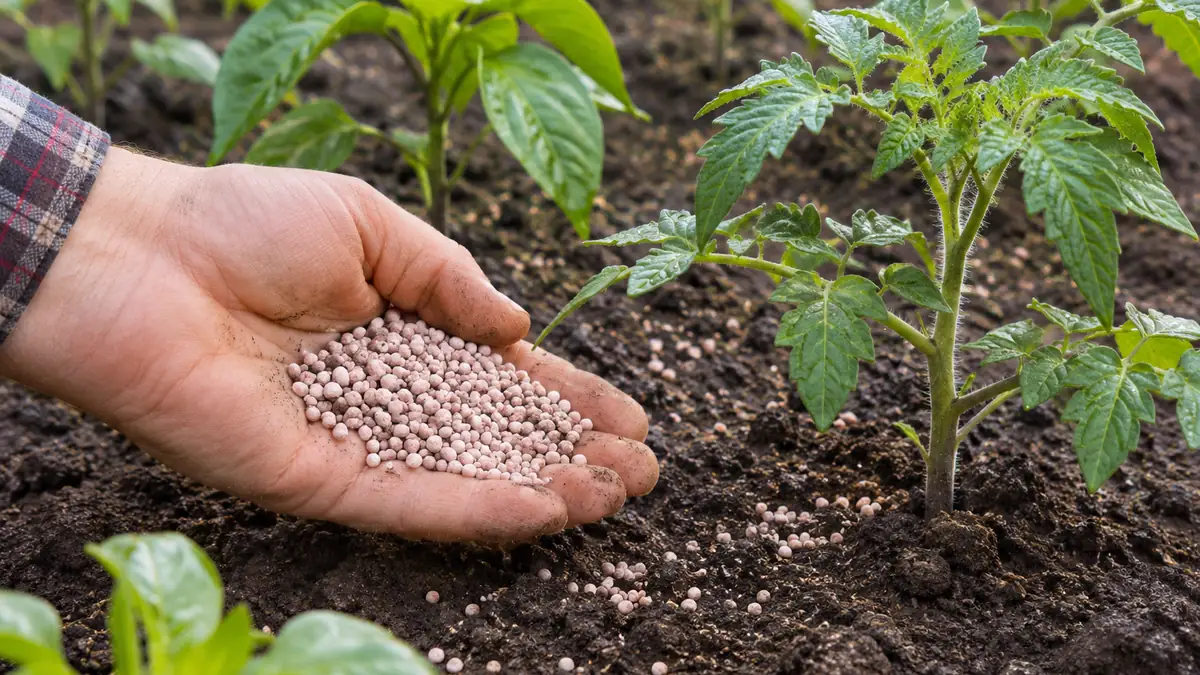
Nitroammophoska is a complex fertiliser, with the three main nutrients combined in one granule. The most common grade has the formula 16-16-16: 16 % nitrogen (N), 16 % phosphorus expressed as P₂O₅ and 16 % potassium expressed as K₂O. The order of the numbers is always the same: nitrogen, phosphorus, potassium. Other ratios exist too, so look at the numbers on the bag, not just the name.
A kilogram of this fertiliser holds 480 g of active substances, 160 g of each. The rest of the weight is the oxygen in the oxides, the compounds the granule is made of and accompanying elements. How to compare formulas with each other is covered in the article on NPK numbers.
The nitrogen in nitroammophoska comes in two forms, ammonium and nitrate. Plants take up nitrate at once, and ammonium works a little longer. So on cool spring soil it acts faster than urea, whose nitrogen first has to be processed by bacteria.
Where an even formula fits
An even ratio does not push the plant in any direction. It does not drive leafy growth like a pure nitrogen fertiliser, and it does not slow growth like low-nitrogen autumn formulas. That is why 16-16-16 suits the main feed for most plants in the first half of the season:
- flowerbeds, shrubs and trees in spring, when growth begins;
- vegetable beds when digging in spring, or in planting holes;
- fruit and berry crops before flowering;
- the lawn in spring, if you have no separate lawn fertiliser;
- a plot with many different plants where you want to use one fertiliser.
If the plot is new and you do not yet know what the soil lacks, an even formula is the least likely to do harm: it will not tip the balance towards leaves or towards flowers.
For specific jobs, special formulas are more precise. A lawn in summer needs more nitrogen, conifers more potassium, roses in bud more phosphorus and potassium, and acid-loving plants a formula that does not make the soil more alkaline. When universal is enough and when a special one is worth buying is covered in detail in the article on complex fertilisers.
When to apply and when to stop
The main application is in spring, as soon as the soil has thawed and dried enough to work. A second one, if needed, comes a few weeks later, at the start of active growth or before flowering. For perennials, the last feed with a formula containing noticeable nitrogen falls in the first half of July.
After that, 16-16-16 is not applied under trees, shrubs and conifers. It has as much nitrogen as phosphorus and potassium, and that nitrogen pushes late growth that goes into winter unripe. In autumn, all garden plants get formulas with a low first number, for example 6-25-27. Nitroammophoska is sometimes dug into an empty bed in autumn, but the nitrate part of the nitrogen is washed out by meltwater over winter, so the bed will need feeding in spring anyway.
How to apply it and how much
For a granular fertiliser with the formula 16-16-16 the working rate is 25 g (one scoop) per 1 m² or under one bush or young tree, and 60 g under mature shrubs and trees. That is how “Universal” from our range is applied.
- Scatter the granules evenly over moist soil, out to the edge of the crown rather than right up against the trunk.
- Carefully mix them into the top layer of soil.
- Water if the soil is dry and no rain is expected. A granule works once it dissolves.
- Make sure no granules are left on wet leaves: they leave burn spots there.
Nitroammophoska versus straight fertilisers
The same nutrients can be applied separately: nitrogen as urea or ammonium nitrate, phosphorus as superphosphate, potassium as potassium sulphate. This is done when you know exactly what the soil lacks, for example from a soil test. On an ordinary plot, three bags mean three rates, three timings and a risk of getting the proportions wrong. One granule with all three nutrients spreads them evenly, and every plant gets all three.
Classic nitroammophoska contains only nitrogen, phosphorus and potassium. It usually has no trace elements, and on poor and sandy soils these are often what is missing: magnesium for green leaves, iron against chlorosis, boron for fruit set.
Universal 16-16-16 with trace elements
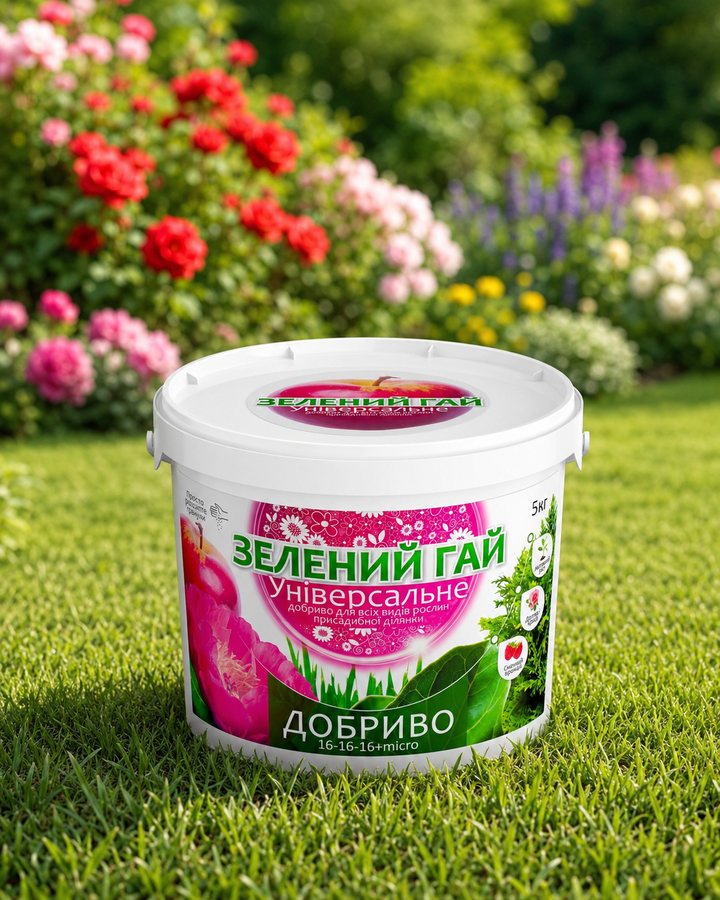
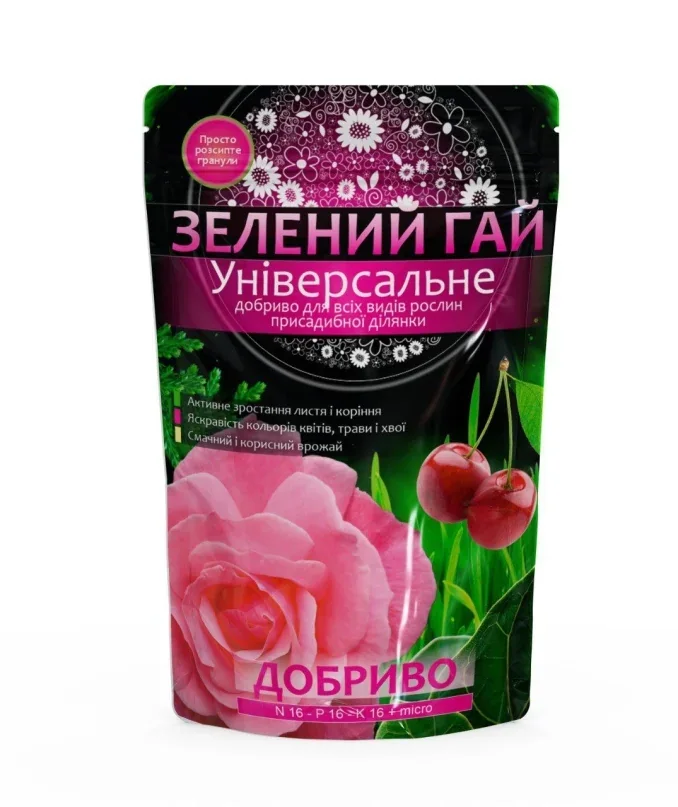
“Universal” has the same NPK 16-16-16 formula in granules, and every bucket also contains MgO, Fe, Mn, B, Cu, Zn, Mo and Co. It is made for the whole garden: flowers, shrubs, trees and the lawn. It comes in 5 and 10 kg buckets with a 25 g scoop. If you need it for one flowerbed, there is a 500 g pack with the same granules.
Frequently asked questions
Nitroammophoska, azofoska, nitrophoska: are they the same thing?
Shops often use these names for similar three-nutrient fertilisers, and what is in the bag can vary. Compare the three NPK numbers on the bag, not the name.
Is it suitable for the vegetable plot?
Yes. In spring it is dug in or put into the planting holes for potatoes, cabbage and tomatoes, mixed with the soil so the granules do not touch the roots. Leafy greens and radishes, with their short season, get nitrogen feeds sparingly.
Can nitroammophoska be used on conifers?
In spring it will not harm them, but conifers do better with a formula high in potassium. From the second half of summer it is not applied to conifers.
Can the granules be dissolved in water for watering?
Granular fertilisers are made to be applied to the soil. For watering and foliar feeding, water-soluble powders that dissolve completely are more convenient.