Gardening tips
Complex fertiliser: when a universal one is enough
The words “complex” and “universal” often appear side by side on packs, but they mean different things. We explain what these fertilisers are, where one bucket really covers the needs of the whole plot and in which cases a specialised formula works better.
What a complex fertiliser is
Mineral fertilisers are either straight or complex. A straight fertiliser contains one main nutrient: urea and ammonium nitrate — nitrogen, superphosphate — phosphorus, potassium sulphate — potassium. To give a plant everything it needs, you have to buy such fertilisers separately, work out the proportions and apply them in turn.
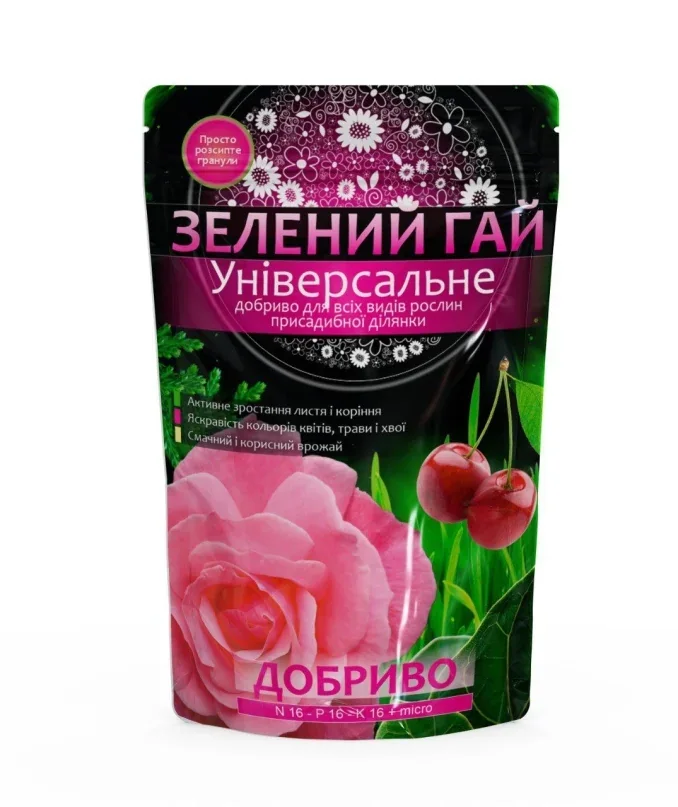
A complex fertiliser combines several nutrients in one product — most often all three main ones: nitrogen (N), phosphorus (P) and potassium (K). Their content is shown by three numbers on the pack: NPK 16-16-16 means the fertiliser contains equal amounts of all three. How to read these numbers and what stands behind each of them is explained in the article what the NPK numbers mean.
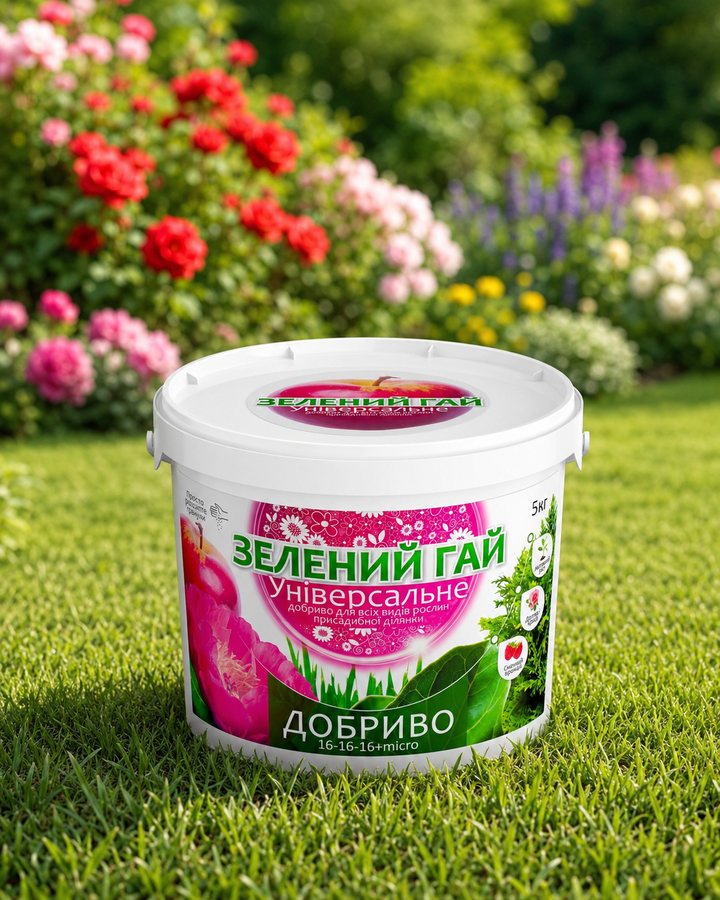
Modern complex fertilisers usually also contain micronutrients. Every bucket of Zelenyi Hai granules contains magnesium, iron, manganese, boron, copper, zinc, molybdenum and cobalt. A plant needs very little of them, but a shortage of any one of them slows growth even when there is plenty of nitrogen, phosphorus and potassium in the soil.
Complex and universal are not the same thing
Every universal fertiliser is complex, but not every complex fertiliser is universal. The difference is in the proportions.
- Universal has a balanced formula with roughly equal amounts of each nutrient. It does not push the plant in one direction — only into leaves or only into flowering — and so it suits most crops.
- A specialised complex fertiliser is shifted towards a specific task. The lawn fertiliser “Emerald Lawn” has NPK 27-4-10: it contains several times more nitrogen than phosphorus, because grass needs green mass, not flowers. The autumn fertiliser “Golden Autumn” is the opposite, 6-25-27: little nitrogen, a lot of phosphorus and potassium for overwintering.
Both fertilisers are complex. But spreading the lawn one under roses or the autumn one on a lawn in May means giving the plant something other than what it needs right now.
When one universal fertiliser is enough
Granular “Universal” with NPK 16-16-16 is designed for flowers, lawns, shrubs and trees. It handles these tasks well:
- A mixed garden without fussy plants. Ornamental shrubs, fruit trees, currants, perennials — spring feeding with one product for all of them.
- Preparing beds and new plantings. Before planting vegetables or laying out a flowerbed, the granules are spread over the plot and worked into the top layer of soil.
- A small plot. When you have only a few plants of each kind, keeping five different packs is inconvenient, and the difference in results is small.
- The main spring feed. At the start of the season almost all plants need the same thing: nitrogen for growth, phosphorus for roots, potassium for strong tissues.
The rate is simple: 25 g (one scoop) per 1 m² or under one shrub or young tree, 60 g under mature shrubs and trees. The granules are spread over moist soil, mixed into the top layer where possible and watered in. They should not land on wet leaves.
When it is better to choose a specialised one
A universal formula is a compromise. For most plants it works well, but there are groups for which the difference is noticeable.
| Situation | Why universal is not enough | What is better |
|---|---|---|
| Lawn | Grass needs much more nitrogen for density and colour | “Emerald Lawn”, 27-4-10 |
| Thujas, junipers, pines, spruces | Potassium and magnesium are needed, excess nitrogen gives soft growth | “Lush Conifer”, 10-10-15 |
| Hydrangeas, rhododendrons, blueberries | A formula that maintains an acidic environment is needed | “Exquisite Hydrangea”, “Magic Blueberry” |
| Roses and garden flowers at the height of the season | Phosphorus and potassium should prevail over nitrogen | “Bright Flowerbed”, 14-17-18 |
| Strawberry, raspberry, grapes | Nutrition is needed for fruit set and berry filling | “Tasty Berry”, 20-17-14 |
| Any plants in autumn | Nitrogen at the end of the season pushes growth that will not ripen | “Golden Autumn”, 6-25-27 |
| Houseplants, hanging baskets | In a small volume of soil granules easily overfeed | Water-soluble or liquid fertilisers |
The logic of choice is this: universal is the base for “ordinary” plants, specialised is for where a plant has special requirements or the season has changed. Most plots need two or three products: universal, lawn and autumn. If you grow thuja or hydrangeas, the matching formula is added for them.
In autumn, universal is replaced with autumn fertiliser
The most common mistake with a universal fertiliser is applying it all year round. In spring a balanced formula with a noticeable share of nitrogen is exactly what is needed, but in August that same nitrogen pushes young shoots that do not have time to ripen before the frosts. That is why for shrubs, trees and perennials nitrogen feeding is finished by mid-July, and from August to the first half of October you switch to “Golden Autumn” with NPK 6-25-27. It strengthens the roots and prepares plants for overwintering.
Annuals and vegetables, which finish their season in autumn anyway, follow this rule less strictly, but they too need less nitrogen at the end of summer.
Mineral complex or organic?
A complex mineral fertiliser has a precisely known composition, works predictably and does not bring weed seeds onto the plot. However, it does not improve soil structure: clay will not become loose from it, and sand will not start holding water better. That job is done by compost and well-rotted manure. In practice a combination works best: organic matter as the basis of the soil, complex granules as precise nutrition. An honest comparison of both approaches is in the article mineral or organic fertilisers.
Bucket, pack or solution
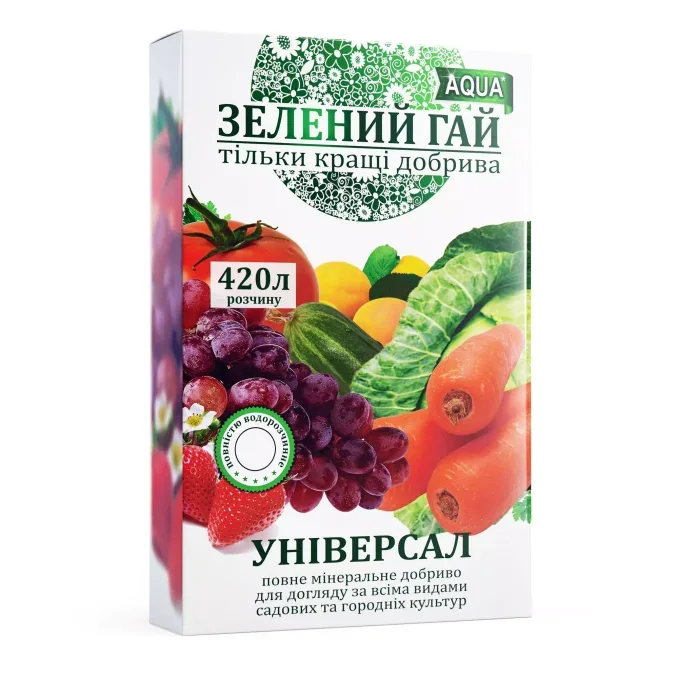
Granular “Universal” is sold in 5 and 10 kg buckets — for the whole plot — and in a 500 g pack when it is a matter of one flowerbed or a few shrubs. For hanging baskets, seedlings and quick correction there is water-soluble “Aqua Universal”: the powder is dissolved in water at the dosage on the pack and watered in at the root. And for the windowsill — liquid “Mister Tsvit Universal”, measured with the cap.
Frequently asked questions
Can you apply a universal fertiliser to a lawn?
Yes, it is designed for lawns among other things. But if you want dense, dark green grass, a lawn formula with high nitrogen and iron will give a more noticeable result.
How many times per season should you apply a universal fertiliser?
Under most shrubs, trees and perennials — once or twice: at the start of growth and, if needed, once more a few weeks later, but no later than mid-July.
Can you apply a universal and a specialised fertiliser at the same time?
Not under the same plant: the doses add up, and it gets a double portion of salts. It is better to divide them so that each group of plants has its own formula.
Is a universal fertiliser suitable for vegetables?
Yes, as the main feed when preparing beds: 25 g per 1 m² over moist soil, worked into the top layer. After that, for some crops, such as tomatoes or cucumbers, it is more convenient to give supplementary feeds as a solution.