Gardening tips
Mineral or organic fertilisers
The “chemicals versus organics” debate has been going on for decades, but on a plot they do not compete — they do different jobs. We honestly look at what manure and compost give, what mineral granules give and how to combine them.
The plant does not care where the nitrogen comes from
Let us start with what both sides often keep quiet about. The root does not take up “organics” or “chemicals” — it absorbs mineral ions dissolved in water: nitrates, ammonium, phosphates, potassium, magnesium, iron. Organic matter in the soil must first be broken down by microorganisms into those same mineral forms, and only then does it become food for the plant. So nitrogen from manure and nitrogen from a granule are the same for the plant.
The difference is not in “which is healthier”, but in how fast, how precisely and what else, besides nutrition, your soil gets.
What organic matter gives
Well-rotted manure, compost, humus, leaf mould — these are above all food for the soil, not only for the plant.
- Structure. Organic matter makes heavy clay looser and light sand more moisture-retentive. Mineral fertilisers cannot do this at all.
- Soil life. Earthworms, fungi and bacteria feed on organic matter; it is they who create the crumbly structure.
- Slow action. Nutrients are released gradually, over the season and longer.
The downsides are real too:
- Unknown composition. How much nitrogen, phosphorus and potassium your manure or compost contains depends on the animals, the bedding, the age and the storage. Precise dosing is impossible.
- Slowness at the moment it matters. When a plant needs nutrition now — for example, in a cold spring when microorganisms are still inactive — organic matter hardly works.
- Fresh manure is dangerous. It burns roots, gives an excess of nitrogen, and may contain weed seeds and pathogens. Fresh manure is applied in autumn when digging empty beds, and under plants only well-rotted manure is used.
- Volumes. To noticeably change the soil, a lot of organic matter is needed — by the bucket and the wheelbarrow, not by the handful.
Manure, humus and compost are not the same thing
Fresh manure is freshly obtained organic matter with bedding. It decomposes actively, heats up, releases ammonia and contains a lot of available nitrogen, so it is not placed under living plants.
Well-rotted manure and humus are the same manure after long maturing. It is dark, loose, without a sharp smell, and the straw in it is no longer recognisable. Such material can be applied under plants and used as mulch.
Compost is rotted plant residue: leaves, grass clippings, kitchen peelings, haulm of healthy plants. It is milder in action than manure and less rich in nitrogen, but it improves structure best. Finished compost smells like forest soil; if twigs and leaves are still recognisable in it, it is not yet mature.
Chicken droppings stand apart: they are much more concentrated than cow or horse manure and burn roots most easily, so they are used only after composting or heavily diluted.
What mineral fertilisers give
- Precision. The package states what percentage of nitrogen, phosphorus and potassium you are applying. How to read these numbers is explained in the article on NPK.
- Control. You can give the plant exactly what it needs now: nitrogen in spring, phosphorus and potassium in autumn. With manure this is impossible — it always brings mostly nitrogen.
- Speed. A granule starts working as soon as it dissolves in moist soil, regardless of the activity of microorganisms.
- Micronutrients. Modern complex fertilisers contain magnesium, iron, manganese, boron, copper, zinc, molybdenum and cobalt — what is often lacking on poor soils.
Downsides: mineral fertilisers do not improve soil structure and do not feed soil life. An overdose burns roots much faster than with compost, so the rate must be followed. How to recognise and correct an excess is covered in the article on overfeeding.
Comparison
| Organic matter (compost, well-rotted manure) | Mineral granules | |
|---|---|---|
| Soil structure | Improves | No effect |
| Dosing precision | Low | High |
| Speed of action | Slow, depends on warmth | Faster, depends on moisture |
| Composition | Mostly nitrogen, unpredictable | Defined, with micronutrients |
| Risk of burning | Fresh manure — high, compost — low | When the rate is exceeded |
| Volume per plot | Large | Small |
Which plants organic matter harms
- Conifers. Fresh manure burns the shallow roots of thujas and spruces, and excess nitrogen produces soft growth that overwinters poorly.
- Blueberries, hydrangeas, rhododendrons. Many types of manure and compost have a neutral or alkaline reaction, while acid-loving plants need acidic soil. For them, organic matter means acidic pine bark, needles, acidic peat. More in the article on acidic soil.
- Bulbs and root crops. Fresh organic matter provokes rot and forking of root crops.
- Acid-loving plants — ash. Wood ash alkalises the soil and can provoke chlorosis.
How to combine them: a working scheme
On most plots the best result comes not from choosing but from dividing the roles:
- Organic matter — for the soil. Compost or well-rotted manure in autumn when digging beds and flowerbeds, mulch of compost or bark under shrubs and trees. This gradually improves structure and moisture retention.
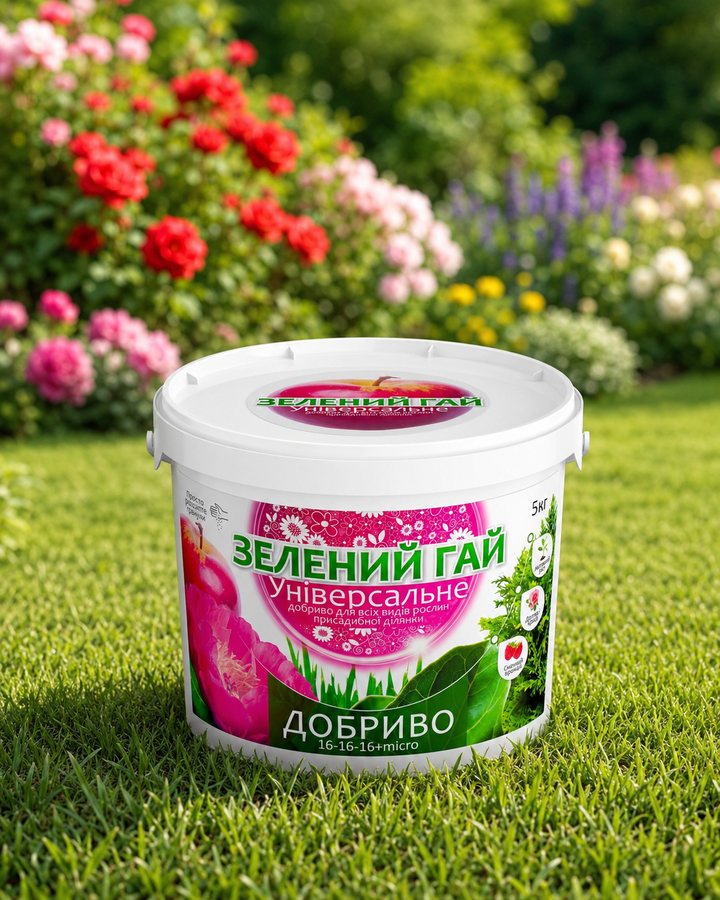
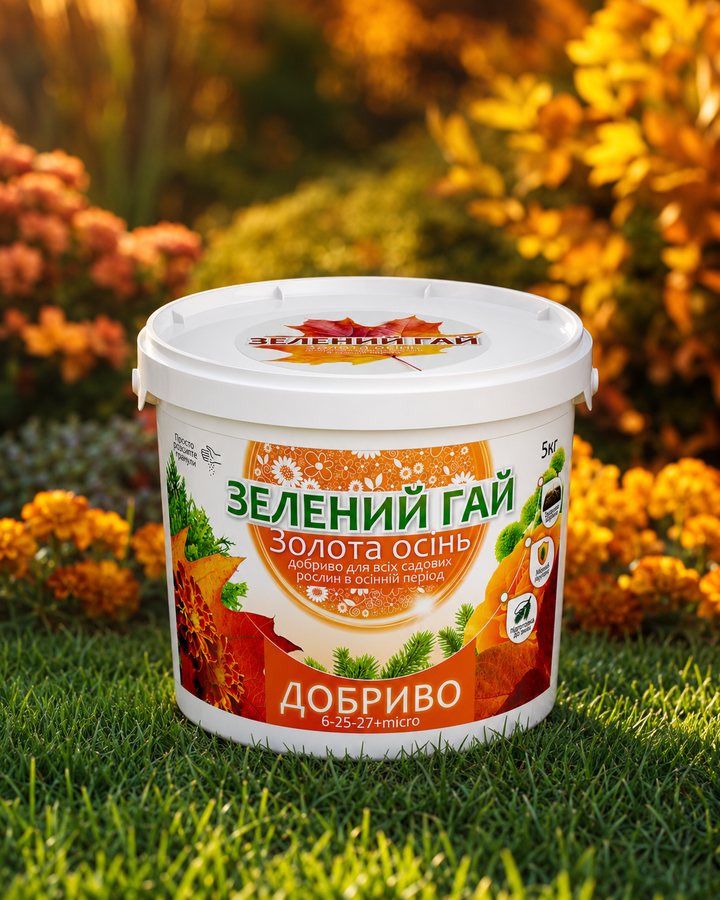
- Mineral fertilisers — for the plant. Precise feeding at the right growth stages: in spring the balanced “Universal” with NPK 16-16-16 or specialised formulas, in autumn “Golden Autumn” with low nitrogen and high phosphorus and potassium.
- Account for organic matter in the rate. If a bed has been generously dressed with compost, the first nitrogen feeding can be done later or made smaller.
Granules and compost can be applied at the same time: scatter the fertiliser, work it into the soil, and mulch with compost on top. The mulch will retain moisture, and the granules will dissolve more evenly.
Frequently asked questions
Do mineral fertilisers “kill” the soil?
If the rates are followed — no. Soil becomes depleted when nothing is returned to it for years — neither organic matter nor mineral nutrition. What harms is an overdose, not the fertiliser itself.
Can you get by with compost alone?
On fertile soil with a lot of compost — sometimes yes. But for demanding crops, lawns, conifers and acid-loving plants, precise mineral nutrition with micronutrients gives a more predictable result.