Gardening tips
Fertilisers for thuja and conifers: comparing Florovit, Agrecol, Yara and Zelenyi Hai
Composition, form, pack sizes and application season of four fertiliser brands for thuja and conifers in one table, plus an explanation of how to read these numbers and when each type fits.
How to choose: the short answer
Fertiliser for thuja and conifers is chosen by season and form. In spring and early summer a formula with moderate nitrogen fits, and in late summer and autumn a formula with low nitrogen and high potassium. Granules are designed for application to garden soil, while liquid and water-soluble fertilisers are convenient when nutrition is needed quickly or the plant grows in a pot.
You can check both features on any pack: the three NPK numbers show which period the formula was made for, and the maker states the form and season. Below, this data is collected in one table. It is not a ranking: the table only shows what is stated about each product.
Comparison: NPK, form, pack sizes, season
| Fertiliser | NPK | Form | Pack sizes | Season as described |
|---|---|---|---|---|
| Florovit for thuja | 11,5-6-11 | not stated | 1, 3, 4, 5, 8, 10, 20 kg | spring — summer |
| Florovit autumn for conifers | 4,5-8-27 | not stated | 1, 3, 4, 8, 10 kg | from July to the end of September |
| Florovit Pinivit | 5,6-0,6-2,7 | liquid | 1 kg, 5.5 kg, 20 l | from the start of growth, no later than the end of June |
| Agrecol for conifers | 14-14-21 | granules | 1; 1.2; 5; 10 kg | March — July |
| Agrecol autumn for conifers | 0-0-25 | granules | 1; 1.2; 3; 5; 10 kg | autumn |
| Yara Mila for conifers and evergreens | not stated | granules | 3 kg | spring — summer |
| Yara Mila Autumn for evergreen trees and shrubs | 7-20-28 | granules | 1, 3, 10 kg | summer — autumn |
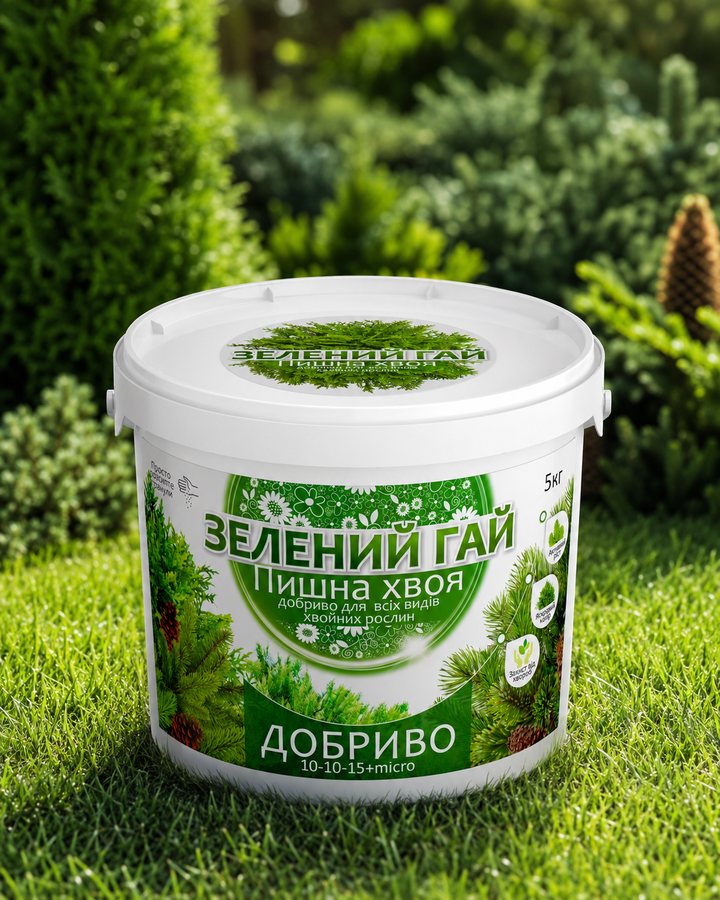
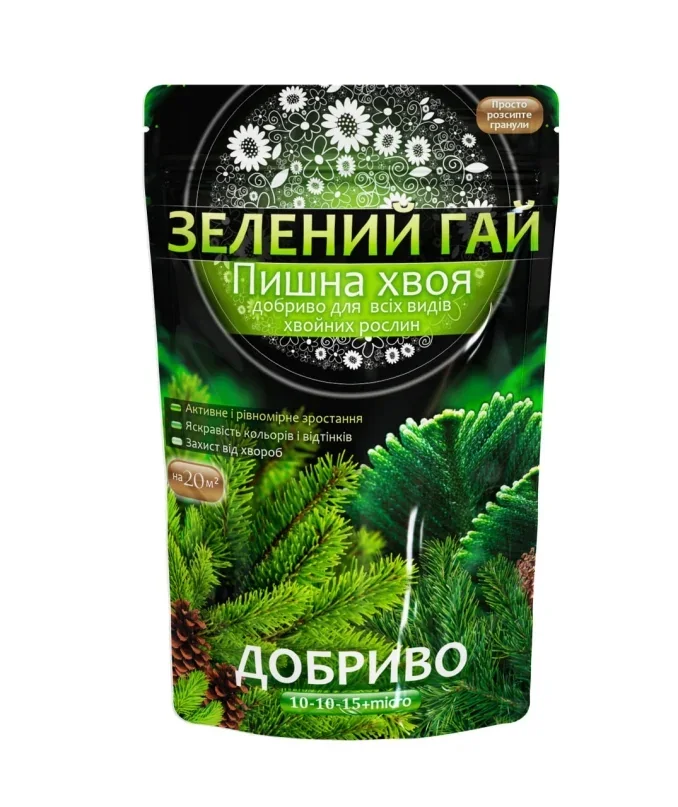
| Zelenyi Hai “Lush Conifer” | 10-10-15 | granules | 5 and 10 kg, 500 g pack | throughout the season |
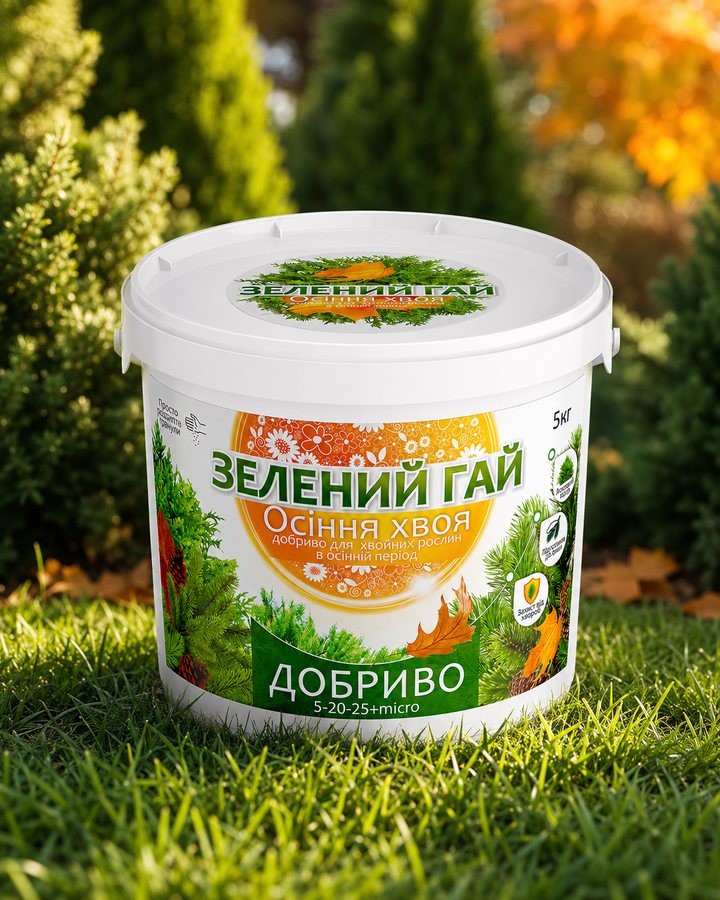
| Zelenyi Hai “Autumn Conifer” | 5-20-25 | granules | 5 and 10 kg, 500 g pack | autumn |
Data on the other brands was collected on 2 November 2026 from the makers' websites and product listings on Rozetka. “Not stated” means the value was not on these pages, not that it is missing from the label. Florovit pack sizes come from the maker's Polish website, so the range on sale in Ukraine may be narrower. Composition and pack sizes change over time, so check the label before buying.
How to read the numbers in the table
The three numbers are the percentages of nitrogen, phosphorus and potassium by weight of the fertiliser. Each element is covered in detail in the article what the NPK numbers mean, and three observations are enough to compare products.
- The first number shows the season. In the autumn formulas in the table, nitrogen is from 0 to 7% and potassium from 25 to 28%. In the spring-summer formulas, apart from the liquid Pinivit, nitrogen is from 10 to 14% and potassium from 11 to 21%.
- The ratio matters, not only the sum. The formulas 14-14-21 and 10-10-15 have the same 2 : 2 : 3 proportion but a different concentration. So an application rate cannot be carried over from one fertiliser to another: take it from the label of the product you bought.
- A zero in a formula means the element is absent. The formula 0-0-25 has neither nitrogen nor phosphorus, and of the three main elements contains only potassium. Such a fertiliser has a different job from the full formula 5-20-25, although both are meant for autumn.
The numbers of liquid and granular fertilisers are not compared directly. A liquid concentrate is diluted with water according to the instructions, so the lower percentages on its label say nothing yet about the amount of nutrition per application.
Beyond NPK, it is worth looking at the additional elements. Magnesium and iron are linked to chlorophyll and therefore to the green colour of the needles, so they are often listed separately for conifers. In Zelenyi Hai buckets these are MgO, Fe, Mn, B, Cu, Zn, Mo and Co. Descriptions of other products name, in particular, magnesium and iron for Florovit for thuja, and magnesium and sulphur for the autumn Agrecol and Yara Mila.
When each type fits
Spring-summer formula
It is needed when conifers start growing and putting on shoots. Nitrogen works on growth here, and potassium supports the tissues. This type is the basis of nutrition for most garden thuja, junipers, pines and spruces. Among our fertilisers, this job is done by “Lush Conifer” with NPK 10-10-15. A nitrogen formula is applied in the first half of the season: shoots that grow in late summer do not have time to ripen before the frosts.
Autumn low-nitrogen formula
Needles do not fall and evaporate water all winter, so preparing for the cold matters to conifers. Phosphorus and potassium help the roots and tissues, and the small amount of nitrogen does not push growth. Our “Autumn Conifer” with NPK 5-20-25 is built this way too. An autumn formula is applied while the soil is still warm: in cold ground roots absorb almost no nutrition.
Granules
Granules are scattered over moist soil, worked into the top layer and watered in. They suit plants in open ground, and the pack size is best chosen by the number of plants. A larger pack is more convenient for a hedge, while a small bag is enough for a few thuja by the entrance. The differences between forms are covered in the article granular or water-soluble fertilisers.
Liquid and water-soluble fertilisers
They are diluted with water, so nutrition reaches the plant faster. This form is convenient for conifers in pots: in a container, salts do not wash down deeper, and granules overfeed the roots more easily. The Zelenyi Hai range has the water-soluble “Aqua Conifer” in a 300 g pack for this. For liquid and water-soluble fertilisers, also take the season and dosage from the label.
What to check on the pack before buying
- Purpose. The pack should name conifers, because a lawn formula with high nitrogen gives a different result.
- Season. Compare it with the current month: after mid-July conifers are no longer given nitrogen formulas.
- NPK formula. It should match the season: in autumn there is little nitrogen and a lot of potassium.
- Form. Take granules for the garden, and a liquid or water-soluble form for containers or when watering with a solution is more convenient.
- Pack size. Count your plants and the rate on the label, so as not to buy much more than you need for the season.
Once the fertiliser is chosen, what remains is to spread the applications correctly across the months. A yearly calendar, rates for young and mature plants and a scheme for hedges are given in the article on feeding thuja throughout the year.
Frequently asked questions
Which fertiliser for thuja can you buy in Ukraine?
Dedicated fertilisers for thuja and conifers are on sale in Ukraine, including the brands Florovit, Agrecol, Yara Mila and Zelenyi Hai (“Lush Conifer” and “Autumn Conifer”). Choose by season, NPK formula and form, checking this data on the label of the specific product.
Can a spring fertiliser for conifers be applied in autumn?
No, a higher-nitrogen formula is not applied in autumn, because nitrogen pushes late growth that does not have time to ripen before the frosts. Autumn formulas with low nitrogen and high potassium are meant for the second half of the season.
What does NPK 0-0-25 mean on a conifer fertiliser?
NPK 0-0-25 means the fertiliser contains no nitrogen or phosphorus, and potassium makes up 25% by weight. This is an autumn formula that may also contain other elements, such as magnesium and sulphur.
What to choose for thuja: granules or liquid fertiliser?
For thuja in open ground, granules are usually chosen; they are applied to the soil and watered in. For thuja in pots, a liquid or water-soluble form is more convenient, because in a container granules overfeed the roots more easily.
Why are the NPK numbers on different conifer fertilisers so different?
Makers design formulas for different seasons and different concentrations. Autumn formulas have less nitrogen and more potassium, and the same proportion of elements can be written with larger or smaller numbers, so each fertiliser has its own application rate.