Gardening tips
How to make a hydrangea blue or pink
The colour of a bigleaf hydrangea is set not by the variety or the fertiliser but by soil chemistry: acidity and available aluminium. We look at what really works, how long it takes and which hydrangeas do not change colour at all.
Which hydrangeas change colour at all
Only the bigleaf hydrangea (Hydrangea macrophylla) and the closely related mountain hydrangea can change from pink to blue and back. And only those varieties that naturally have pink, lilac or blue flower heads.
- White varieties of bigleaf hydrangea stay white in any soil — they lack the pigment that reacts to aluminium.
- Panicle hydrangea does not change colour with the soil. Its flower heads often turn pink or red towards autumn, but that is a property of the variety and a reaction to cool nights, not to acidity.
- Smooth hydrangea does not react to the soil either: white varieties stay white, pink ones stay pink.
So if you have a panicle or smooth hydrangea, no acidifiers or “blue” fertilisers will change the colour — there is no point spending effort on it.
Where the blue colour comes from
The pigment in bigleaf hydrangea flowers is pink in itself. It turns blue when it binds with aluminium, which the plant absorbs from the soil. Hence two conditions, and both are needed at the same time:
- There must be aluminium in the soil. Most clay and loam soils have enough of it; poor sandy soils and peat mixes for pots often do not.
- The aluminium must be available. The plant can absorb it only in an acidic environment. As a rough guide: at pH below 5.5 the flower heads are blue, at pH 6–6.5 and above — pink, in between — lilac, purple or mixed, when one bush has flower heads of different colours.
Hence the typical story: a bush was bought blue, planted on a plot with neutral or alkaline soil — and after a season it flowers pink. The variety has nothing to do with it; the chemistry has changed.
How to get a blue colour
The aim is to lower the pH and give the plant available aluminium.
- Measure the pH. Without this, everything you do is guesswork. How to do it at home and how to acidify the soil is explained in the article on acidic soil and pH.
- Acidify the soil. Acidic high-moor peat in the planting hole, mulch of conifer bark or conifer needle litter, sulphur products — following the manufacturer’s instructions.
- Add aluminium. For blueing, aluminium sulphate or potassium alum is used. Take the dose from the instructions on the package of the specific product and do not exceed it: an excess burns the roots.
- Water with soft water. Hard water from a well or the mains contains calcium and gradually alkalises the soil, undoing the acidification. Rainwater is best.
- Do not overfeed with phosphorus. Phosphorus binds aluminium in the soil into an unavailable form. A fertiliser for a “blue” hydrangea should be moderate in phosphorus.
- Do not apply ash, lime or dolomite flour. All of these raise the pH.
How to get or keep a pink colour
Here the task is the opposite: prevent the plant from absorbing aluminium.
- Keep the pH closer to neutral, around 6–6.5. If the soil is acidic, it is deacidified with dolomite flour — gradually and based on measurement results.
- Do not mulch with conifer bark or peat, and do not water with acidified water.
- Fertilisers with sufficient phosphorus help keep aluminium in an unavailable form.
Be careful with deacidification: the hydrangea remains an acid-loving plant, and on soil that is too alkaline it suffers from chlorosis — young leaves turn yellow between green veins. Causes and treatment are covered in the article on chlorosis and yellow leaves.
A season plan for a blue hydrangea
- Early spring. Measure the soil pH under the bush. If it is higher than needed, start acidifying and renew the conifer mulch.
- April — May. While the flower heads are forming, apply the aluminium product according to the manufacturer’s instructions, splitting the dose over several waterings rather than all at once.
- All season. Water with rainwater or soft water, feed with a fertiliser for acid-loving plants and do not apply ash.
- Autumn. Measure the pH again and record the result: this way next spring you will see how much the soil “drifts” back.
Keep a simple diary — date, pH, what was applied, what colour the flower heads were. After two seasons it will become clear what works on your plot and what does not.
How long it takes
The colour is set in the flower head while it is forming, so flowers that have already opened will not change colour. The first changes are visible on the next season’s flower heads, and a stable colour on a plot with naturally different soil is often achieved only after two or three years of regular effort. The soil gradually returns to its original state, so acidification is not a one-off action but yearly maintenance.
In a pot it is easier to change the colour: the volume of soil is small and its composition is fully under your control. That is exactly why blue hydrangeas in shops are usually grown in an acidic substrate with aluminium.
What role the fertiliser plays here
Honestly: no fertiliser works like a dye. It will not provide aluminium where there is none, and it will not recolour a pink bush on alkaline soil.
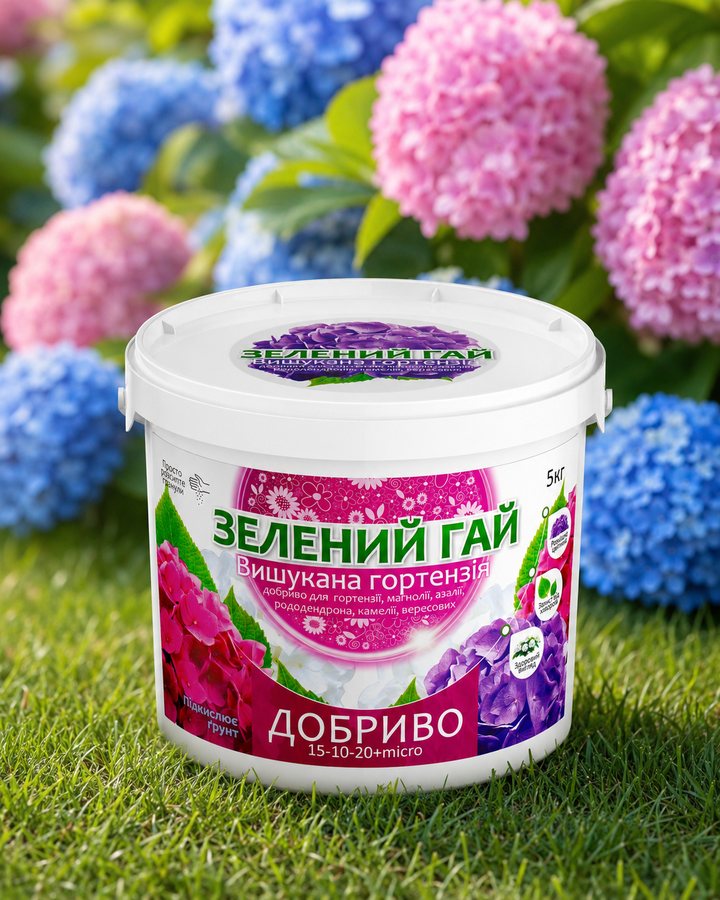
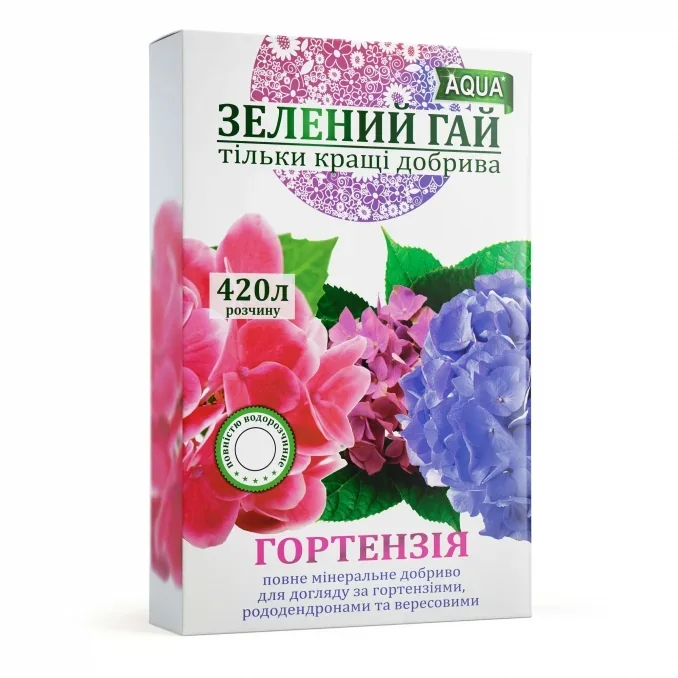
What a fertiliser can do is not get in the way. “Exquisite Hydrangea” (NPK 15-10-20) is designed for acid-loving plants: it supports an acidic soil reaction, has moderate phosphorus and micronutrients, including iron, so a bush on an acidified plot stays healthy and blooms abundantly. For a hydrangea in a pot, the same role is played by the water-soluble “Aqua Hydrangea”. Rates and the feeding calendar are in the article how to feed a hydrangea.
Frequently asked questions
Why are there blue and pink flower heads on one bush?
Acidity and aluminium are distributed unevenly in the soil, and different parts of the root system feed different shoots. This often happens in the first years after acidification, or when the bush grows near a foundation or a path, from which lime gets into the soil.
Can a hydrangea be watered with citric acid or vinegar?
Acidified water helps compensate for the hardness of irrigation water, but it is support, not a way to sharply change the soil pH. Without aluminium it will not give a blue colour.
I bought a blue hydrangea, but it bloomed pink. Is it a fake?
Most often, no. The bush simply ended up in soil with a higher pH than in the nursery. Measure the acidity — and you will see the cause.