Gardening tips
Feeding cucumbers
Cucumber grows fast, fruits for a long time, and its roots are shallow and delicate. So it is fed not rarely and heavily but often and little by little — and here is exactly how.
Why cucumber is fed differently from other vegetables
Cucumber has three peculiarities that determine all its feeding.
- Shallow roots. The bulk of the roots are in the top 20–25 cm of soil. They dry out quickly, are easily burned by concentrated fertilisers and do not like loosening.
- Continuous fruiting. The plant grows, flowers and fills fruit at the same time for several weeks in a row. It does not need a large single dose — it needs even nutrition throughout this time.
- Sensitivity to salts. Cucumber feels an excess of fertiliser earlier than most crops: the leaf edges dry, the plant wilts even on moist soil.
Hence the rule: small doses, often, on moist soil.
Preparing the bed
Cucumber likes loose, warm soil rich in organic matter. Rotted compost or humus is added to the bed in autumn or spring. Fresh manure goes only into a “warm” bed, deep under a layer of soil, never up to the roots.
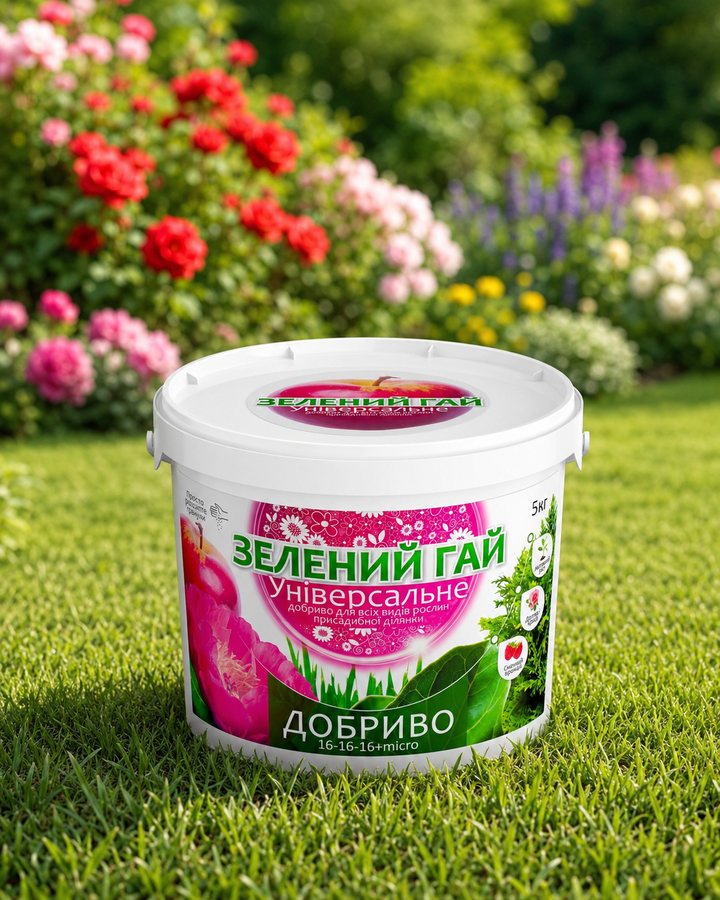
On poor soil, before sowing or planting out, you can apply the granular “Universal” (NPK 16-16-16) — 25 g per 1 m², mixing it into the top layer and watering. This is a basic reserve; after that, cucumber is fed with a solution through the season.
Feeding calendar
| When | What for |
|---|---|
| 2 weeks after planting out seedlings, or at 2–3 true leaves when sown directly | Growth of leaves and roots |
| Start of flowering | Fruit set |
| Fruiting — roughly once every 7–10 days | Fruit filling, new fruitlets |
| Right after every big harvest | Recovery for the next wave |
Greenhouse and open ground
In a greenhouse cucumbers grow and fruit longer, so there are more feeds per season. There it is more important to watch the air temperature and humidity: in a stuffy, overheated greenhouse the plant absorbs nutrients poorly even from moist soil. In open ground fruiting is shorter, and cold nights at the start and end of the season slow absorption — in such periods it is not worth increasing the dose, it is better to wait for warmth.
About feeding before planting out — in the article on feeding seedlings.
What to feed with
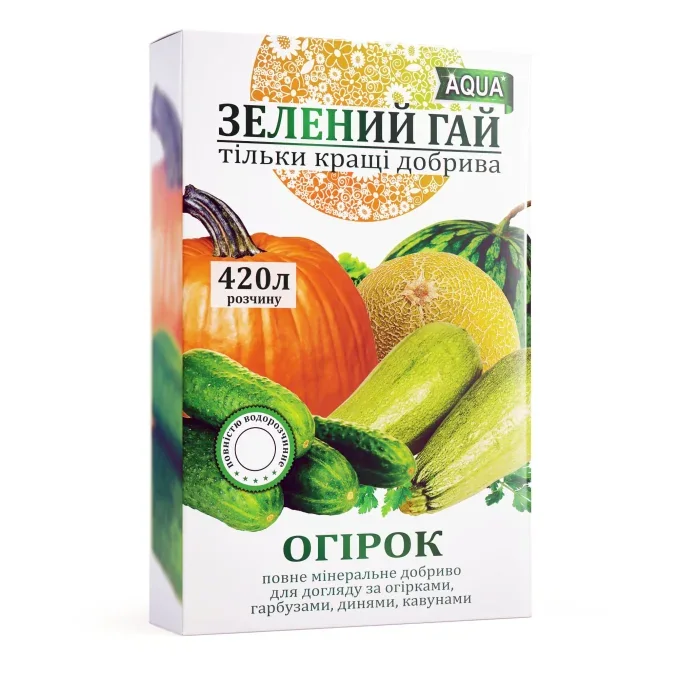
Granules are inconvenient for frequent feeding: they have to be worked in, and cucumber does not like its roots being disturbed. So the main nutrition is a solution. We recommend the water-soluble “Aqua Cucumber” — for fruit set and long fruiting.
- Dissolve the powder in water in the proportion given on the pack. The water should be warm — watering with cold water is a stress for cucumber in itself.
- Water the bed with clean water, then with the solution at the root. There is no point in pouring deep: the nutrients should stay where the roots are.
- Foliar spraying works well because the leaf is large and thin. Do it in the evening, treating the underside of the leaf too.
- Do not feed at midday in the heat — neither at the root nor on the leaves.
The same box suits pumpkins, watermelons and melons — they are one family with similar needs. A comparison of fertiliser forms is in the article granular or water-soluble fertilisers.
Why fruitlets turn yellow and drop
The most common question about cucumbers, and fertiliser is only one of the causes here.
- Overload. The plant has more fruitlets than it can feed. Pick fruit often, without letting it overgrow: every overgrown fruit holds back new fruitlets.
- Lack of nutrients during mass fruiting — especially after a big harvest without feeding.
- Temperature. Cold nights, heat in the greenhouse, sharp swings.
- Lack of light in overcrowded plantings.
- No pollination of bee-pollinated varieties in a closed greenhouse.
Hooked fruits, pear shapes and bitterness
- Hooked and pear-shaped fruits — most often uneven watering and a lack of nutrients precisely during filling. Regular feeding with watering removes the second cause; the first is cured by the watering regime and mulch.
- Bitterness — does not come from fertiliser and is not cured by fertiliser. It is caused by water stress — drying out, watering with cold water, temperature swings — plus the variety's tendency.
- Barren flowers. At the start of flowering male flowers appear first — this is normal. If there are no female flowers for a long time, the cause may be excess nitrogen, heat or old seed.
What fertiliser will not fix
Downy mildew and powdery mildew are fungal diseases: yellow angular spots on top and a grey coating under the leaf, or a white powdery coating. A fungicide is needed. A rotting stem base is root rot, most often from cold water or waterlogging; nutrients are no longer absorbed there. If you suspect there was too much fertiliser, follow the article on overfeeding.
Frequently asked questions
Can cucumbers be watered with fertiliser solution every day?
No. Often means roughly once every week to week and a half, and the ordinary watering between feeds is done with clean warm water. A daily solution will lead to salts building up in the soil, and cucumber, being sensitive to them, will react with drying leaf edges.
How do I tell that a cucumber lacks potassium?
Typical signs are a pale or brown border along the leaf edges and fruits that thicken towards the tip like a pear. Potassium is especially needed during mass fruiting, when the plant is filling several fruits every day.
How many times a season should cucumbers be fed?
During fruiting — roughly once every 7–10 days, so over a season there are far more feeds than for tomato. The main thing is not to increase the dose but to keep the rhythm.
Why do cucumber leaves turn pale from the bottom up?
Even yellowing of the lower leaves during active fruiting is most often a lack of nitrogen: the plant moves it from old leaves to young ones. If, however, it yellows between the veins while the veins stay green, it is a lack of magnesium or other trace elements. In both cases regular feeding helps, but first check the watering and the water temperature.
Can cucumbers be fed with yeast or ash?
Ash gives potassium but makes the soil alkaline and is incompatible with applying nitrogen fertilisers at the same time. Yeast is a folk remedy with unpredictable results. A balanced solution is more reliable.