Gardening tips
Feeding fruit trees
Apple, pear, plum and cherry live in one place for decades and every year take a harvest out of the soil. Here is when to feed them, where exactly to scatter the fertiliser and why nitrogen already does harm after mid-July.
What a tree needs through the year
A fruit tree goes through several stages in a season, and at each it has a different “request”. In spring it unfolds its leaves, flowers and sets fruit — at this moment it needs nitrogen for leaves and shoots, phosphorus for roots and flowering. In summer the fruits fill, and next year's flower buds are set on the branches; here potassium comes to the fore. In autumn the tree no longer grows but ripens: the wood hardens, the roots store nutrients for winter, and nitrogen at this time only gets in the way.
Hence a simple rule for all pome and stone fruits: nitrogen in the first half of the season, phosphorus and potassium in the second. If this sequence is not kept, the tree either goes hungry in spring or pushes out soft shoots in autumn that get frost-damaged.
Where to scatter the fertiliser
The most common mistake is scattering granules right by the trunk. There are thick structural roots there that hold the tree up but absorb almost no nutrients. The fine feeder roots are much further out — roughly under the edge of the crown and a little beyond it. So the fertiliser is scattered in a ring along the crown projection, not right up against the trunk.
If the trunk circle is grassed over, the grass intercepts a significant part of the nutrients. For young trees it is better to keep the circle clean and mulched. Under a mature tree in a lawn, the granules are scattered over the grass in the zone of the crown edge and watered in — the lawn will not suffer from this either. The step-by-step technique of application with watering and working in is described in the article how to apply granular fertilisers.
Spring: the start and flowering
The first feed is given when the soil has thawed and dried enough to walk on, and the buds are beginning to swell. Fertiliser is not applied on frozen ground or snow: water carries it away, and the roots are not yet working.
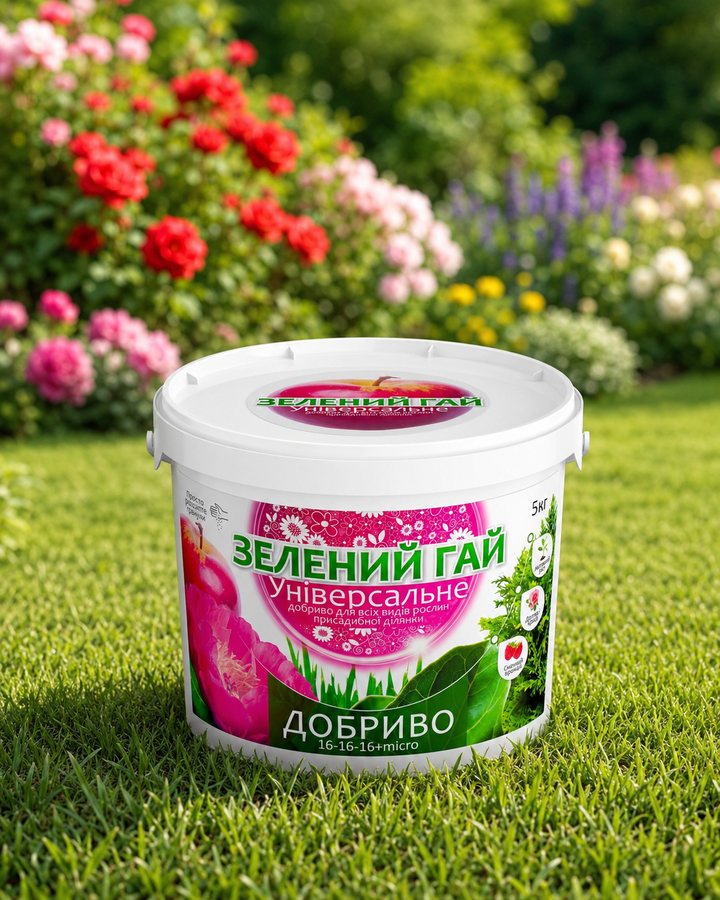
For spring and early summer the balanced “Universal” with NPK 16-16-16 is suitable — an equal share of nitrogen, phosphorus and potassium plus trace elements. Rate per application:
- mature tree — 60 g;
- young tree — 25 g (1 scoop).
The granules are scattered over moist soil, lightly raked into the top layer and watered in. A second feed is appropriate after flowering, when the fruit set is already visible — at this moment the tree decides how many fruits it is able to feed.
Summer: fruit filling and next year's buds
In June many trees go through the natural drop of fruitlets: apple and plum shed part of the fruit they cannot feed. This is normal, and fertiliser will not cancel it. But a third feed in the first half of June to early July helps the remaining fruits gain size and the tree set flower buds for next year.
After mid-July nitrogen fertilisers are not given to fruit trees. Late nitrogen provokes a second wave of growth: the shoots do not have time to become woody before the frosts and get frost-damaged, and the tree enters winter weakened. This is the same limit for all perennial garden plants; it is explained in the feeding calendar.
In summer watering is often more important than fertiliser. Granules dissolve only in moist soil, and in a drought a tree drops its fruit even on rich ground. Infrequent but deep watering along the crown edge in hot weeks gives more than an extra portion of nutrients.
Autumn: potassium and phosphorus for overwintering
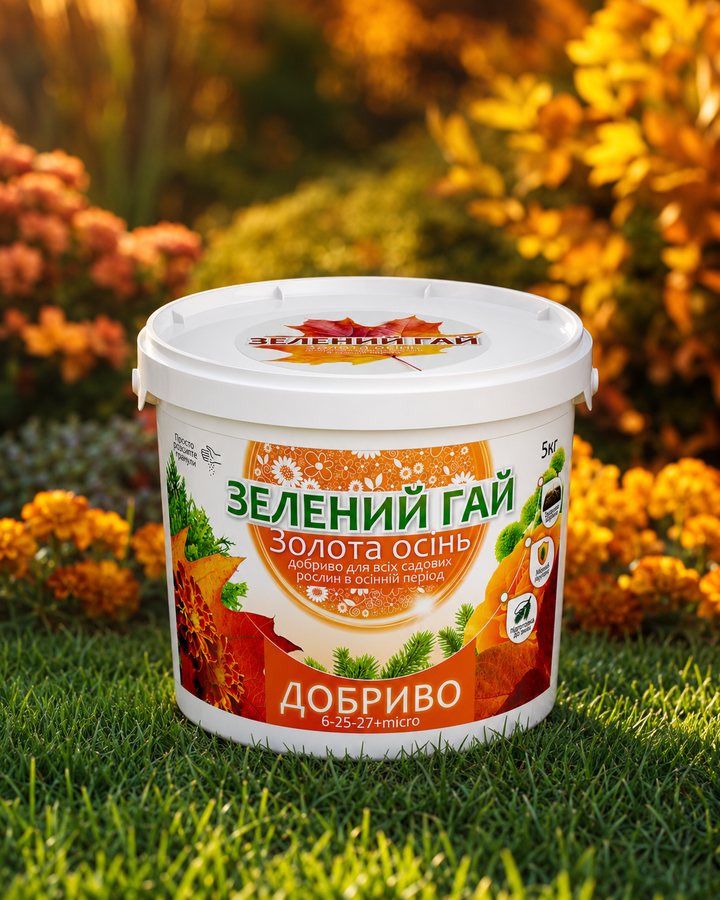
After the harvest the tree prepares for winter. A low-nitrogen formula is needed here — “Golden Autumn” with NPK 6-25-27. Phosphorus strengthens the roots, potassium helps the wood ripen and withstand frosts better. The rate is the same: 60 g under a mature tree, 25 g under a young one.
It is applied from August to the first half of October, while the soil is still warm and the roots are active. Granules can be scattered on cold ground, but they will lie there uselessly until spring. Stone fruits — sour cherry, sweet cherry, plum — finish growing earlier than apple and pear, so it is convenient to feed them first, in August to early September.
How apple, pear, plum and cherry differ
| Crop | What to pay attention to |
|---|---|
| Apple | Sensitive to calcium deficiency: brown spots under the skin of the fruit are more often linked to uneven watering and calcium than to NPK. Do not overfeed with nitrogen — the fruit keeps worse. |
| Pear | Tolerates excess moisture and fresh organic matter near the roots poorly. Feeding as for apple, on the same schedule. |
| Plum | Produces abundant suckers; excess nitrogen increases them. Finishes growing early — it is better not to postpone the autumn feed. |
| Sour cherry, sweet cherry | Crop early, so the main summer feed is right after picking the berries, while the buds are being set. |
Young trees and the first year after planting
In its first year it matters more for a sapling to take root than to grow. If the planting hole was prepared with fertiliser, extra feeding in the year of planting is usually not needed; if not, a small rate in spring, when the tree has already started growing, and an autumn feed at the end of summer are enough. More on preparing the hole and first care is in the article on planting saplings.
A young tree that has not yet started fruiting is fed at a rate of 25 g, keeping to the same timing: spring, early summer, autumn.
Frequently asked questions
Can a tree be fed during flowering?
Granules — yes, if the soil is moist: they act not instantly but over weeks. Spraying the crown during flowering is not a good idea — you wash off the pollen and get in the way of the bees.
The tree has not flowered for several years. Is it a lack of fertiliser?
Rarely. More often the cause is the young age of the rootstock, shade, heavy pruning or, conversely, excess nitrogen, which makes the tree push out branches instead of buds. Hunger usually looks different: small pale leaves and short growth.
The apple tree fruits every other year. Will feeding help?
Biennial bearing is a trait of many varieties. Regular feeding and thinning of the fruit set in a heavy year soften it, but do not remove it completely.
Can I get by with a single autumn feed?
For poor soil — no: in spring the tree needs nitrogen. The autumn formula prepares it for winter but does not replace the spring start.