Gardening tips
How to apply granular fertilisers
Granules forgive a lot, but not everything. Where and how you scatter them determines whether the nutrition reaches the roots, stays lying on the surface or burns the plant. Step-by-step technique for a shrub, a tree, a flowerbed and a lawn.
How a granule works
A granule is not nutrition but a store of it. On its own it gives the plant nothing: nutrients become available only when the granule gradually dissolves in moist soil and the solution reaches the roots. All the application rules follow from this:
- the granule must lie where the feeder roots are;
- there must be moisture around it;
- it must not touch leaves and stems, especially wet ones.
How granules differ from water-soluble and liquid fertilisers and when each form is more appropriate is explained in a separate article on granular and water-soluble fertilisers. Here — technique only.
Five steps for any plant
- Moisten the soil. Granules are scattered on moist ground — after rain or watering. Fertiliser is not applied to dried-out soil: in a drought the plant is already stressed, and a concentrated solution next to dry roots can burn them.
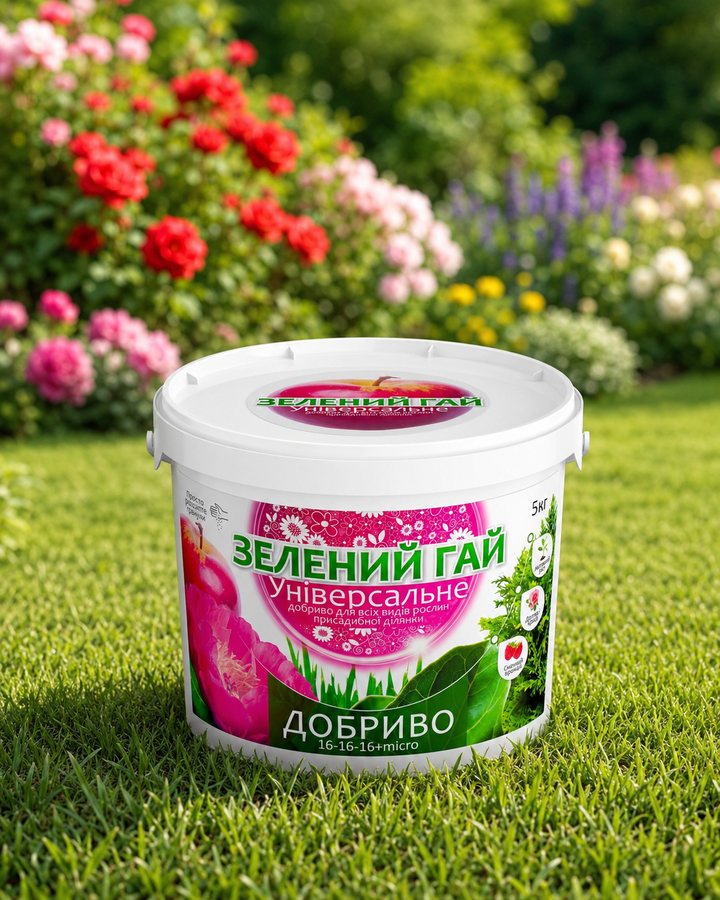
- Measure the rate. The basic rate is 25 g (1 scoop) per 1 m² or per shrub or young tree, 60 g for mature shrubs and trees. Some fertilisers have their own rates — they are given on the package.
- Scatter evenly over the root zone, not in a heap in one spot.
- Work into the top layer. Gently mix the granules into the soil a few centimetres deep with a rake, hoe or cultivator. This way they do not dry out on the surface, birds do not carry them off and a downpour does not wash them away.
- Water. Watering starts the dissolving and carries the nutrition to the roots. After that water regularly — this increases the fertiliser’s effectiveness.
After application you can mulch the soil: under mulch moisture lasts longer, and the granules dissolve more evenly.
Scoop, spoon and scales
Fertiliser buckets come with a 25 g scoop. 500 g bags have no scoop, so the first time it is convenient to weigh a portion on kitchen scales and remember how much it is by volume: a glass, a jar or a spoon. For “Exquisite Hydrangea” the manufacturer states that a tablespoon holds about 17 g; for other fertilisers check by weight, as granules of different formulas may differ.
The rate is calculated for one feed. Do not try to “make up” for a missed one by doubling the dose: excess salts near the roots cause a burn. The signs and the rescue procedure are described in the article on overfeeding.
Under a shrub and under a tree
The feeder roots are not by the trunk but roughly under the edge of the crown. Therefore:
- Under a shrub the granules are scattered in a ring over the crown’s footprint, keeping 10–15 cm away from the stem. Do not concentrate fertiliser at the very base of the shrub.
- Under a mature tree — in a wide ring under the edge of the crown and slightly beyond it. Near the trunk lie thick structural roots that take up almost no nutrition.
- Under plants with shallow roots — hydrangeas, rhododendrons, blueberry, raspberry, conifers — the granules are not buried deep but only lightly mixed into the top layer or the mulch. Deep loosening tears the fine roots.
- A hedge or a row of shrubs is conveniently fertilised in a strip along the row on both sides.
On a flowerbed, vegetable bed and lawn
Flowerbed and vegetable bed
Before planting, the granules are scattered over the whole area and worked into the top layer — then the nutrition is distributed evenly even before the roots appear. On a planted flowerbed, fertiliser is scattered between the plants, not onto rosettes or leaves, and watered in.
Lawn
A lawn is the most sensitive to uneven application: where granules are dense, dark or burnt patches appear; where they are sparse, pale stripes. To avoid this:
- apply to a freshly mown lawn with moist soil but dry grass;
- split the rate in half and spread it in two passes — lengthwise and crosswise;
- on a large area it is easier to use a handheld or wheeled spreader;
- water the lawn right after application so the granules do not stick to the blades and reach the soil.
Timing and seasonal formulas for a lawn — in the article on feeding a lawn.
When and how often
The best time of day is morning or evening, the best weather is overcast, before forecast rain or with watering afterwards. In winter, granules are not scattered on frozen soil or on snow: meltwater will wash the fertiliser away, and the roots are not working yet.
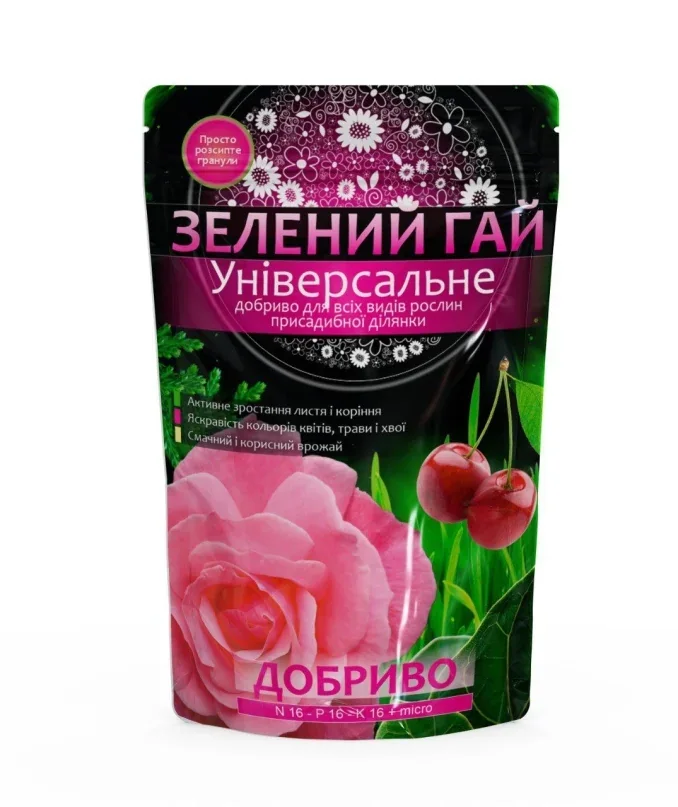
The interval between applications is several weeks: a granule dissolves gradually, and the previous feed is still working. For the balanced “Universal” (NPK 16-16-16) the typical schedule is in spring, in early summer and, for annual crops, once more in mid-season. Under shrubs and trees, nitrogen formulas are applied no later than mid-July, and in autumn you switch to low-nitrogen autumn formulas. For one flowerbed or a few shrubs the “Universal” 500 g bag is more convenient — the same granules as in the bucket.
Safety
- Work in gloves, wash your hands after work.
- Avoid contact with mucous membranes.
- Store the fertiliser tightly closed in a dark place out of the reach of children. In an open bucket the granules absorb moisture from the air and clump together.
Frequently asked questions
Can I just scatter the granules without working them in?
Yes, if you water right away or if the application coincides with rain. But granules that are worked in act more evenly and are not lost on the surface.
The granules have been lying on the soil for several weeks. Why haven’t they dissolved?
Most often — lack of moisture. In a drought a granule hardly dissolves. Water the area, and next time work the granules into the soil.
Can I put granules into the planting hole?
Yes, but mixed with the soil, not as a layer under the roots. Direct contact of concentrated fertiliser with the roots of a young plant is best avoided.