


Aqua Petunia
300 gFor petunias, surfinias and calibrachoa in hanging baskets and balcony boxes.
75 UAH
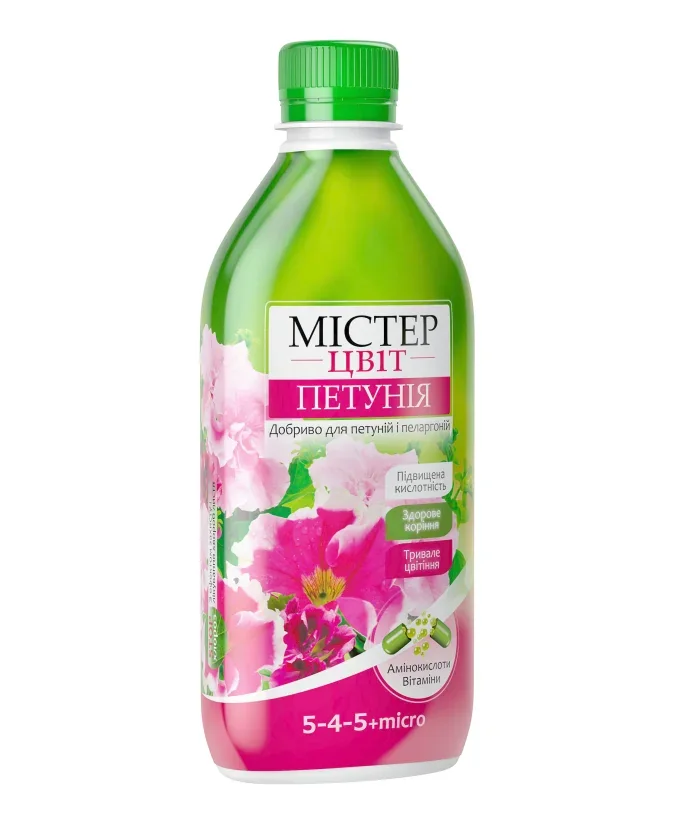
Mister Tsvit · 300 ml
For petunias in hanging baskets, balcony boxes and hanging planters.
Travels in one parcel with the rest of your order — no separate delivery to pay for. The minimum order amount is 250 UAH. Shipped by Nova Poshta or Ukrposhta within 1–3 days all over Ukraine. Questions and orders by phone: (093) 727-55-00 — we are the manufacturer.
| Pack size | 300 ml |
|---|---|
| Form | liquid |
| Price | 63 UAH |
| SKU | 558007 |
| Manufacturer | Gileya brand, Ukraine |
The label says “fertiliser for petunias and pelargoniums”, the bottom of the bottle 5-4-5 + micro, and on the side a separate badge: increased acidity. That badge is the most important thing here. Petunia and pelargonium like a slightly acidic substrate, while tap water in most Ukrainian cities is alkaline, and over the summer it gradually alkalises the soil in the box. Then something unpleasant happens: there are still nutrients in the pot, but the root stops taking them up. A formula with increased acidity works against exactly this.
A petunia in a hanging pot follows a predictable schedule. In May–June the plant is lush, in July the stems start to stretch, in August the bottom goes bare, flowers shrink by half and last a single day each. At the same time the leaves pale between the veins — petunia reacts to alkaline water with chlorosis faster than any other balcony plant. Pelargonium shows its complaint differently: the lower leaves turn yellow at the edge, then brown at the edge too, and the flower heads come out sparse, with a dozen flowers instead of a full ball. The cause in both cases is the same — there is little substrate in the box and flowering is continuous, so consumption is at its maximum.
Dose — with the cap, as per the label. Balcony plants are that rare case where feeding is frequent: the soil in the box dries out every day, watering is heavy, and nutrition goes into the saucer along with the excess water. Water not in the midday heat but in the morning or evening, and always onto moist soil. The most useful moment to feed is right after the summer pruning: when you have cut the stretched stems back by a third, the plant needs resources for new shoots, and that is when feeding gives a visible result within two weeks.
Fertiliser will not pull stretched bare stems back. If a petunia has already “gone bald” at the bottom, prune first, then feed — the other way round does not work. Pests do not belong here either: a sticky coating on the leaves and tiny white flies are whitefly; silvery streaks on the petals are thrips, and an insecticide is needed. Do not feed seedlings right after planting them in the box — give them a week to settle in. And do not use this formula for foliage houseplants: not every plant needs increased acidity, and it will do nothing to improve a ficus or a palm.
Here the size ladder really matters. One or two hanging pots on the balcony — this 300 ml bottle for 63 UAH lasts the season. A dozen balcony boxes or hanging baskets — it pays to take the water-soluble Zelenyi Hai Aqua Petunia 300 g (75 UAH): the powder is diluted by the bucket, not by the cap. A bed of petunias in open ground — that is granules: Bright Flowerbed 500 g (89 UAH) or a 5 kg bucket (610 UAH) with the 14-17-18 formula, rate 25 g per square metre every 3–4 weeks, up to five times a season.
Roses and garden flowers. NPK 14-17-18. 5 kg — 610 UAH · 10 kg — 1 090 UAH. Discount by number of buckets: 2 — −4%, 5 — −7%, 10 — −10%.
Petunia and pelargonium absorb nutrition in a slightly acidic environment. Watering with hard tap water gradually alkalises the substrate, and absorption drops even when the pot is full of nutrients. The acidic reaction of the solution counteracts this.
In everyday speech both names refer to the same indoor and balcony plant. Botanically it is pelargonium; true geranium is a different genus, a garden perennial. The fertiliser is designed for the one growing in your pot.
Not on its own. Stretched stems are cut back by a third, and only after pruning does feeding give a second wave of flowering. Without pruning you will be feeding bare whips.
The frequency is printed on the label. General rule: balcony plants in a small volume of soil are fed much more often than houseplants, because every heavy watering carries part of the nutrition out into the saucer.
For petunias, surfinias and calibrachoa in hanging baskets and balcony boxes.


Liquid concentrate for houseplants: measure with the cap and water. 63 UAH per pack.


