Gardening tips
Lawn feeding through the season
A lawn is the hungriest part of the plot: every mowing takes away part of the leaves together with nutrients. Here is a plan for the whole season — what to apply, when, how much, and how mowing and watering affect the result.
Why a lawn needs regular feeding
Lawn grasses grow densely, their roots are shallow, and the cut grass with all its nutrients is mostly removed from the plot. Without feeding, by the second or third year a lawn thins out, gets lighter, and moss and weeds appear in the gaps. Regular feeding is the simplest way to keep the turf dense: dense grass crowds out weeds by itself.
A lawn's needs change through the year. In spring and early summer it needs nitrogen — for leaf growth and colour. In autumn nitrogen already does harm, and what is needed is potassium and phosphorus — for roots and winter hardiness. What these numbers on the package mean is explained in the article about NPK.
Spring: nitrogen and iron
The first feed is given when the snow has gone, the soil has thawed and the grass has started to grow — usually after the first mowing or just before it. First rake away last year's grass and debris so the granules land on the soil and do not get stuck in the thatch.
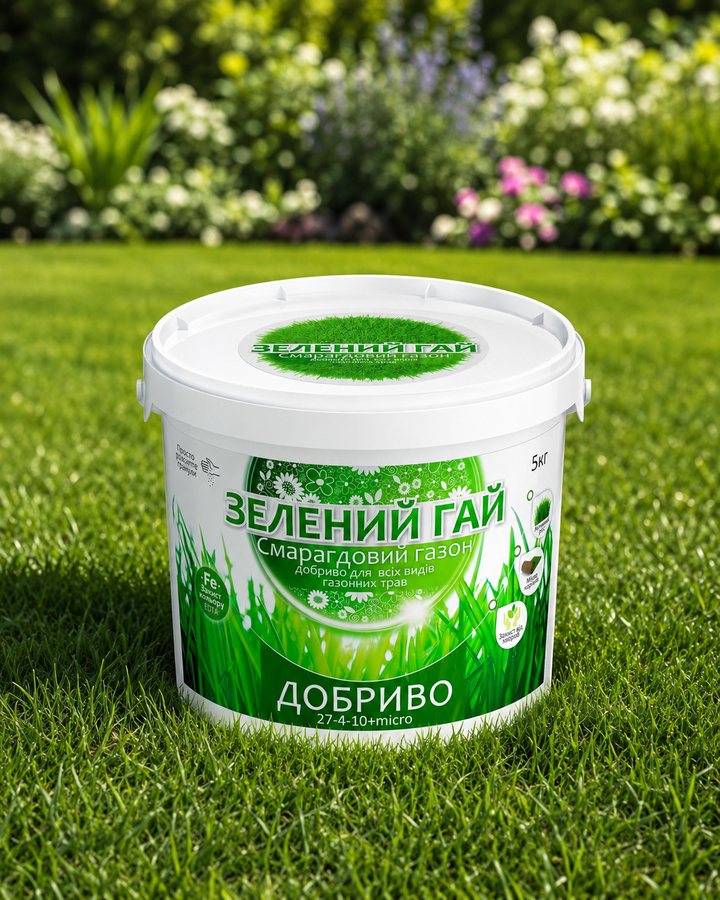
For this feed we recommend “Emerald Lawn” (NPK 27-4-10). High nitrogen kicks off growth, and the iron (Fe) in the composition gives a deep green colour without yellowness. The rate is 25 g (1 scoop) per 1 m².
- Apply the granules to moist soil but over dry grass — on wet leaves they stick and can burn.
- Spread evenly, preferably in two perpendicular directions: half the rate along the plot, half across. That way there will be no stripes.
- Water the lawn right after applying, so the granules roll off the leaves onto the soil and start to dissolve.
Aeration before feeding
If the lawn is trampled and water stands on it after rain, aerate it in spring before feeding — pierce the turf with an aerator or a garden fork. Air and water, and nutrients with them, will go to the roots instead of running off the surface. A thick layer of thatch — old dead grass — is removed with a scarifier or a rake: granules cannot get through it to the soil.
Summer: support without overheating
The second feed with “Emerald Lawn” is given at the end of May or in June, when the grass is growing actively and is mowed often. Same method and same rate.
In the July heat a lawn naturally slows its growth. Feeding it nitrogen at the height of the heat, when the grass is not being watered, is not worth it: growth will not start, and the risk of burn will rise. If the lawn is watered and keeps its colour, you can give one more feed closer to the end of summer, when the heat eases. If the grass has turned yellow from drought, water first, and feed only after it recovers.
The main rule: do not exceed the rate “just in case”. A double dose of nitrogen does not make the lawn twice as green — it causes burns, “fat”, soft grass that gets sick more often, and requires more frequent mowing.
Autumn: potassium for overwintering
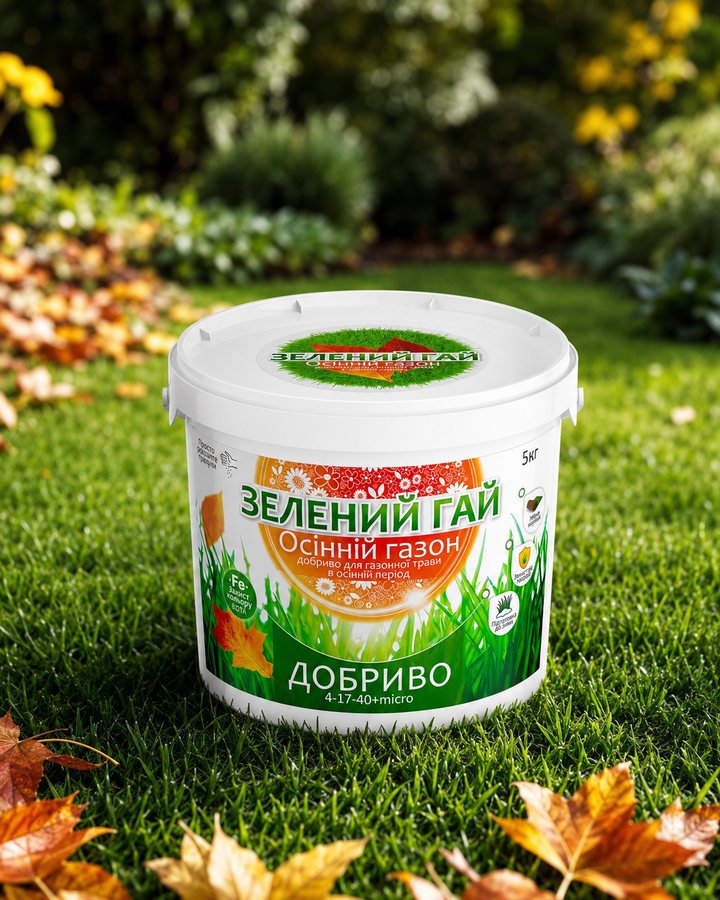
In September or early October a lawn is given an autumn feed. A completely different formula is needed here: “Autumn Lawn” (NPK 4-17-40). Little nitrogen, so the grass is not pushed into growth before the frosts; a lot of potassium — it strengthens the turf, and the lawn copes with winter more easily and greens up earlier in spring. The rate is the same — 25 g per 1 m², and the method of application is the same.
Late nitrogen in autumn is one of the common causes of snow mould: soft, lush grass goes under the snow and is infected by fungus there. More on autumn feeding for the whole garden — in the article on autumn feeding.
How much fertiliser your lawn needs
The calculation is simple: area in square metres × 25 g is the amount for one feed.
| Lawn area | Per feed |
|---|---|
| 50 m² | 1.25 kg |
| 100 m² (one sotka) | 2.5 kg |
| 200 m² | 5 kg |
| 400 m² | 10 kg |
So a 5 kg bucket is enough for one application on 200 m² or for two on one sotka (100 m²). For a small plot or overseeding there are 500 g packs — that is 20 m². More on calculating for the whole plot — in the article how much fertiliser your plot needs.
Mowing: fertiliser does not work without it
- The one-third rule. Cut no more than a third of the grass height at a time. Hard mowing weakens a lawn more than any lack of nutrients.
- Height. For an ordinary lawn — about 4–6 cm. In hot weather leave the grass taller: it shades the soil and dries out less.
- A sharp blade. A blunt one tears the leaves, the tips turn brown, and the lawn looks yellow even after feeding.
- The last mowing in autumn — when growth has almost stopped. Going into winter the grass should be neither too long nor shaved short.
Watering
Water less often but more deeply: the soil should get wet to the depth of the roots. Frequent shallow watering teaches grass to keep its roots right under the surface, and it is the first to burn out in the heat. The best time is morning: the leaves dry during the day, and fungi have less of a chance. Watering after every application of granules is a must.
Frequently asked questions
Does turf (rolled lawn) need feeding?
Yes, on the same schedule, but the first feed is given once the rolls have rooted — they can no longer be lifted by the edge. Until then the main thing is daily watering.
Can I feed a lawn right after sowing?
Young seedlings get their first feed when the grass has rooted and has already been mowed once or twice. In this case it is better to reduce the rate.
Where does moss on a lawn come from?
Moss is a sign of conditions in which grass does poorly: shade, compacted waterlogged soil, acidic reaction and hungry, sparse grass. Feeding helps the grass thicken and crowd out the moss, but without aeration, better drainage and correcting acidity it will come back.
Can I apply fertiliser before rain?
Light rain after application is good — it replaces watering. A downpour right after application can wash the granules off the plot or collect them in low spots, where burns will then appear.
Why did yellow patches appear after feeding?
Most often the granules were spilled in a heap or stayed on wet grass. Water these spots generously; the grass will grow back.