Gardening tips
Lawn after winter
After the snow melts, a lawn rarely looks the way it did in autumn: grey patches, matted grass, bare spots. Most of this can be fixed within a few weeks if you do everything in the right order and do not rush with the rake.
Rule one: do not walk on a wet lawn
The most damage to a lawn in spring is done not by winter but by impatience. Thawed, waterlogged soil compacts easily: every step on it squeezes out the air, and the grass later thins in the footprints. So while the ground is soft and squelches underfoot, it is better not to step on the lawn at all. Work begins when the soil has dried enough that no footprints are left on it.
While you wait, you can do two safe things: clear the lawn of branches, leaves and debris blown in by the wind, and, if meltwater is standing in low spots, dig shallow channels to drain it away. Standing water under an ice crust is the most common cause of frozen-out and smothered patches.
Inspection: what the patches mean
| What you see | Likely cause | What to do |
|---|---|---|
| Grey-white or pinkish patches with a cobweb-like coating right after the snow melts | Snow mould — a fungal disease under long snow cover | Carefully loosen with a rake so the patches dry out; in severe cases — a fungicide |
| Matted, flattened grass without a coating | Snow pressure, especially where it was piled into drifts | Light raking, the grass will rise on its own |
| Bare spots in low areas | Waterlogging, ice crust | Overseeding, improving drainage |
| Dry strips along paths | De-icing salt, mechanical damage | Flush with water, replace the topsoil, overseed |
| Burrows, ridges of soil | Moles, mice | Level out, add soil, overseed |
Do not jump to conclusions: part of the brown grass is last year's leaves, and new shoots are already greening underneath. Wait a week or two after the snow melts: live areas will noticeably green up, dead ones will not. If the lawn turns yellow later, during the season, the causes are covered in the article why a lawn turns yellow.
Raking and aeration
Light raking
As soon as the soil has dried a little, the lawn is raked with a fan rake: last year's dead grass and leaves are removed and snow mould patches are broken up. The movements are light, without force: the aim is to lift the grass and let it breathe, not to tear up the turf.
Scarification
If a dense springy layer of thatch — dead stems and roots — has formed under the grass, it is removed with a scarifier. Thatch prevents water, air and fertiliser from reaching the soil. Scarification is done when the grass is already actively growing, because afterwards the lawn looks ragged and has to recover quickly. A weak, thin lawn is better not scarified — a rake is enough.
Aeration
A compacted lawn where water stands after rain is pierced with an aerator, a garden fork or special spiked sandals. The soil should be moist but not wet. The holes open access for air and water to the roots and help fertiliser get where it is needed.
Overseeding bare patches
Bare areas should be sown as early as possible: if this is not done, weeds and moss will take them over. The best time is when the soil has warmed up and the threat of hard frosts has passed, while summer heat is still far off.
- Loosen the bare patch with a rake to a depth of a few centimetres and remove dead grass.
- If the soil is poor or salty, replace the top layer with fertile soil.
- Sow seed of the same grass mix as the main lawn, so there are no differently coloured patches.
- Lightly work it in with a rake and press it down — the seed must be in close contact with the soil.
- Water with a fine spray so the surface does not dry out until the seedlings appear.
Overseeded areas are not mown until the young grass is established, and are not walked on.
The first mowing
The lawn is mown for the first time when the grass has noticeably grown. The main rule of the first mowing is not low: cut only the tips, about a third of the height. The lawnmower blades are best sharpened during winter: a blunt blade tears the grass, and torn tips turn brown. A low first mowing of a lawn weakened by winter is one of the causes of its spring yellowing.
The first feeding
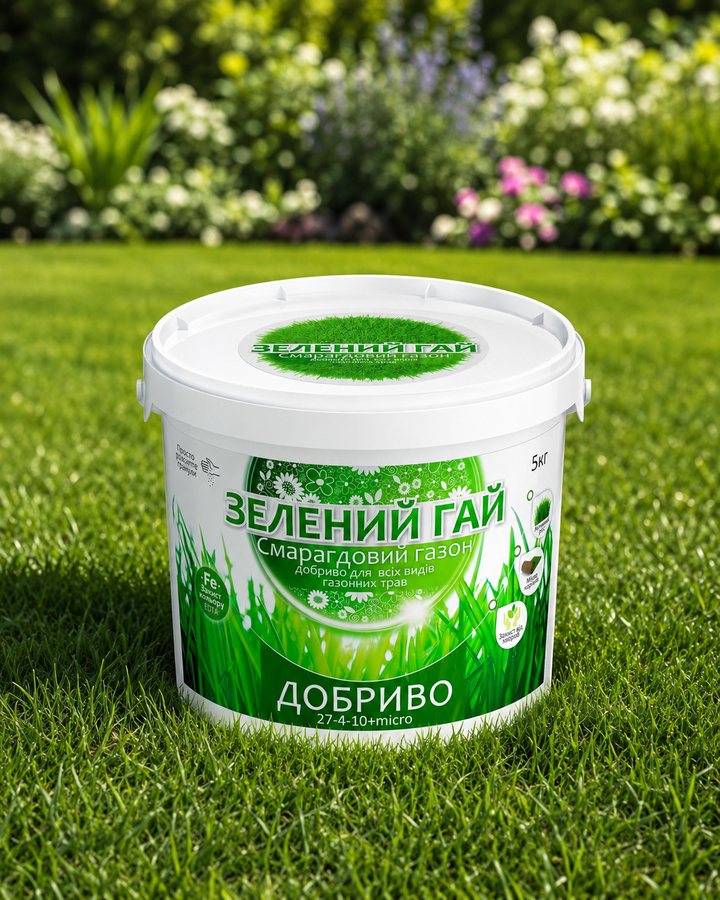
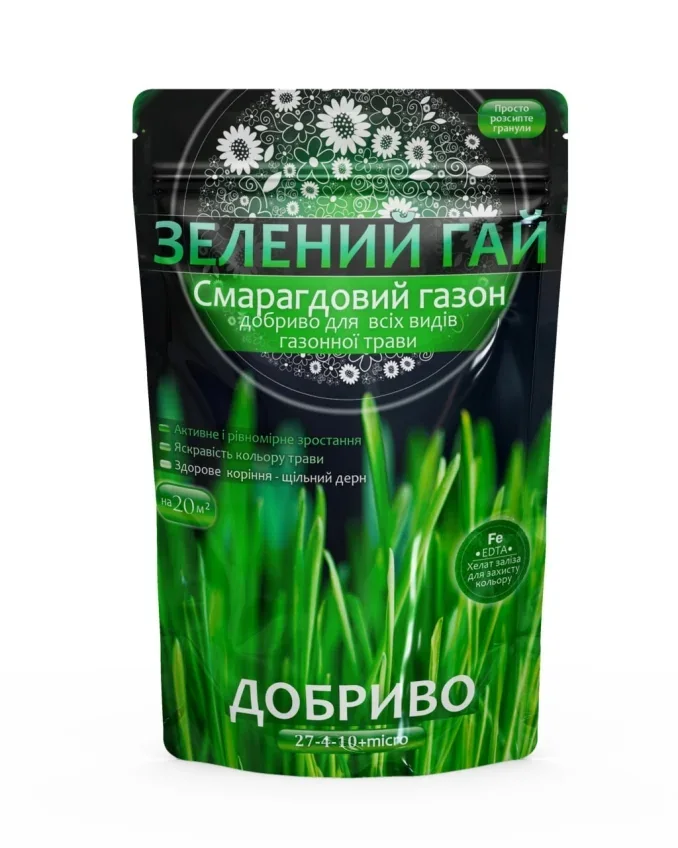
After winter a lawn needs nitrogen most of all, and iron for a good colour. That is what “Emerald Lawn” with NPK 27-4-10 and iron (Fe) is for. The rate is 25 g (1 scoop) per 1 m².
- Apply when the grass has started to grow back — most conveniently after the first mowing.
- Soil moist, grass dry; spread in two passes, lengthwise and crosswise.
- Water immediately after application.
- Give overseeded areas fertiliser later, once the young grass has rooted, and at a lower rate.
For overseeding a few bare patches or a small area, the “Emerald Lawn” 500 g pack is more convenient. How to feed the lawn later, in summer and autumn, is covered in the article on lawn feeding.
Frequently asked questions
Can I rake and aerate the lawn at the same time as feeding it?
Yes, and it is even convenient: first raking and aeration, then fertiliser and watering. Through the holes the nutrients will reach the roots faster.
More than half of the lawn is damaged. Overseed or sow again from scratch?
If little live grass is left and the rest of the area is taken over by moss and weeds, it is simpler to resow the area completely: remove the old turf, loosen and level the soil, apply a starter fertiliser and sow the lawn anew. If the bare patches are isolated, with dense live grass between them, overseeding is cheaper and faster — the neighbouring grass tufts will help close the bare spots themselves.
Does the lawn need liming in spring?
Only if a test has shown acidic soil and there is a lot of moss on the lawn. Liming at random without a measurement is not worth it.
How to avoid this state next spring?
In autumn, give the lawn a potassium feeding, do not leave tall grass and fallen leaves on it for winter, and do not shovel snow from paths onto the lawn. Details are in the article on autumn feeding.