Gardening tips
Spring garden feeding
In spring the whole garden wakes up almost at once, and within a few weeks you need to feed the lawn, trees, shrubs and flowers. We explain where to start, in what order to go round the plot and what to fertilise each group of plants with.
When to start: not by the date, but by the soil
Spring feeding starts not on the first of March, but when the soil has thawed and dried out a little and the plants have begun to wake up: buds swell, grass starts growing, shoots of perennials appear. In the south this may be March; in the north and in hilly areas — April.
Why not earlier:
- on frozen ground and on snow the fertiliser is not absorbed, and meltwater carries it off the plot;
- in cold soil the roots hardly work — the nutrients lie there uselessly;
- it is best not to walk on wet spring soil: compacted soil lets air and water through worse for the whole season.
The main rule of spring is simple: in spring plants need nitrogen — for leaves, shoots, grass. Phosphorus and potassium are needed too, but a predominance of nitrogen in spring formulas is normal. In autumn everything is the other way round, and the full yearly scheme is collected in the garden feeding calendar.
Order of work on the plot
- Clean-up. Rake up last year's leaves, cut back the dry stems of perennials, remove broken branches. Under matted leaves the soil warms up more slowly.
- Removing covers — gradually, in overcast weather, once the soil has thawed.
- Pruning of roses, fruit trees and shrubs according to the rules for each crop.
- Feeding — after the clean-up, onto moist soil.
- Mulch — after feeding, to retain spring moisture.
The vegetable plot lives on its own schedule. Vegetable beds are prepared before sowing and planting out seedlings: the granules are scattered over the area and worked into the soil while loosening. Seedlings on the windowsill are already growing at this time and need their own, much weaker feeding. Overwintered winter garlic is fed among the first — as soon as the leaves start growing.
If you do not know the soil reaction on your plot, spring is the best time to check it: an inexpensive test kit or a pH meter will show whether the soil suits acid-loving plants and whether alkaline soil may cause chlorosis later. That way you will not waste fertiliser on plants that are unable to absorb it.
Overview by crop
| What | When | With what | Rate per application |
|---|---|---|---|
| Lawn | Grass has started growing, after the first mowing | “Emerald Lawn” 27-4-10 | 25 g per 1 m² |
| Conifers | Soil has thawed and warmed up | “Lush Conifer” 10-10-15 | 25 g young, 60 g mature plant |
| Roses, flowerbeds | After spring pruning, regrowth | “Bright Flowerbed” 14-17-18 | 25 g per bush or per 1 m² |
| Hydrangeas, rhododendrons | April, soil +10 °C | “Exquisite Hydrangea” 15-10-20 | 25 g, bigleaf — 12 g |
| Blueberry | Start of growth | “Magic Blueberry” 15-12-20 | 25 g per bush |
| Strawberry, raspberry, grapes | Regrowth of leaves and shoots | “Tasty Berry” 20-17-14 | 25 g, large bushes — up to 60 g |
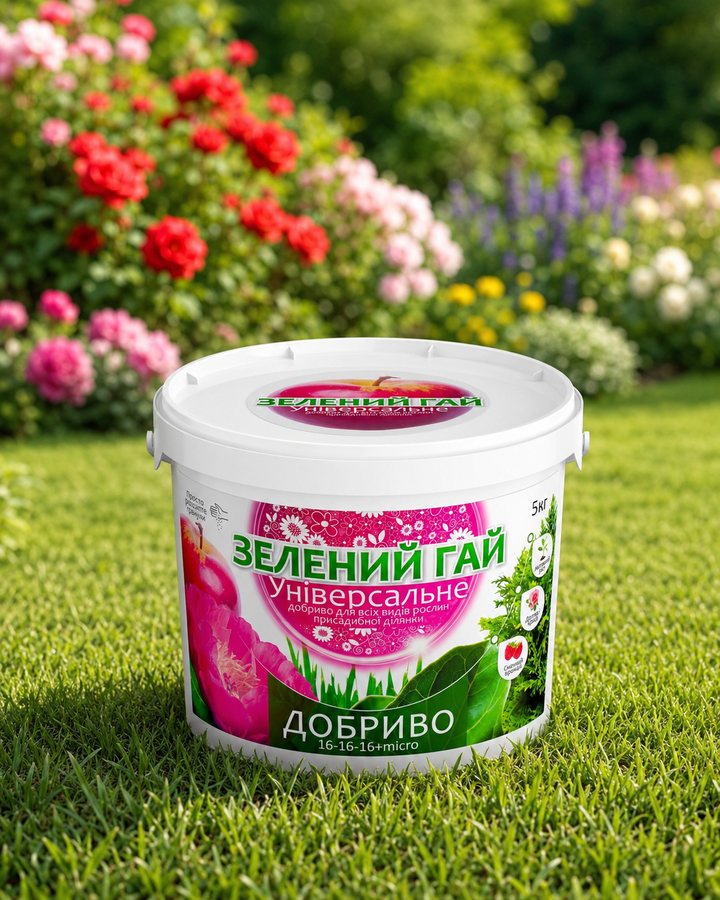
| Fruit trees, shrubs, everything else | Bud swelling | “Universal” 16-16-16 | 25 g young, 60 g mature |
Lawn and conifers — first
The lawn wakes up earlier than most plants and after winter needs nitrogen most of all. The first feeding is done when the grass has started to regrow — most conveniently after the first mowing. “Emerald Lawn” combines high nitrogen with iron, which gives a deep green colour. But before it a lawn usually needs scarifying, aeration and overseeding of bare patches — this is described step by step in the article on the lawn after winter.
Conifers in spring require a particular order: first protection from the sun and water, then nutrition. For thujas, junipers, pines and spruces “Lush Conifer” is suitable, with magnesium and iron among its micronutrients. In detail — in the article on spring feeding of conifers.
Trees, shrubs and berry bushes
Fruit trees and ornamental shrubs need balanced nutrition in spring. The simplest solution is “Universal” with NPK 16-16-16 and micronutrients: 60 g per mature tree or shrub, 25 g per young one. The granules are scattered not by the trunk but along the edge of the crown, where the feeder roots lie, lightly worked in and watered.
Berry crops — strawberry, raspberry, grapes — need more nitrogen at the start and phosphorus for fruit set. The first feeding is done when the leaves regrow, the second before flowering. Currants and gooseberries are fed at the same times as other shrubs. Blueberry is a special case: it needs an acidic environment, so it gets its own formula.
Flowers, hydrangeas and acid-lovers
Roses are fed after spring pruning, when the buds have started. Perennials in the flowerbed — when shoots have appeared. Annuals have not yet been planted out, but the flowerbed for them can be dressed with granules in advance and worked into the soil.
Hydrangeas, rhododendrons and azaleas start being fed in April, when the soil has warmed to +10 °C. Bigleaf hydrangea is given half the rate — it has the most sensitive roots. Ash and lime are not scattered near acid-lovers in spring.
What not to do in spring
- Do not apply autumn formulas instead of spring ones. They have little nitrogen — the plant starts slowly.
- Do not feed newly planted saplings at the full rate. They first need to establish.
- Do not scatter fertiliser on dry soil in a dry spring without watering. The granules will not dissolve.
- Do not exceed the rate “so that it wakes up faster”. A double dose does not speed up growth, it burns the roots.
- Do not forget about water. After a winter with little snow, spring watering is more important than feeding.
Frequently asked questions
Can the whole garden be fed with one fertiliser in spring?
Yes: “Universal” covers the spring needs of most plants. Separate formulas are needed for acid-lovers (hydrangeas, rhododendrons, blueberry), and for the lawn and conifers specialised ones give a better result.
They say fertiliser can simply be spread over the snow. Is that so?
People do it, but it is wasteful. While the snow melts, the soil is still frozen, and meltwater carries part of the granules into low spots and onto paths. It is more reliable to wait until the ground thaws and takes in water.
How many times should you feed in spring?
Usually one or two applications: at the start of growth and before flowering, or a few weeks after the first.