Gardening tips
Ammonium nitrate in the garden and vegetable plot
Ammonium nitrate gives nitrogen that a plant starts taking up straight away, even from cold spring soil. We explain when it is useful, how much to apply, how to store the bag and how it differs from urea.
What ammonium nitrate is
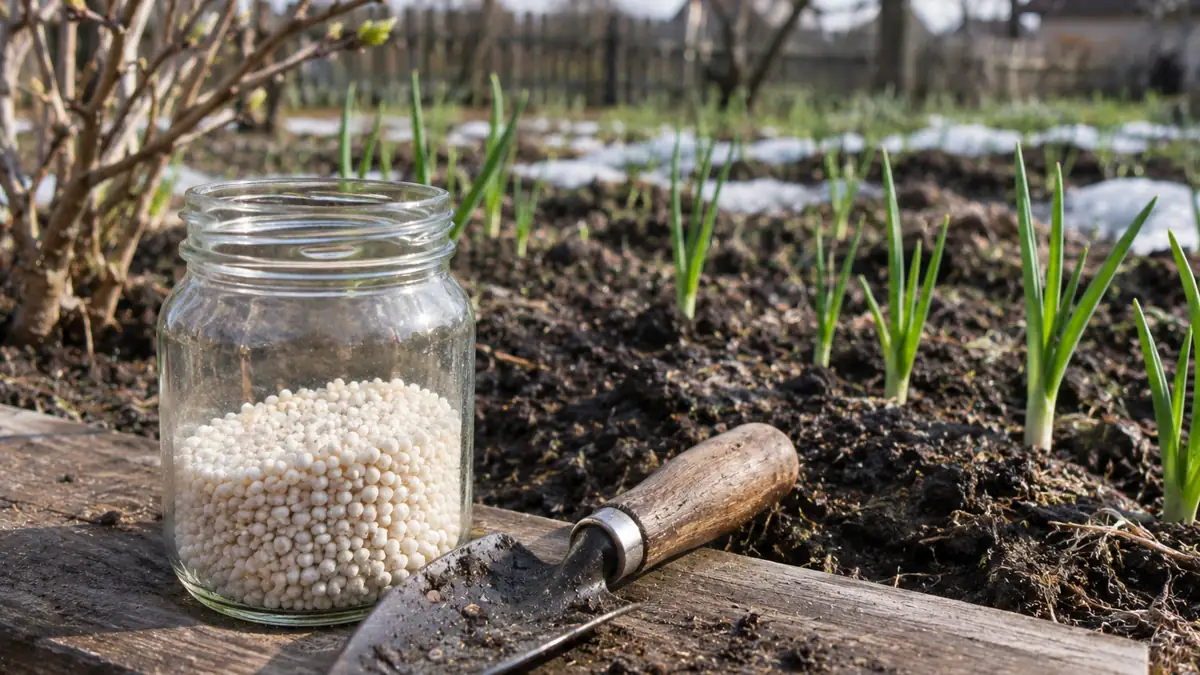
Ammonium nitrate, also called ammonium saltpetre, is the compound NH₄NO₃. It contains about 34 % nitrogen and no other nutrients. It is sold as white or light-coloured granules that dissolve quickly in water.
Half the nitrogen in ammonium nitrate is in nitrate form and half in ammonium form. Plants take up nitrate at once: it moves with soil water to the roots and starts working within a few days. Ammonium binds to the soil and lasts longer, while bacteria gradually turn it into nitrate. The mix gives both a quick start and a supply for several weeks.
Why ammonium nitrate is applied in spring
In early spring the soil is cold, bacteria are sluggish, and hardly any nitrogen is released from humus or urea. This is when the plant starts growing, and it is short of nitrogen it can use. The nitrate part of ammonium nitrate does not need bacteria, so it works even in soil that is still cold.
That makes ammonium nitrate a good choice for the first feed of:
- garlic and winter onions, as soon as the snow melts and the first leaves appear;
- strawberries after the bed has been cleaned up in spring;
- fruit trees, currants and gooseberries on poor soils, before flowering;
- the lawn after winter, once the grass has started growing.
From midsummer onwards ammonium nitrate is no longer applied to perennials. Nitrogen pushes new growth that has no time to ripen, and in frost these shoots are the first to die. Applying it in autumn is pointless for another reason too: rain and meltwater wash nitrate down below the roots.
How to apply it and how much
The usual rate for garden and vegetable crops is 10–20 g per 1 m² per application. For a tree, count the area of the trunk circle out to the edge of the crown. Poor sandy soil and hungry crops are closer to the upper limit, fertile soil and bulbs closer to the lower one.
- Scatter the granules evenly over moist soil, keeping away from stems and trunks.
- Rake them lightly into the top layer.
- Water if no rain is expected. Nitrate from ammonium nitrate does not escape into the air the way ammonia does from urea, but a granule only works once dissolved.
Ammonium nitrate is not scattered over wet leaves. It is rarely used as a foliar spray: urea suits that better, and ammonium nitrate burns leaves more easily. It is not placed next to seeds or young roots either, because the concentrated solution around a granule burns the rootlets.
Excess nitrogen shows within a few weeks: large dark leaves, long soft shoots, few flowers and little fruit set. Nitrate builds up in greens and root vegetables, so leafy vegetables and radishes get ammonium nitrate sparingly and not shortly before harvest. The signs of overfeeding and how to save the plant are covered in the article on overfeeding.
Storage and safety
Ammonium nitrate is an oxidiser, so the bag is handled more carefully than ordinary fertiliser. The rules are simple:
- store it in a closed bag in a dry, cool place, away from stoves, heaters and open flame;
- do not keep it near fuel, oils, sawdust, hay, straw or other flammable materials;
- do not mix it in a bag or bucket with other fertilisers, lime or ash;
- do not heat it; break up caked lumps by hand through the bag;
- wear gloves, keep the bag where children and animals cannot reach it, and wash your hands after work.
Ammonium nitrate draws a lot of moisture from the air. An open bag sets into a solid block within a few weeks, so buy only as much as you will use in a season.
Ammonium nitrate or urea
| Ammonium nitrate | Urea (carbamide) | |
|---|---|---|
| Nitrogen | about 34 % | 46 % |
| Form of nitrogen | nitrate and ammonium, half and half | amide, turns into ammonium and nitrate in the soil |
| Cold soil | works fast | works more slowly until the soil warms up |
| Losses from the surface | almost none | some nitrogen escapes as ammonia unless worked in |
| Foliar spraying | rarely, burns more easily | suitable in a weak solution |
| Leaching | rain washes nitrate out | less, while nitrogen is in amide and ammonium form |
| Storage | oxidiser, cakes badly | cakes, but not an oxidiser |
For an early spring feed in cold weather ammonium nitrate works better. Urea is better value on warm soil and the one to use for foliar feeding. More about it in the article on urea.
When a complex fertiliser is easier
Ammonium nitrate gives only nitrogen. If a plant is fed nothing else for years, it runs short of phosphorus for the roots and potassium for strong tissue and wintering, and a second or third handful of nitrogen will not fix that.
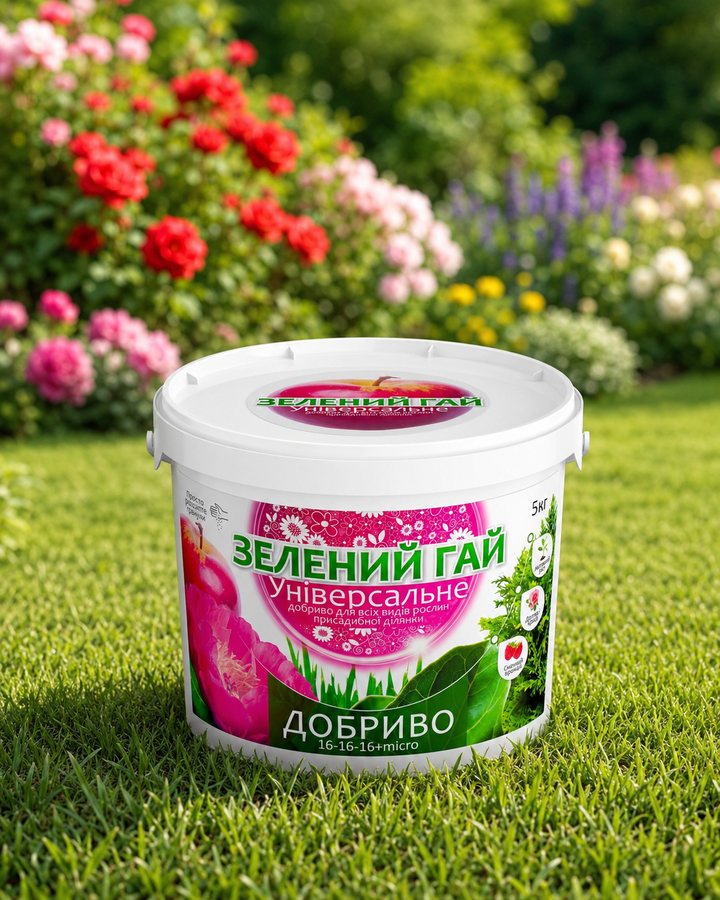
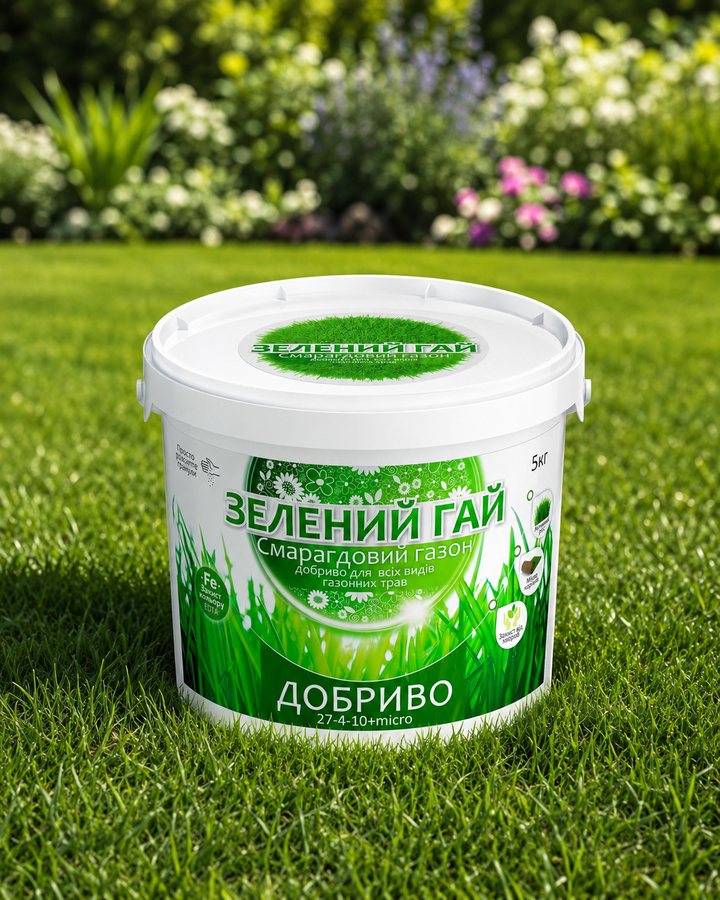
For a spring feed of the whole plot it is simpler to take a complex formula. “Universal” has NPK 16-16-16 plus MgO, Fe, Mn, B, Cu, Zn, Mo and Co. The rate is 25 g (1 scoop) per 1 m² or per bush, and 60 g under mature shrubs and trees. For a lawn, which needs nitrogen above all in spring and summer, there is “Emerald Lawn” with NPK 27-4-10 and iron. Both are applied the same way: over moist soil, mixed into the top layer, keeping off wet leaves.
Frequently asked questions
Can ammonium nitrate be spread on snow?
Some of the nitrogen will run off with the meltwater to where there are no plants, and some will wash down deep. It is better to wait until the soil has thawed and dried out a little.
Is ammonium nitrate suitable for acid-loving plants?
For blueberry and hydrangea it is not the best choice: they do better with nitrogen in ammonium form and special formulas for acid soil.