Gardening tips
Feeding lemon, mandarin and other citrus at home
A citrus in a flat keeps its leaves for years and has no real dormancy, so it is fed differently from the rest of the windowsill. We go through the seasonal regime, winter, chlorosis and the causes fertiliser can't deal with.
How citrus differs from other houseplants
Lemon, mandarin, calamondin, kumquat, lime, an orange or grapefruit grown from a pip — they are all evergreen trees. A citrus leaf lives for several years and works all that time. So every fallen leaf is a noticeable loss of reserves for the plant, not a seasonal renewal as in deciduous plants.
Hence two features of its nutrition. First: citrus needs relatively a lot of nitrogen to keep and renew its leaves. Second: it has no real dormant period, so in winter feeding is not stopped completely but reduced. And one more detail that matters in a flat: citrus likes slightly acidic soil and tolerates hard alkaline water poorly, which is why chlorosis often develops in it.
Seasonal regime
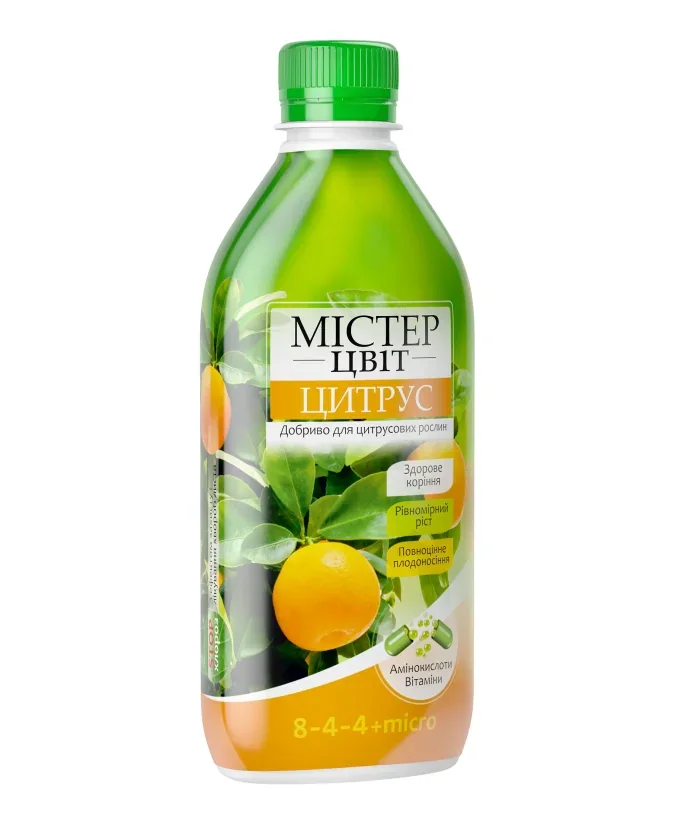
For lemon and mandarin the line has a separate formula — “Mister Tsvit Citrus” with NPK 8-4-4 and micronutrients. Twice as much nitrogen as phosphorus and potassium — for evergreen leaves. The dose is printed on the label; the concentrate is measured with the cap.
- Spring and summer are the main season. The citrus puts on several flushes of growth, blooms, sets and fills fruit, and spends the most at this time.
- Autumn and winter — feeding roughly half as often as in spring. Do not stop completely if the tree stands in a bright, warm place.
- During fruiting there is no pause: a tree with fruit needs nutrition the most. A break, if needed, is taken after the fruit is harvested.
More about the winter regime for different houseplants in the article should houseplants be fed in winter.
How to feed correctly
- Only onto moist soil. First a regular watering, then the solution. If the tree has dried out so much that the leaves droop, first restore watering with plain water and feed only a day later: on a dried-out root the concentrate acts like a burn.
- Not on a cold windowsill. If the pot stands somewhere cool and the soil is cold, the root hardly absorbs anything, and salts accumulate. Warmth first — then feeding.
- Not right after purchase or a move. Citrus reacts badly to a change of place and light and often drops some of its leaves. Fertiliser does not relieve this stress, it adds to the load.
- Not after repotting. There are nutrients in fresh soil; give the root two to three weeks.
- Flush the soil. If you water with hard water, a white crust appears on the soil surface. A few times a year it is worth flushing the pot with a large amount of settled soft water to wash out excess salts.
Yellow leaves: hunger or chlorosis
Yellowing leaves are the most common complaint of lemon owners, and there are several causes. The main thing is to look at which leaves turn yellow and how.
| What you see | Likely cause | What to do |
|---|---|---|
| Old leaves at the bottom evenly pale and drop, new ones small and light | Lack of nutrition, primarily nitrogen | Regular seasonal feeding |
| Young leaves at the top lighten, the veins stay a green network | Chlorosis — iron deficiency, more often because of alkaline water | Anti-Chlorosis and softer water |
| Yellowing between the veins on old leaves | More often magnesium deficiency | Balanced feeding with micronutrients |
| Leaves turn yellow and drop en masse after a move or in winter | Stress, lack of light, overwatering | Light, moderate watering, no fertiliser |
Chlorosis in citrus is linked not so much to an absence of iron in the soil as to the root being unable to take it up. Hard tap water gradually makes the substrate alkaline, and the iron turns into an unavailable form. So chlorosis is treated with two actions at once: giving the plant available micronutrients and removing the cause.
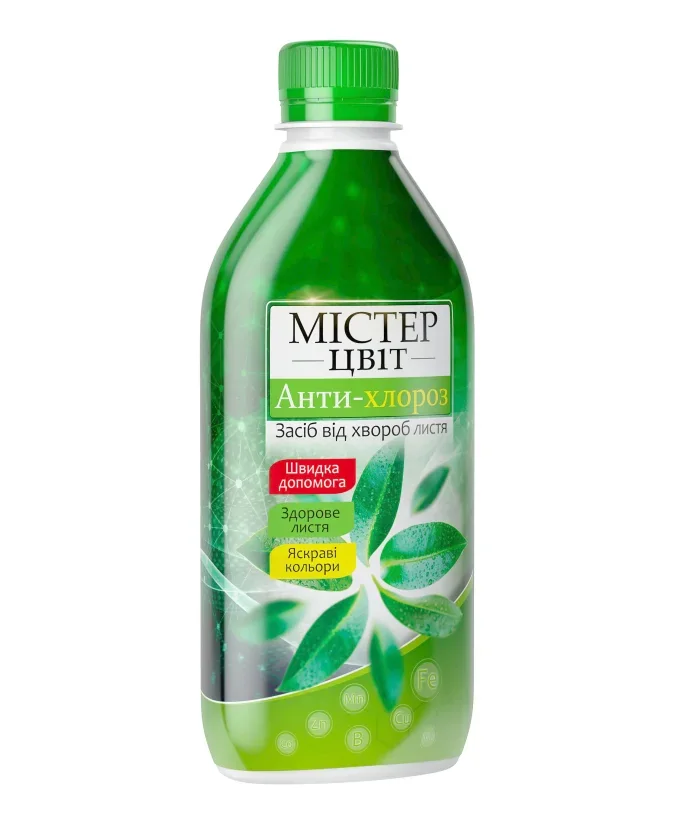
For the first there is “Mister Tsvit Anti-Chlorosis” with iron, manganese, zinc, copper and boron. The dose and frequency are on the label; it is applied as a course until the new leaves start coming out a normal colour. For the second — water with soft settled water or acidify it. Judge the response by the new growth: old yellowed leaves almost never turn fully green again, and that is normal. A general overview of chlorosis in the garden and on the windowsill is in the article why leaves turn yellow.
Why flowers and fruitlets drop
Citrus often blooms profusely and then drops most of its fruitlets. Partly this is normal: the tree keeps as many fruits as it can feed, and a young lemon tree cannot hold dozens of lemons. But mass dropping of fruitlets, especially when not a single fruit remains, has causes:
- lack of light — the most common cause in a flat;
- the root ball drying out or sharp swings in watering;
- dry hot air near the radiator;
- lack of nutrition during fruit set;
- moving and turning the pot during flowering.
If the fruits set but stay small, with a thick peel and no flavour, it is more often a sign of a lack of both nutrition and light.
What fertiliser will not fix
- Spider mite. Tiny pale dots on the leaves and fine webbing in the leaf axils are a pest, not hunger. A treatment is needed, and fertiliser only adds to the load.
- Scale insects. Raised brown bumps on stems and leaves and a sticky coating — also a pest.
- Leaf drop from cold or a draught. An open window vent next to a citrus in winter can cost half the crown.
- No flowering in a seedling. A citrus grown from a pip may not bloom for years — this is a feature of seedlings, not a lack of fertiliser.
Frequently asked questions
Can lemon be fed with garden granules?
Better not. In a pot the salts are not washed down as in open ground, and the concentration at the roots rises quickly. Liquid concentrates, which are easy to dose, are intended for plants in pots.
The lemon stands on the balcony in summer — should it be fed more often?
Outdoors there is more light and the tree grows more actively, so regular feeding there is entirely appropriate. But watch the watering: in hot weather the pot dries out in a day, and dry soil must not be fed. Bring the citrus indoors in good time, before the cold nights, and after the move give it a few weeks to adjust without fertiliser.
In short
- Spring and summer — regular feeding with a citrus formula, in winter — roughly half as often.
- Only onto moist, warm soil, never onto dried-out soil.
- Young leaves turn yellow with green veins — chlorosis; treat with micronutrients and soft water.
- Light matters more than any fertiliser.