Gardening tips
Feeding blueberries
Blueberry is unlike any other berry crop: what is good for currants or strawberries harms it. Here is how to feed it so the bush does not turn yellow and fruits abundantly.
The key thing about blueberries: without acid soil, feeding does not work
Blueberry is a plant of the heather family, like cranberry, lingonberry and rhododendron. In nature it grows on acid peat and sandy soils, and its roots are adapted precisely to them. A comfortable acidity for blueberry is roughly pH 4–5. On ordinary garden soil with a pH of about 6–7 it survives but does not grow: the leaves turn yellow, growth is meagre, there are few berries.
Two more peculiarities:
- Roots without root hairs. Blueberry feeds in symbiosis with special mycorrhizal fungi that work only in an acid environment. Neutralise the soil — and the plant loses its “absorption system”.
- Shallow root system. Most of the roots are in the top centimetres of soil. They are easy to dry out, damage by digging and burn with excess fertiliser.
So before feeding, make sure the acidity is right. How to measure and acidify the soil is explained in the article on acid soil and pH.
What must not be used to fertilise blueberries
- Manure and poultry droppings. They make the soil alkaline, give a sharp excess of nitrogen, and fresh ones burn the shallow roots.
- Ash. Strongly raises pH — for blueberry it is probably the most harmful “natural” fertiliser.
- Lime, dolomite flour, chalk. The same: they de-acidify the soil.
- Ordinary compost and humus. Neutral or slightly alkaline; not suitable as mulch or as planting-hole filler.
- Fertilisers with chlorine. Heathers are sensitive to chlorides.
For mulch, use conifer bark, conifer sawdust, pine or spruce litter, acid high-moor peat. Mulch maintains acidity, retains moisture and protects the shallow roots from overheating.
Feeding season
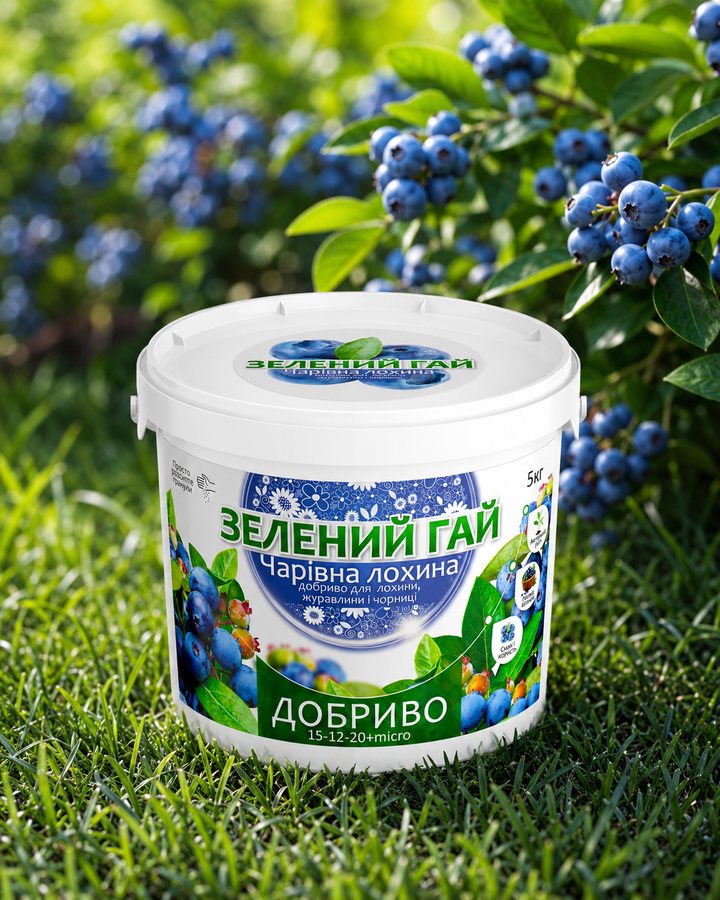
For blueberries we recommend “Magic Blueberry” (NPK 15-12-20 with trace elements). It is a special formula for blueberries and other heathers: it maintains an acid environment, and the increased potassium works for the taste and quality of the berries. The same fertiliser suits cranberries and bilberries.
| When | What for |
|---|---|
| In spring, when the buds have swollen | Start of growth, leaves, flower bud formation |
| During flowering — berry set | Fruit set, shoot growth |
| At the start of berry filling (before early July) | Berry size and taste |
| August — first half of October, once | Shoot ripening, buds for next year |
Spring and summer feeding is finished in the first half of summer. Later nitrogen drives shoots that do not have time to become woody before the frosts, and the flower buds — that is, next year's harvest — freeze along with them.
How much to give
Rate of “Magic Blueberry” per feed:
- young bush — 25 g (1 scoop);
- mature fruiting bush — 60 g;
- solid planting (cranberry, bilberry) — 25 g per 1 m².
The granules are scattered over moist soil along the crown projection, not right up against the stems, gently mixed into the top layer of mulch or soil — without digging — and watered in. In the first year after planting it is better not to exceed the rate for a young bush: the roots are still small and sensitive.
Autumn feeding
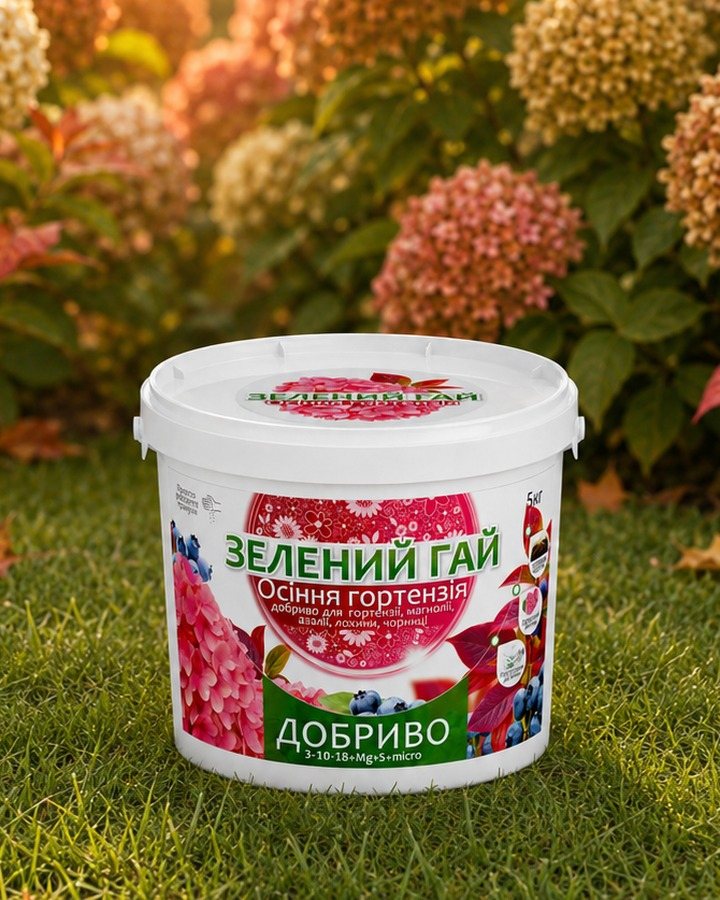
In autumn blueberry needs not nitrogen but phosphorus and potassium: they help the shoots ripen and set flower buds. A separate autumn fertiliser “for blueberries” is not needed — “Autumn Hydrangea” (NPK 3-10-18) is designed for all acid-lovers: hydrangea, blueberry, cranberry, heather. It is applied once — from August to the first half of October, while the soil is still warm:
- mature blueberry bush — 25 g (1 scoop);
- young seedling — 12 g (0.5 scoop);
- blueberry, cranberry, heather in solid planting — 25 g per 1 m².
The granules are scattered along the edge of the crown projection, mixed into the top layer and watered in. Granular fertilisers are not used for blueberries in a container: in a pot the salts are not washed down and the concentration near the roots becomes dangerous.
Why blueberry leaves turn yellow
The most common picture is young leaves turning yellow while the veins stay green. This is chlorosis, and in blueberry it almost always means the soil has become insufficiently acid: there is iron in it, but the plant cannot absorb it. Typical culprits are hard irrigation water, nearby concrete paths and foundations, ash or compost added “for good measure”.
Extra fertiliser will not help here until the pH is corrected: acidify the soil, water with soft water, renew the conifer mulch. Other causes of yellowing and how to tell them apart are in the article on chlorosis and yellow leaves.
Reddening of leaves in autumn is a normal autumn colour change. But red leaves in spring or summer often point to cold or waterlogged soil in which the roots absorb phosphorus poorly.
Watering and mulch are half the success
Blueberry's shallow roots dry out faster than those of any other berry bush, and a dried-out bush drops its fruit set and its berries get smaller. The soil under blueberry must be constantly moderately moist, especially during berry filling and in hot weather. At the same time it does not tolerate standing water either: on heavy clay it is planted in a raised bed or a wide hole with acid substrate and drainage.
Watering water should be rain water or soft water. If only hard water is available, it is periodically acidified, otherwise the calcium gradually undoes the soil acidification with every watering. Renew the layer of conifer mulch every year: it decomposes, acidifies the top layer, retains moisture and protects the roots from overheating.
Frequently asked questions
Can blueberries be grown in a container?
Yes, in a large volume of acid substrate. But granular fertilisers for open ground are not put into a container: the salts are not washed out, and the concentration near the roots becomes dangerous. Container blueberries are fed with weak solutions for acid-lovers.
Can blueberries be fed with a universal fertiliser?
Universal fertilisers are designed for plants of ordinary, near-neutral soils and do not help maintain an acid environment. For blueberry, which cannot absorb nutrients without acid soil, a special formula for heathers is more reliable.
Can blueberries be watered with acidified water instead of fertiliser?
Acidified water maintains pH but does not feed. It is a supplement to feeding, not a replacement.
How many years does blueberry not fruit after planting?
The first berries usually appear in the second or third year, a full harvest later. During this time the main thing is building up roots and shoots, so regular feeding in the first years pays off the most.