Gardening tips
Feeding potatoes: at planting and at earthing up
Potatoes take a lot from the soil but have little time to do it: they need their main nutrition in the first weeks after emergence. We look at when and how to apply fertiliser so that it goes into the tubers, not the haulm.
When potatoes eat the most
Potatoes are a crop with a short nutrition window. From emergence to flowering the plant builds its haulm and sets stolons, on which the tubers later form. It is in this period that it actively takes up nitrogen, phosphorus and potassium, and it is then that the nutrients should already be in the soil, next to the roots.
After flowering the picture changes: the haulm stops growing, and everything accumulated passes into the tubers. Extra nitrogen at this time no longer helps but hinders — the plant keeps pushing out greenery, the tubers mature later, the skin stays thin, and the potatoes store worse over winter.
Hence a simple two-step scheme: the main application at planting and a feed at the first earthing up. This is usually enough unless the soil is completely exhausted.
Preparing the plot
Potatoes like loose, airy soil in which tubers grow easily. On heavy clay the tubers come out small and misshapen regardless of fertiliser, so soil structure matters here no less than nutrition. Well-rotted compost added in autumn or at spring digging improves both.
A few things worth knowing in advance:
- Fresh manure is not applied for potatoes. It gives excess nitrogen, and tubers on such a plot are more often affected by scab.
- Liming right before planting potatoes is undesirable — on freshly limed soil scab also shows up more strongly. Potatoes do well on slightly acidic soils; what acidity is and how to determine it is explained in the article on acidic soil and pH.
- Crop rotation matters more than any fertiliser when it comes to diseases and pests: potatoes in the same place year after year accumulate them in the soil.
Step 1. Fertiliser at planting
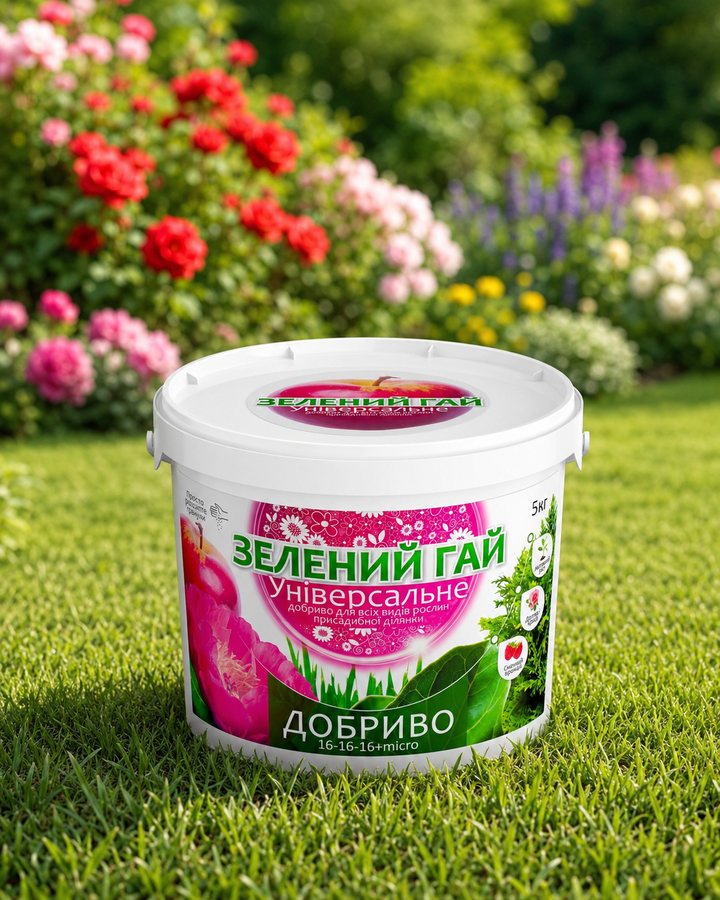
The simplest and most even method is to spread granules over the whole area before planting. Granular “Universal” (NPK 16-16-16) is applied at 25 g, i.e. one scoop, per 1 m², on moist soil, and worked into the top layer while digging, ploughing or rotavating. Equal shares of nitrogen, phosphorus and potassium match the potato's starting needs: nitrogen for the haulm, phosphorus for the roots and stolon formation, potassium for the future filling of the tubers.
If the plot is not dug but planted in furrows, the granules are scattered along the furrow and mixed with the soil at its bottom, and only then are the tubers laid. The main rule: granules must not lie in a heap right under a tuber. Concentrated fertiliser in direct contact with sprouts can damage them, while evenly distributed in the soil it feeds the whole root system.
Step 2. Feeding at earthing up
The first earthing up is done when the plants have risen above the ground but the rows have not yet closed. This is the most convenient moment for the second application: granules of “Universal” at the same rate, 25 g per 1 m², are scattered over moist soil between the rows, and during earthing up the soil moves towards the stems together with the fertiliser. There is no need to work the granules in separately — the hoe or ridger will do it.
A few conditions without which feeding works poorly:
- the soil must be moist — after rain or watering; on dry ground the granules lie inactive;
- granules must not stay on wet leaves — shake them off or water them in;
- the second earthing up, if you do one, is done without nitrogen feeding: the plant is approaching flowering.
More on the technique of applying granules — in the article how to apply granular fertilisers.
How much fertiliser the plot needs
The calculation is simple: the area in metres multiplied by 25 g — for one application.
| Area | One application (25 g/m²) | Two applications per season |
|---|---|---|
| 10 m² (a small bed) | 250 g | 500 g |
| 50 m² | 1.25 kg | 2.5 kg |
| 1 sotka (100 m²) | 2.5 kg | 5 kg |
So a 5 kg bucket is enough for two applications on one sotka, and a 10 kg one for two sotkas. For a small potato bed a 500 g pack is enough.
What not to do
- Do not feed nitrogen after flowering. A haulm that is dark green and lush in August is not a sign of a good harvest but a sign that the tubers will mature late.
- Do not increase the rate “just to be sure”. Excess salts harm the roots, and excess nitrogen worsens the keeping quality of the tubers.
- Do not replace fertiliser with watering or vice versa. In a drought during budding and flowering, potatoes critically need moisture — that is when the tubers are set. No feeding can make up for dry soil without watering.
- Do not expect fertiliser to protect against late blight or the Colorado beetle. That is a matter of variety, crop rotation and plant protection products.
How to tell that potatoes lack nutrition
The signs can be read from the haulm in the first half of summer. Low plants with thin stems, small pale leaves, lower leaves yellowing early — most likely there is too little nitrogen. Dark leaves with a bronze tint and drying edges on old leaves may indicate potassium deficiency. But drought, a cold spring and diseases produce similar pictures, so first assess the weather and watering. And if potatoes are growing in the same place for the second or third year in a row without any application, the cause is usually obvious without diagnosis.
Frequently asked questions
Can I put fertiliser straight into the planting hole?
Only mixed with the soil at the bottom of the hole. Granules lying on a tuber or sprout can damage it.
Mineral fertiliser or compost?
Best of all — together: compost improves soil structure, mineral fertiliser gives the exact amount of nutrients at the right moment. The differences are covered in the article mineral or organic fertilisers.
Will fertiliser increase the harvest?
If the soil is exhausted — yes, the difference can be noticeable. But a potato harvest depends on the variety, seed stock, moisture and diseases, so no fertiliser guarantees a specific figure.