Gardening tips
Feeding cabbage: from seedling to a firm head
Cabbage is one of the hungriest vegetable crops, but it needs to be fed differently at the beginning and at the end of the season. We look at when it needs nitrogen, when potassium, and what fertiliser will not fix.
Two phases — two different needs
Over the season cabbage goes through two completely different phases. First it builds a rosette — large outer leaves that will later feed the head. This is the nitrogen phase: the more powerful the rosette, the bigger the “factory” working for the harvest. Then the plant starts to form a head, and the priorities change: now potassium and phosphorus are needed for firmness and filling, and excess nitrogen already does harm.
The most common mistake is to feed cabbage the same way from planting out to harvest. Then it gets too little at the start and too much at the end: heads come out loose, crack, store worse, and nitrates accumulate in the leaves.
Preparing the bed
Cabbage likes heavyish, moisture-retentive, rich soil and tolerates acidic soil poorly. On acidic soils it more often suffers from clubroot: growths appear on the roots, causing the plant to wilt in the heat and fail to form a head. It is worth knowing the soil reaction before planting; how to check and correct it is explained in the article on acidic soil and pH.
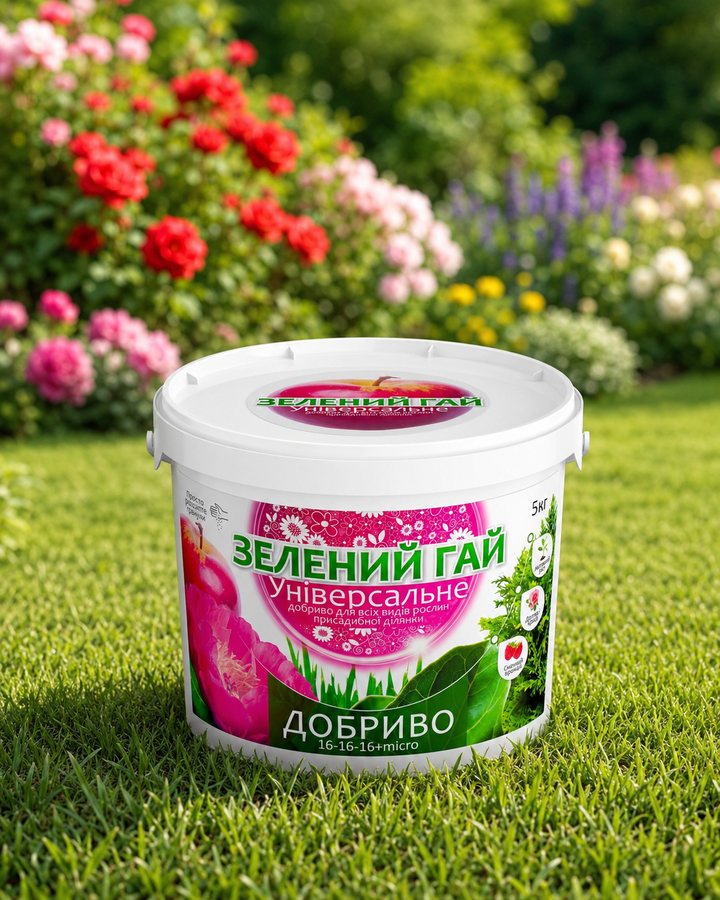
Well-rotted compost is added when digging — cabbage responds very well to it. The mineral base is provided by granular “Universal” (NPK 16-16-16): 25 g, one scoop, per 1 m², spread evenly over moist soil and mixed into the top layer. Such a start covers the seedlings' needs in the first weeks after planting out, while they establish.
A separate plus: the granules contain micronutrients, including boron and molybdenum. Cabbage needs them in tiny amounts, but without them characteristic problems arise — a hollow heart in the head with boron deficiency, deformed narrow leaves in cauliflower with molybdenum deficiency. More details — in the article about micronutrients.
After planting out: the nitrogen phase
For the first one or two weeks after planting out the seedlings are not fed: the roots need to take hold. The sign that you can start is new leaves in the centre of the rosette.
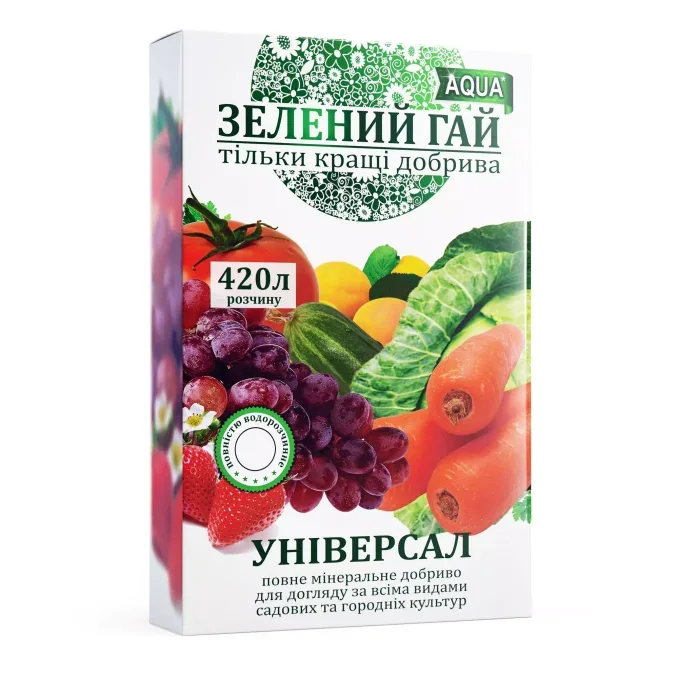
After that cabbage is fed with a solution. It is convenient to use water-soluble “Aqua Universal”: the solution is prepared according to the dosage on the package and poured at the root roughly once every two to three weeks while the plant builds its rosette. A solution acts faster than granules and does not require loosening the soil, and cabbage roots lie quite close to the surface.
The rules are the same as for any vegetable feeding:
- water with clean water first, then the solution — on dry soil the concentrate burns the fine roots;
- in the evening or on an overcast day, not in the heat;
- do not increase the dose if the seedlings got off to a slow start — more often that is cold or drying out, not hunger.
Head formation: the potassium phase
Once cabbage has started forming a head, nitrogen feeds are gradually stopped. At this stage early cabbage needs almost nothing except even watering. Mid-season and late cabbage need potassium and phosphorus, which are responsible for firmness, flavour and keeping quality.
How to do this in practice:
- give no more nitrogen feeds after the head starts forming;
- if the soil is poor and late cabbage still has a long way to go, add wood ash — a traditional potassium source for the vegetable garden; it makes the soil more alkaline, which is appropriate on a cabbage bed, but do not combine it with nitrogen fertilisers in the same application;
- keep the soil consistently moist: a head is almost all water, and without even watering no potassium will help.
Early, late, cauliflower: what is the difference
Early cabbage grows fast, and its whole cycle from planting out to harvest is short. A well-prepared bed and one or two solution feeds in the first half of growth are enough for it. Early varieties do not need prolonged feeding: the head forms before a late application has time to work.
Mid-season and late cabbage stays in the bed until autumn, takes the most out of the soil, and for it the switch from nitrogen to potassium matters most. Late varieties are grown for storage, so extra nitrogen in the second half of summer is especially undesirable for them: such heads keep worse.
Cauliflower and broccoli are more demanding about even conditions. Drought, heat or sudden stress at the moment the curd forms give a small, crumbly head that feeding can no longer fix. Micronutrients — boron and molybdenum — are especially important for them, so granules with micronutrients when preparing the bed are doubly appropriate here. Cauliflower should also be shaded from direct sun so the curd stays white.
Why heads crack and fail to form
Cracks almost always appear after a sharp change in moisture: a long drought, then a downpour or heavy watering. The inner leaves grow faster than the outer ones, and the head bursts. Even watering and timely harvesting help: an overripe head of early cabbage is better not left in the bed.
A head fails to form for several reasons: severe heat and drought at the time of formation, shading, excess nitrogen (the rosette “running to leaf”), and also clubroot on the roots. Pull up one plant and look at the root — if there are growths on it, the problem is not nutrition.
A loose, light head is often the result of late nitrogen or lack of moisture during filling.
Signs of nutrient deficiency
| What you see | Likely cause |
|---|---|
| Lower leaves evenly turn lighter and yellow, the rosette is weak | Nitrogen deficiency |
| Leaves with a purple tint, especially in cold weather | Impaired phosphorus uptake in cold soil |
| Edges of old leaves turn yellow, then brown, and dry out | Potassium deficiency |
| A cavity in the head, a brown heart | Boron deficiency |
| Yellowing between the veins on old leaves | Magnesium deficiency |
A reminder: similar symptoms are caused by clubroot, root pests and waterlogging. Check the conditions first, and only then increase feeding.
In short
- When preparing the bed — compost and 25 g of “Universal” per 1 m².
- From seedlings establishing to the head starting to form — a solution once every two to three weeks.
- After the head starts forming — no nitrogen, only even watering and, if needed, potassium.
- Acidic soil means a risk of clubroot, so check the soil reaction in advance.
- Seedlings are fed separately and carefully before planting out — see the article on feeding seedlings.