Gardening tips
Feeding cacti and succulents
A cactus is easy to ruin with a fertiliser that is perfect for a ficus. We explain why succulents need the opposite formula, in which months they are fed, and why nothing at all may be given in winter.
Do cacti need fertiliser at all
There is a common belief that a cactus lives “on stones” and does not need feeding. That is half true. Cactus soil really is deliberately poor, sandy and quick to dry — that way the roots do not rot. But precisely because of this, the nutrients in it run out in one season, and after that the plant lives on leftovers for years.
Hunger in a cactus is hard to spot, because it grows slowly even when healthy. Here is what to pay attention to:
- the top of the new growth is narrower than the base — the stem seems to taper upwards;
- the epidermis turns dull and loses its waxy sheen;
- new spines come out shorter and softer than the old ones;
- the plant produces no offsets for years and has never flowered, although it is already mature;
- in succulents — echeveria, jade plant, haworthia — the lower leaves wilt and drop faster than new ones grow, and the rosette thins out.
Why a universal fertiliser does not suit a cactus
Most houseplant fertilisers are made for foliage plants: they contain the most nitrogen, because nitrogen builds green mass. For a cactus this is a problem. Cacti and succulents store water in their tissues, and excess nitrogen makes this tissue loose and watery. The stem grows fast but turns out weak: it cracks, wounds heal poorly, and rot gets in through them.
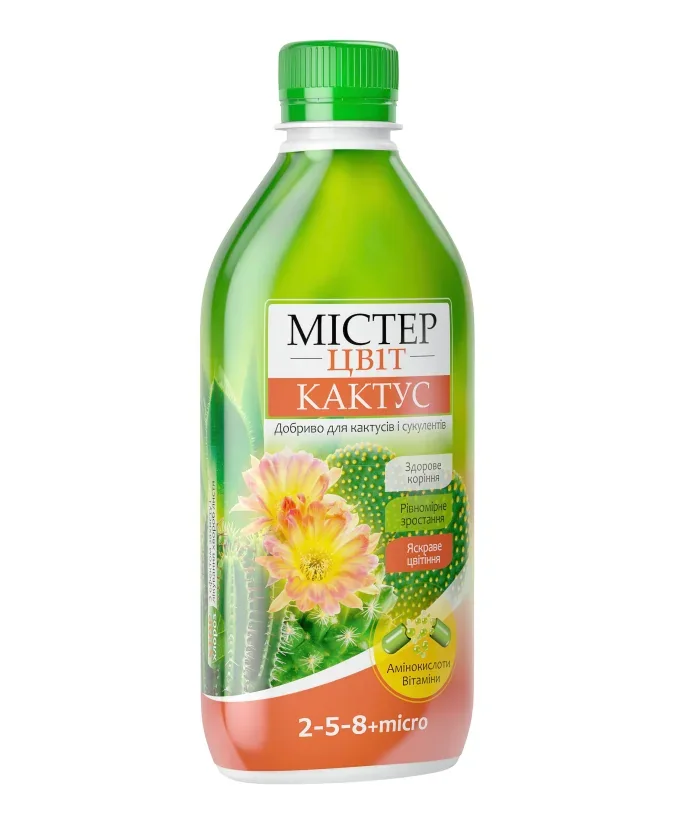
That is why the formula for cacti is the opposite of the usual one. “Mister Tsvit Cactus” has NPK 2-5-8 with micronutrients: only 2 units of nitrogen, 8 of potassium. Potassium makes tissues denser and more resilient, phosphorus works for the roots and bud formation. If the numbers on labels do not mean anything to you yet, they are decoded in the article what the NPK numbers mean.
The dose is on the label and is measured with the cap. Do not exceed it: a cactus takes little, and the excess stays in the pot.
Calendar: when to feed and when not to
Seasonality in cacti is stricter than in any other group of houseplants.
| Period | What is happening | Feeding |
|---|---|---|
| April — September | Active growth, flowering | Yes, on moist substrate after a regular watering |
| October — February | Dry, cool dormancy | No |
| March | Waking up, first watering | Usually not yet — wait for signs of growth |
The most important rule: do not feed a cactus from October to February. In a cool, dry winter rest it drinks almost nothing, the solution stagnates in the pot, and the roots rot. This is the most common way to lose a collection. General rules for winter windowsill care — in the article should you feed houseplants in winter.
How to feed correctly
- Water first, then the solution. A cactus standing in dry soil will not tolerate concentrate — the fine roots will get burned. Water with plain water, and give the solution at the next watering or onto already moist substrate.
- Only during growth. The signs are fresh growth at the top, new spines, buds. If the plant stands still even in summer, there is nothing to feed.
- Not after repotting. After repotting, a cactus's roots are left to dry for a few days and not watered at all, and it is fed only once the plant has established and started growing.
- Not in the worst heat. Some cacti pause their growth in the hot period. At such a time it is better to skip feeding.
Epiphytic cacti — a different calendar
The Christmas cactus (schlumbergera), rhipsalis and epiphyllum are cacti too, but forest ones: in nature they grow on trees, not in the desert. Their rhythm is different — they grow in summer and flower in winter. So they are fed in the growth season, and before budding, from autumn, they are moved into rest: less frequent watering, coolness, no fertiliser. During budding a Christmas cactus is not moved or turned — it drops its buds.
Epiphytes need more moisture and diffused light, and they tolerate direct sun worse than desert cacti.
How to make a cactus flower
A fertiliser with potassium and phosphorus helps flowering but does not trigger it by itself. Most desert cacti set buds after a proper winter rest — cool, dry and bright. A cactus that spent the whole winter warm by a radiator, with watering and feeding, usually does not flower.
What is needed for flowering:
- a cool, dry winter rest on a bright windowsill;
- plenty of direct light in spring and summer;
- a snug pot — in a large one a cactus builds roots;
- age: some species flower only several years after sowing;
- moderate feeding with a minimal-nitrogen formula in the growth season.
Other reasons why houseplants do not flower are covered in the article why houseplants do not flower.
What fertiliser will not fix
- A stretched, pale stem reaching upwards is etiolation from lack of light. It will not shrink back; the cactus must be gradually accustomed to a brighter spot, and the stretched part can in time be cut off and rooted.
- A soft dark stem at the base is rot from overwatering. Here you need to cut back to healthy tissue, not feed.
- Brown corky patches on the old part of the stem are often natural lignification with age.
- Succulents turning red in the sun is a protective reaction, not a disease and not hunger.
Frequently asked questions
Can cacti and succulents be fed with the same fertiliser?
Yes. Their needs are very similar: both store water in their tissues and tolerate excess nitrogen poorly. The cactus formula suits aloe, jade plants, echeveria, haworthia, kalanchoe and other succulents.
How often should the solution be given in season?
The frequency is printed on the label. Also go by watering: a cactus in mineral substrate is watered in summer when the soil has dried out completely, and the solution is given in place of one such watering, not more often.
I bought a cactus in a shop — should I feed it right away?
No. First give it a few weeks to get used to its new place, and if it sits in transport peat, repot it into mineral substrate. Feeding starts after it has established, in the growth season.