Gardening tips
Feeding garlic and onions
The size of a garlic head and an onion bulb is set in spring, while the leaves are growing. Late feeding does not increase the yield but worsens storage life. We go through the calendar for winter garlic, spring garlic and onions.
The main rule: feed while the leaves are growing
Garlic and onions first build up leaves and then transfer what they have accumulated into the head or bulb. The more healthy leaves the plant manages to grow before the head starts forming, the bigger the head will be. Hence the logic of the whole calendar: nutrition is needed in spring and early summer, and once the leaves stop growing and the head has started to fill out, feeding for growth no longer brings any benefit — only harm.
Alliums have shallow, weakly branched roots without root hairs. They are poor at extracting nutrients from the soil on their own, so on poor plots they respond noticeably to feeding.
Feeding calendar
Winter garlic
| When | What for |
|---|---|
| As soon as the snow has melted and the leaves have started growing | Start of growth after winter |
| 2–3 weeks after the first | Leaf growth |
| May, main leaf growth | Last feeding for growth |
| Appearance of scapes | Feeding for growth is stopped |
| 2–3 weeks before lifting | No feeding at all |
On hardneck varieties it is best to break off the scapes once they have curled: this way the plant directs its resources into the head rather than into seed.
Spring garlic and bulb onions
Spring garlic and onions planted in spring follow the same logic, but shifted about three to four weeks later: the first feeding is when the shoots have a few leaves, the second two to three weeks later, the third at the start of bulb formation. After that we stop.
Onions for greens and herbs are a separate case: they can be fed regularly throughout the cutting period, since the harvest here is the greens themselves.
What to feed with
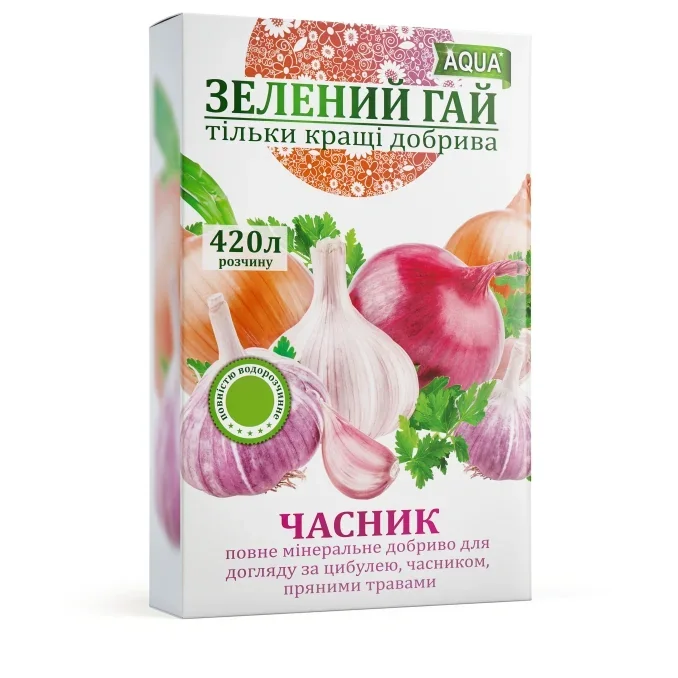
For garlic, onions and herbs we recommend the water-soluble “Aqua Garlic”. A soluble form is more convenient here than granules: garlic and onions are planted densely, and granules cannot be scattered evenly between the rows and worked in without the risk of damaging the roots.
- The solution is prepared according to the proportion on the package.
- Water at the root on moist soil — clean water first, then the solution.
- Foliar spraying works worse on alliums than on other crops: the leaf is narrow, vertical and covered with a waxy layer, so the solution rolls off. The main method is at the root.
When to stop feeding — and why it matters
The most common mistake is feeding garlic in June–July “so that the head grows bigger”. It will not grow: the size is already set. Instead, late nitrogen gives:
- excess leaves that take a long time to fall over;
- loose, immature scales;
- heads and bulbs that store worse in winter, sprout and rot more often.
That is why two to three weeks before harvesting both feeding and watering are stopped. Onions are not watered before harvesting either, so that the neck dries and closes.
Preparing the soil for winter garlic
Garlic likes loose, fertile, neutral soil and does not tolerate standing water. On acidic soils it is limed in advance, under the previous crop. Fresh manure is not applied for garlic and onions: it provokes rot and pest damage, and the heads come out loose. Well-rotted compost is fine, applied under the previous crop.
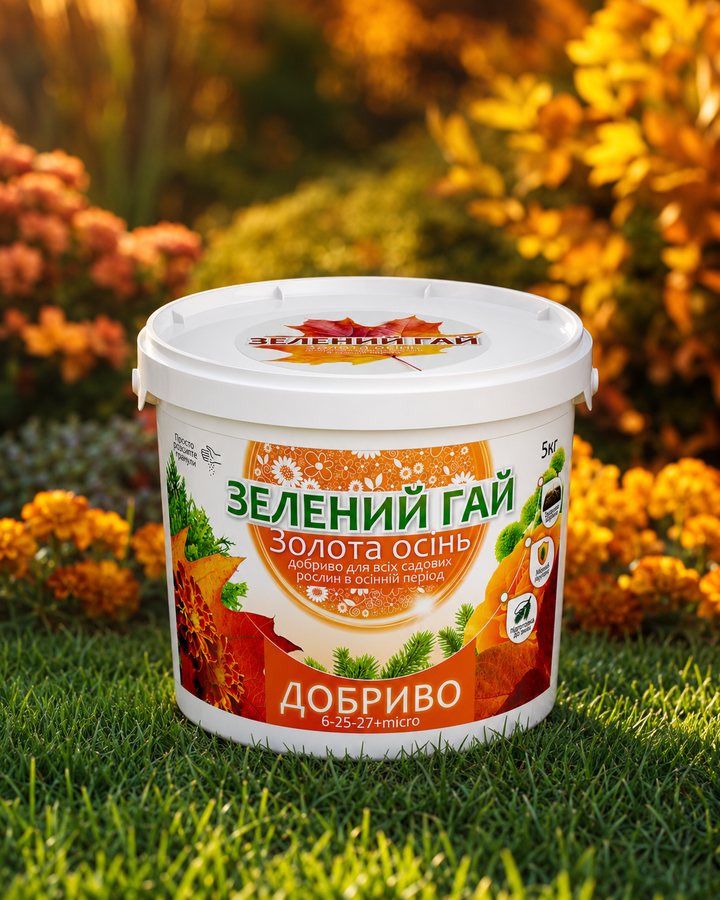
For autumn planting of garlic, the soil can be dressed with the autumn fertiliser “Golden Autumn” (NPK 6-25-27): it contains little nitrogen, while the phosphorus and potassium will help the cloves root before the frosts. The rate is 25 g per 1 m², the granules are mixed with the top layer of soil before planting. How autumn nutrition of a plot works in general is covered in the article on autumn feeding.
Why the leaf tips turn yellow
It is not always hunger. The leaf tips of garlic and onions turn yellow for several reasons:
- nitrogen deficiency — yellowing is even, plants are pale and grow slowly;
- waterlogging on heavy soil, where water stands after rain;
- spring frosts on the tender leaves;
- onion fly — the leaves turn yellow and wilt, the plant is easily pulled out, white larvae are visible near the basal plate. Here protection is needed, not fertiliser;
- natural ripening — at the end of the season, yellowing and falling over of the leaves mean it is time to harvest.
First check whether water is standing in the bed and whether the plant sits firmly in the soil. Other causes of yellowing leaves are covered in the article on chlorosis and yellow leaves.
What fertiliser will not do
Feeding is only one of the conditions for a big head. Fertiliser will not fix what was set at planting. It will not enlarge the head if a small clove or onion set was planted: the size of the planting material sets the ceiling of the yield. It will not fix overcrowded planting. It will not help against basal rot and nematodes — here crop rotation, healthy planting material and returning the crop to the same bed no sooner than after several years are needed.
Frequently asked questions
Can garlic be fed with urea or ammonium nitrate?
In early spring garlic really does need nitrogen, but a pure nitrogen fertiliser is easy to overdose, and an excess gives watery heads that store poorly. Balanced nutrition with phosphorus, potassium and micronutrients is safer: the garlic gets everything it needs for leaf growth and head formation.
When to feed onion sets?
The first time — when the leaves have grown a few centimetres, the second — two to three weeks later, the last — at the start of bulb formation. Once the neck has started to thin and the leaves to fall over, feeding and watering are stopped.
Until when should winter garlic be fed?
Roughly until the end of May — beginning of June, while the leaves are growing. After the scapes appear, no feeding for growth is given.
Can garlic be fed on snow?
There is no point in scattering fertiliser on snow or frozen ground: meltwater will wash it off the bed, and the roots are not yet working. The first feeding is given when the soil has thawed and the leaves have started growing.
Why did the garlic grow small?
The most common reasons are a small planting clove, overcrowded planting and a missed May feeding. The size of the head is set in spring, not in July.